Research Blog
Parasin I: Biochemical and Antimicrobial Peptide Data Guide
Published
Discover the unique properties of Parasin I, a powerful antimicrobial peptide with broad-spectrum activity and no hemolytic effect. Learn more!

Parasin I: Biochemical and Antimicrobial Peptide Data Guide
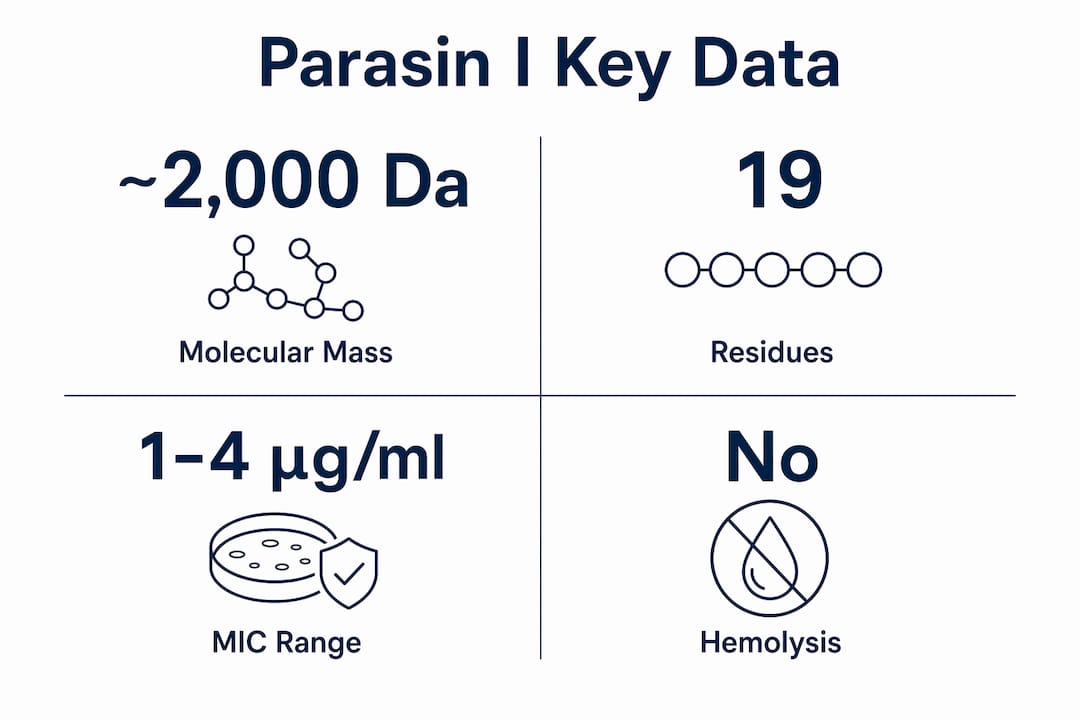
Parasin I is a 19-residue antimicrobial peptide01238-1) derived from the N-terminal region of histone H2A in the catfish Parasilurus asotus. Its core significance in antimicrobial peptide research comes from three properties that rarely appear together in a single molecule:
- Broad-spectrum activity against Gram-positive bacteria, Gram-negative bacteria, and fungi
- No hemolytic effect on mammalian red blood cells, even at active concentrations
- Potency 12–100 times greater than magainin 2, with minimum inhibitory concentrations (MICs) at low microgram-per-milliliter levels (https://doi.org/10.1016/s0014-5793(98)01238-1)
- Inducible expression — secreted only into wounded skin mucus, not constitutively present
That last point sets Parasin I apart from many other host-defense peptides. It appears in the epithelial mucosal layer exclusively after epidermal injury, functioning as a triggered innate immune response rather than a standing chemical barrier.
Molecular and biochemical properties of Parasin I
The molecular formula of Parasin I is C₈₂H₁₅₄N₃₄O₂₄, with a molecular mass just over 2,000 Da. Its amino acid sequence runs: Lys-Gly-Arg-Gly-Lys-Gln-Gly-Gly-Lys-Val-Arg-Ala-Lys-Ala-Lys-Thr-Arg-Ser-Ser. The high density of lysine and arginine residues produces a strongly positive net charge, which drives electrostatic attraction to negatively charged bacterial membranes.

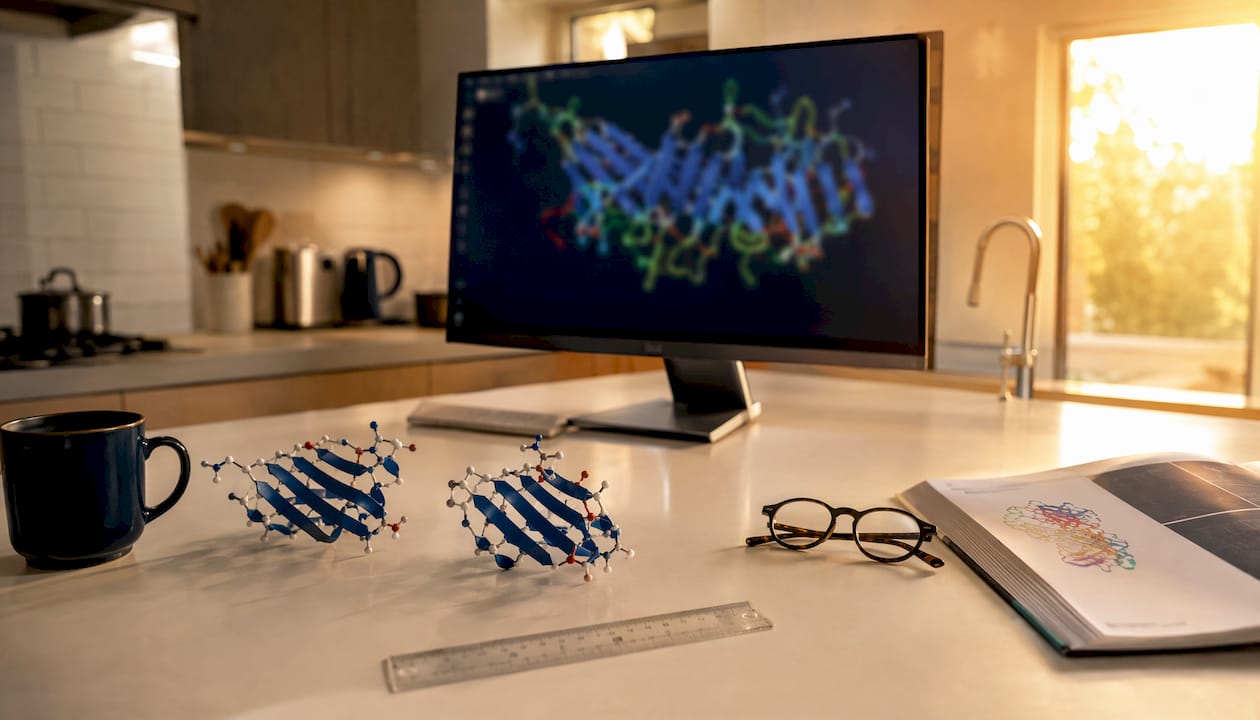
Structurally, Parasin I adopts an amphipathic beta-sheet conformation in membrane-mimicking environments, with some random coil character in aqueous solution. This structural flexibility is thought to facilitate initial membrane contact followed by insertion. The sequence shares homology with the N-terminus of histone H2A and with buforin I, a related peptide from the Asian toad Bufo bufo gargarizans, though Parasin I’s MIC values are considerably lower.
| Property | Value |
|---|---|
| Molecular formula | C₈₂H₁₅₄N₃₄O₂₄ |
| Molecular mass | ~2,000.4 Da |
| Residue count | 19 |
| Net charge | positive net charge |
| Secondary structure | Amphipathic beta-sheet / random coil |
| Biological source | Histone H2A, Parasilurus asotus |
| MIC range | low microgram-per-milliliter levels |
How to store and prepare Parasin I in the lab
Peptide degradation is the most common source of irreproducible results with Parasin I, and most of it is preventable with standard precautions.
- Storage: Keep lyophilized powder dry, protected from light, and frozen at –20°C or below. Avoid repeated freeze-thaw cycles by aliquoting before the first use.
- Reconstitution: Dissolve in sterile water or a physiologically compatible buffer. Aseptic technique is required throughout; prompt use after reconstitution minimizes aggregation risk.
- Solvent compatibility: Aqueous buffers at near-neutral pH are preferred. Organic co-solvents can disrupt the beta-sheet structure and should be avoided unless the experimental design specifically requires them.
- Handling: Work in a laminar flow hood when preparing stock solutions for cell-based assays. Label all aliquots with batch number and preparation date.
| Step | Recommendation |
|---|---|
| Long-term storage | –20°C, desiccated, light-protected |
| Working aliquots | Single-use; avoid freeze-thaw cycling |
| Reconstitution solvent | Sterile water or compatible aqueous buffer |
| Technique | Aseptic; use immediately after preparation |
| Container | Low-binding polypropylene tubes |
Safety, quality control, and research-use considerations
Parasin I carries no hemolytic activity at its effective antimicrobial concentrations, which makes it a cleaner tool for membrane-disruption studies than many cationic peptides that damage host cells alongside target organisms. That selectivity is a key reason it attracts attention as a scaffold for therapeutic development.
For research reliability, every lot should arrive with a third-party tested Certificate of Analysis confirming identity, sequence, and purity. Optimized-aminos supplies research peptides with 99%+ purity verified by HPLC and mass spectrometry, with COA documentation attached to each shipment.
Research use only. Parasin I is not approved for human or veterinary therapeutic use. All experimental work must comply with applicable institutional biosafety and ethics protocols.
- Verify HPLC chromatogram and mass spec data against the stated sequence before use
- Confirm the COA is batch-specific, not a generic document
- Source from suppliers who publish third-party testing results, not just in-house data
- Retain COA records for the full duration of any study for audit and reproducibility purposes
“Parasin” vs. Parasin I: a critical distinction for researchers
Search results for “Parasin” frequently return information about a commercial anthelmintic drug containing albendazole, used to treat helminthiasis and other parasitic infections. That drug is chemically and functionally unrelated to the antimicrobial peptide Parasin I. Confusing the two at the procurement stage can derail an experiment before it begins.
- The clinical drug “Parasin” is an albendazole-based antiparasitic formulation, not a peptide
- Parasin I is a 19-amino-acid cationic peptide with a defined sequence and molecular mass just over 2,000 Da
- No overlap exists in mechanism, target organism, or chemical class between the two compounds
- When ordering, specify “Parasin I” with the full amino acid sequence and request a COA confirming peptide identity
- Use a reliable peptide supplier that explicitly lists sequence, purity, and testing method to avoid receiving the wrong compound
Structure-activity relationship studies
Truncation and substitution studies on Parasin I have mapped which residues drive antimicrobial potency. The cationic lysine and arginine residues are not interchangeable — positional shifts reduce MIC performance, confirming that charge distribution across the amphipathic face, not total charge alone, governs membrane selectivity. Replacing hydrophobic residues in the core of the beta-sheet similarly attenuates activity, pointing to a dual requirement for electrostatic docking and hydrophobic insertion. These findings align with structure-activity data from related histone-derived peptides and support the view that Parasin I’s sequence is near-optimally tuned for its biological role.
How Parasin I is synthesized for research use
Research-grade Parasin I is produced almost exclusively by solid-phase peptide synthesis (SPPS), typically using Fmoc chemistry on a resin support. Each residue is added sequentially, deprotected, and coupled under controlled conditions, giving precise control over sequence fidelity. After cleavage from the resin, the crude peptide undergoes reverse-phase HPLC purification to achieve the purity levels required for biological assays. Mass spectrometry confirms molecular identity before release. This synthetic route avoids the batch variability inherent in natural extraction from catfish mucus and allows isotopic labeling or non-natural amino acid incorporation for mechanistic studies.
Applications in biomedical research and therapeutics
Parasin I’s combination of broad-spectrum activity, low MICs, and absence of hemolysis positions it as a useful model compound in several active research areas. Membrane-disruption mechanism studies use it alongside buforin I to dissect how histone-derived peptides interact with lipid bilayers. Researchers investigating antibiotic-resistant pathogens have tested it against clinical isolates of Staphylococcus aureus and Escherichia coli where conventional antibiotics underperform. Its scaffold has also been used as a starting point for analog design, with modified sequences tested for improved stability or narrowed spectrum. Work on antimicrobial peptide therapeutics increasingly draws on histone-derived peptides like Parasin I as templates precisely because their natural origin provides a validated structural framework.
Resistance development and challenges
Bacteria develop resistance to conventional antibiotics through well-characterized mechanisms: target mutation, efflux pumps, and enzymatic inactivation. Antimicrobial peptides that act primarily by disrupting the physical integrity of the membrane, as Parasin I does, present a higher barrier to resistance because the target is the membrane itself rather than a specific protein. Resistance would require fundamental changes to membrane lipid composition, which carry significant fitness costs for the organism. That said, some bacterial species upregulate proteases or modify surface charge under selective pressure, and Parasin I’s relatively short sequence makes it susceptible to proteolytic degradation in complex biological matrices. Stability engineering through D-amino acid substitution or cyclization is an active area of investigation for peptides in this class.
How Parasin I compares to other antimicrobial peptides
Parasin I occupies a specific niche among cationic antimicrobial peptides. Its closest structural relative is buforin I, which shares the histone H2A origin and a similar N-terminal sequence, but buforin I’s primary mechanism involves intracellular DNA binding rather than membrane disruption. Magainin 2, the benchmark peptide from Xenopus laevis skin, acts via membrane pore formation but requires MICs roughly 12–100 times higher than Parasin I for equivalent coverage. Defensins, a broader family of mammalian host-defense peptides, share the cationic amphipathic architecture but rely on disulfide-stabilized beta-sheet structures absent in Parasin I. For researchers building a comparative peptide reference, Parasin I’s value lies in its unusually high potency relative to its short sequence length and its clean selectivity profile against mammalian cells.
Key Takeaways
Parasin I is a 19-residue histone-derived peptide with MICs of 1–4 µg/ml, no hemolytic activity, and potency significantly greater than magainin 2, making it one of the most selective short-sequence antimicrobial peptides characterized to date.
| Point | Details |
|---|---|
| Molecular identity | C₈₂H₁₅₄N₃₄O₂₄, ~2,000.4 Da, net charge positive net charge, 19 residues from histone H2A |
| Antimicrobial potency | MIC of 1–4 µg/ml; 12–100 times more potent than magainin 2; no hemolytic effect |
| Storage and handling | Store lyophilized at –20°C, desiccated; reconstitute in sterile aqueous buffer with aseptic technique |
| Quality verification | Require a third-party COA with HPLC and mass spectrometry confirmation of 99%+ purity |
| Name confusion risk | The drug “Parasin” contains albendazole and is unrelated to the peptide Parasin I; verify compound identity before ordering |
Recommended
- How to Publish Original Peptide Sourcing Survey Findings | O
- Peptide Storage Stress Test: What Actually Happens If You Do
- The Complete Timeline of Peptide Research: 1921 to 2026 — In
- Ultimate Guide to Research Peptides in 2026 | Optimized Amin
For laboratory and research use only. Not for human consumption.