Research Blog
Peptide Endotoxin Testing: Assay Choice & COA Guide
Published
Ensure the safety of your research with peptide endotoxin testing. Learn how to assess endotoxin levels using a COA checklist.
Peptide Endotoxin Testing: Assay Choice & COA Guide
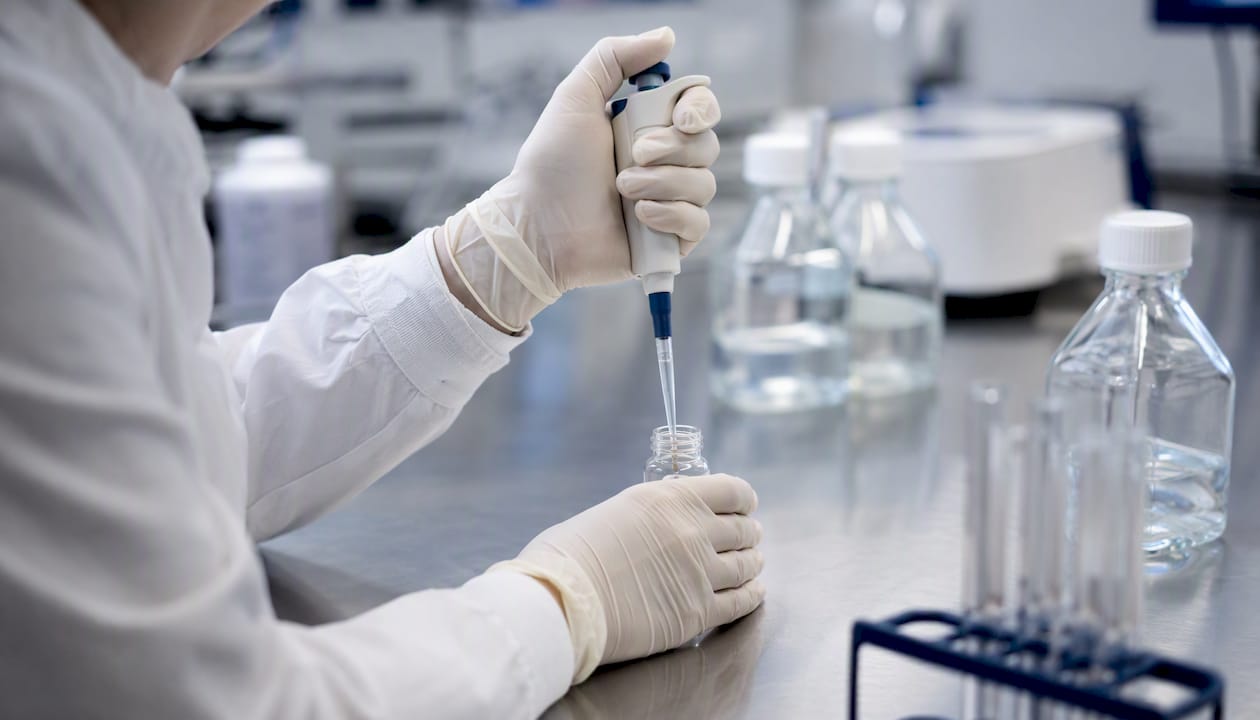
Peptide endotoxin testing is the process of quantifying lipopolysaccharide (LPS) contamination in a peptide sample using a validated biological assay, and the single most important action you can take before using any peptide in a cell-based or in-vivo experiment is to locate the EU/mg value on the Certificate of Analysis and confirm which assay method generated it. A COA that lists HPLC purity and mass spectrometry data but omits an endotoxin result is incomplete for any application where immune activation would confound your readout. The assay method matters as much as the number itself: a gel-clot result tells you the sample passed a qualitative threshold, while a kinetic chromogenic result gives you a quantitative EU/mg figure you can convert into per-dose exposure and compare against pharmacopoeial ceilings.
Before accepting a peptide vial, run through this checklist:
- Confirm the COA lists an endotoxin result with units (EU/mg or EU/mL) and names the assay method (gel-clot, kinetic chromogenic, kinetic turbidimetric, or recombinant Factor C).
- Verify that spike recovery or inhibition/enhancement data is available, confirming the assay was validated for that specific peptide matrix.
- Convert EU/mg to EU per dose using your intended dose in mg/kg and the animal or cell-culture volume, then compare to the FDA’s regulatory ceiling of 5 EU/kg for most parenteral routes.
- If the endotoxin level exceeds your threshold, or if no endotoxin data is present, reject or remediate before use.
SOP-ready verdict: Accept a peptide vial only when the COA shows a quantitative endotoxin result from a matrix-validated assay, with spike recovery data confirming assay suitability.
Key Takeaways
Reliable peptide endotoxin testing requires a quantitative, matrix-validated assay method, a complete COA, and a per-dose calculation that connects the EU/mg result to the pharmacopoeial ceiling of 5 EU/kg for parenteral routes.
| Point | Details |
|---|---|
| Always use a quantitative assay | Kinetic chromogenic or rFC methods report EU/mg directly; gel-clot gives only pass/fail and a higher detection limit. |
| Validate the matrix first | Spike recovery between 50–200% is required before any endotoxin result can be accepted as valid for a peptide sample. |
| Convert EU/mg to per-dose exposure | Use L = K ÷ M (K = 5 EU/kg) to confirm the batch meets the pharmacopoeial ceiling for your dosing scenario. |
| A COA without endotoxin data is incomplete | HPLC and MS confirm purity and identity; they do not detect LPS. Require a separate endotoxin result for any in-vivo or immune-endpoint application. |
| Optimized-aminos publishes third-party-tested COAs | Each order ships with third-party HPLC, MS, and traceability documentation; endotoxin data and spike recovery records are available on request. |
Table of Contents
- How do peptides pick up endotoxin during synthesis and handling?
- Which assays detect endotoxin in peptide samples?
- What should you check on a COA and ask your peptide supplier?
- What are your options when endotoxin levels are too high?
- How do you prevent endotoxin contamination during lab handling?
- What are the common pitfalls and how do you troubleshoot them?
- How does Optimized-aminos document and control endotoxin in research peptides?
- The gap between a clean COA and a clean experiment
- Optimized-aminos: research peptides with documented quality
- Useful sources and references
How do peptides pick up endotoxin during synthesis and handling?
Endotoxin enters a peptide batch at multiple stages, and understanding where contamination is most likely to occur helps you ask the right questions of your supplier. The critical control point is aqueous contact: LPS is water-soluble, heat-stable, and binds readily to surfaces, so any step involving water or aqueous buffers is a potential introduction point.
Process flow from synthesis to vial:
- HPLC purification: This is the highest-risk step. Reverse-phase HPLC columns accumulate LPS from previous runs and can release it into subsequent purifications. HPLC columns act as reservoirs for endotoxin and must be sanitized after every purification run using dilute sodium hydroxide or phosphoric acid–isopropanol mixtures.
Highest-risk steps and mitigation controls:
Achieving stringent specifications like <0.1 EU/mg requires upstream process design. Water quality, reagent qualification, and facility practices matter more than any single purification step, which is why low-endotoxin manufacturing is an end-to-end commitment rather than a post-synthesis fix.
Which assays detect endotoxin in peptide samples?
USP <85> recognizes three LAL-based methods: gel-clot, kinetic turbidimetric, and kinetic chromogenic. USP <86> (effective May 2025) adds recombinant Factor C (rFC) as a fourth pharmacopoeially recognized option. Each method uses a different detection principle, and the choice has real consequences for peptide matrices.
| Assay Method | Detection Principle | Output | Sensitivity | Best Use Case for Peptides |
|---|---|---|---|---|
| Gel-clot (LAL) | Clot formation in lysate | Pass/Fail | ~0.03–0.125 EU/mL | Referee testing; simple pass/fail release |
| Kinetic turbidimetric (LAL) | Turbidity over time | Quantitative EU/mL | ~0.001–0.01 EU/mL | General quantitative testing |
| Kinetic chromogenic (LAL) | Chromophore release | Quantitative EU/mL | ~0.001–0.005 EU/mL | Preferred for low-endotoxin specs; most sensitive |
| Recombinant Factor C (rFC) | Fluorescent substrate cleavage | Quantitative EU/mL | ~0.005 EU/mL | Animal-free; reduced batch variability; useful when LAL cascades are inhibited |
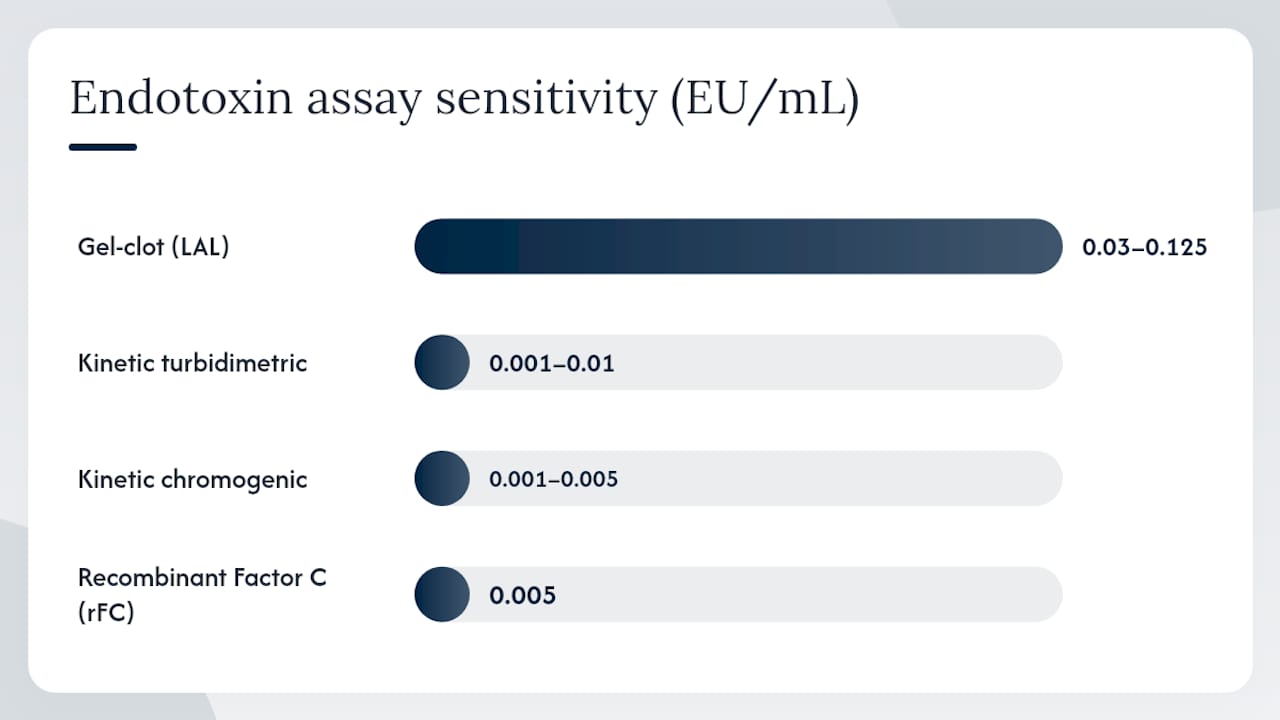
Gel-clot is the pharmacopoeial referee method, meaning it is used to resolve disputes between other methods. For routine peptide testing, kinetic chromogenic is the practical standard because it delivers the most sensitive quantitative output and reports EU/mg values directly on a COA. The rFC method, now recognized under USP <86>, offers an animal-free alternative that often reduces the batch-to-batch variability associated with LAL reagent sourcing. This is particularly useful when peptide matrices interfere with the LAL coagulation cascade, a common problem with chelating peptides or those containing surfactants.
The Monocyte Activation Test (MAT) detects a broader range of pyrogens beyond LPS and is gaining traction for translational work, though it is not yet a standard requirement for research-grade peptide COAs.
Method selection guidance:
- Use kinetic chromogenic as the default for any peptide with a low-endotoxin specification (<1 EU/mg).
- Request rFC when the peptide matrix shows inhibition in LAL-based methods or when an animal-free testing policy applies.
- Use gel-clot as a referee when quantitative methods give conflicting results or when a simple pass/fail release test is all that is required.
- Consider MAT for peptides intended for translational or clinical-stage work where non-LPS pyrogens are also a concern.
Pro Tip: Before accepting any quantitative endotoxin result for a peptide, confirm that method suitability testing (inhibition/enhancement and spike recovery) was performed at the intended sample dilution. A validated kinetic chromogenic or turbidimetric method that reports EU/mg at the tested concentration is the practical standard for low-endotoxin specifications.
What should you check on a COA and ask your peptide supplier?
HPLC purity and mass spectrometry data confirm identity and chemical purity, but they say nothing about endotoxin. A COA that lists HPLC and MS but omits endotoxin data should be treated as incomplete for any application where immune activation is a concern. This distinction is clearly documented in the technical literature on LAL assay interpretation: three different tests answer three different quality questions, and none substitutes for another.
COA completeness checklist:
- Assay method named explicitly (gel-clot, kinetic chromogenic, kinetic turbidimetric, or rFC).
- Raw result with units (EU/mg or EU/mL), not just “pass” or “compliant.”
- Lot number and testing date for traceability.
- Spike recovery or inhibition/enhancement data confirming matrix suitability.
- Testing laboratory name and accreditation status (ISO 17025 preferred).
- Chain of custody or batch traceability linking the tested lot to the shipped vial.
Targeted questions for your supplier:
- “Was method suitability testing (inhibition/enhancement) performed for this peptide at the reported dilution?”
- “What is the assay’s limit of detection and limit of quantitation at the tested concentration?”
- “Is the testing laboratory ISO 17025 accredited for endotoxin assays?”
- “Can you provide the raw spike recovery data for this lot?”
- “Was the sample reconstituted in LAL-grade water before testing?”
A credible third-party COA names the testing laboratory, states the assay method, and includes spike recovery data. A minimal COA that lists only “endotoxin: pass” with no method, no units, and no accreditation information provides no actionable data. When you receive an incomplete COA, request re-testing with a quantitative method, or ask for the raw data from the original run. For guidance on vetting suppliers and confirming COA completeness, the supplier selection criteria matter as much as the document itself.
If the assay method is unclear or spike recovery is absent, request a gel-clot referee test as a confirmatory step before committing the sample to a critical experiment.
What are your options when endotoxin levels are too high?
Detection of endotoxin above your threshold does not automatically mean the batch is unusable, but the remediation options for peptides are more limited than for small molecules or proteins, and some methods carry real risks of peptide loss or modification.
Common removal and depyrogenation methods:
- Anion-exchange chromatography: — LPS carries a strong negative charge and binds to anion-exchange resins. Effective for many peptides, but cationic or highly basic peptides may co-elute with LPS, reducing recovery.
Decision flow for contaminated batches:
When remediation is not feasible, the correct path is to send the sample back to the contract manufacturer for re-synthesis under low-endotoxin manufacturing conditions, including WFI water, qualified reagents, and dedicated depyrogenated equipment. Biological testing services offered by specialized contract labs can also provide endotoxin removal as a standalone service for batches where re-synthesis is not practical.
How do you prevent endotoxin contamination during lab handling?
Even a peptide that arrives with a clean COA can become contaminated during reconstitution, aliquoting, or storage if handling practices are not controlled. The steps below apply from the moment the vial arrives in your facility.
Step-by-step handling protocol:
- Receipt: — Inspect the vial and COA together. Confirm the lot number on the vial matches the COA. Store lyophilized peptides at the manufacturer’s recommended temperature (typically -20°C) in the original sealed vial until use.
Equipment sanitation notes:
HPLC columns used for peptide purification should be sanitized after every run with dilute sodium hydroxide or a phosphoric acid–isopropanol mixture, as columns accumulate endotoxin and release it in subsequent purifications. Glassware should be depyrogenated by dry heat at 250°C for at least 30 minutes. Water systems used for buffer preparation should be monitored regularly for endotoxin levels, with WFI or equivalent quality maintained at all aqueous contact points.
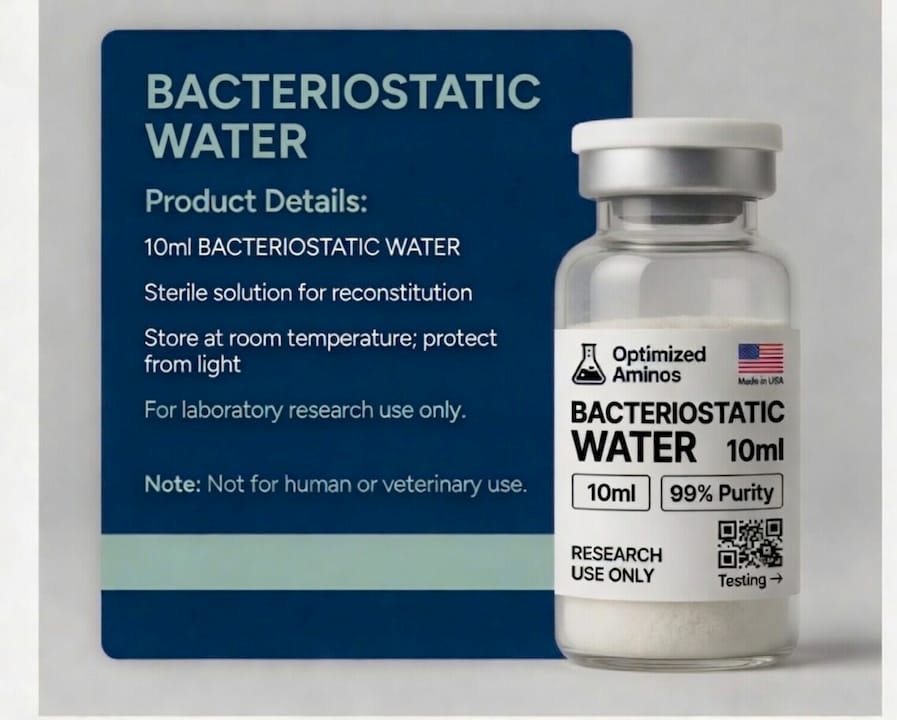
Pro Tip: Add this single line to your lab SOP under “Peptide Reconstitution”: “All solvents, consumables, and equipment contacting reconstituted peptide must be certified endotoxin-free or depyrogenated prior to use; reconstitution water must meet WFI or LAL-grade specifications.” This language covers the most common contamination routes and is defensible in a regulatory audit.
What are the common pitfalls and how do you troubleshoot them?
Endotoxin assays for peptides fail more often than most researchers expect, and the failure mode is almost always inhibition rather than enhancement. A peptide that chelates divalent cations, contains a surfactant-like structure, or is tested at too high a concentration will suppress the LAL reaction and return a falsely low result.
Common pitfalls:
- Matrix inhibition: The most frequent problem. Chelating peptides (those with multiple Asp, Glu, or His residues) bind Mg²⁺ and Ca²⁺, disrupting the LAL cascade. Spike recovery below 50% is the diagnostic signal.
- Insoluble aggregates: Peptides that aggregate at the test concentration scatter light and interfere with turbidimetric readings, or physically trap LPS and prevent it from reacting with the lysate.
- Surfactant-like peptides: Amphipathic sequences can solubilize LPS micelles, altering their reactivity with LAL reagent and producing unpredictable results.
- Wrong dilution: Testing at a concentration below the MVD risks false negatives; testing at too high a concentration risks inhibition. Calculate MVD before every run.
- Improper reagent storage: LAL reagent stored above -20°C or subjected to repeated freeze-thaw cycles loses activity. Always use freshly thawed reagent and confirm the standard curve is within specification before reading samples.
- Failed spike recovery accepted without investigation: A spike recovery outside 50–200% invalidates the result. Reporting the number anyway is a documentation error with real experimental consequences.
Troubleshooting protocol:
- If spike recovery fails, increase the sample dilution by 2-fold increments and repeat the PPC until recovery falls within 50–200%.
- If inhibition persists at high dilutions, switch to a buffer containing added Mg²⁺ and Ca²⁺ at concentrations specified by the reagent manufacturer.
- If inhibition is still present, run a parallel rFC assay. The rFC cascade is less susceptible to chelation interference and can confirm whether the LAL inhibition is matrix-driven.
- If both LAL and rFC show inhibition, consider a gel-clot referee test at the highest feasible dilution, or consult the testing laboratory about alternative sample preparation (e.g., dilution in a different endotoxin-free buffer or mild heat treatment to disrupt aggregates).
- Document every troubleshooting step, the dilution used, the spike recovery at each dilution, and the final validated dilution in your assay record.
When no dilution resolves inhibition, escalate to a contract testing laboratory with experience in peptide matrices. Some labs offer orthogonal confirmation using both LAL and rFC, which together provide stronger evidence than either method alone.
How does Optimized-aminos document and control endotoxin in research peptides?
Optimized-aminos publishes a third-party-tested Certificate of Analysis for every peptide, and each COA documents the results of third-party HPLC and mass spectrometry verification. For researchers who need endotoxin data, the COA structure is designed to support the assay comparisons and interpretation guidance published in the Optimized-aminos technical resource library.
What Optimized-aminos COAs include:
- HPLC purity result (≥99% for standard catalog peptides).
- Mass spectrometry confirmation of molecular identity.
- Lot number and test date for full batch traceability.
- Endotoxin result with assay method and units (EU/mg or EU/mL) when endotoxin testing has been performed on the batch.
- Third-party laboratory name and, where applicable, accreditation status.
Transparency checklist researchers should expect from any supplier:
- Third-party testing by an independent laboratory, not in-house self-certification.
- ISO 17025 accreditation of the testing laboratory for the specific assay method used.
- Spike recovery or inhibition/enhancement data available on request.
- Batch traceability linking the COA lot number to the shipped vial.
- Clear policy on re-testing requests and raw data availability.
Optimized-aminos ships within 1–2 business days and maintains documentation practices that allow researchers to request batch-specific data or clarification on testing methodology. For researchers building or auditing lab SOPs, the manufacturing and testing standards documentation provides additional context on GMP, GLP, and ISO 17025 expectations for research-grade peptide suppliers.
The gap between a clean COA and a clean experiment
The most persistent misunderstanding in peptide endotoxin testing is treating a COA result as a property of the peptide rather than a property of the tested lot at the moment of testing. A batch that passes at <0.1 EU/mg at the manufacturer’s facility can arrive in your lab with a higher endotoxin load if reconstitution water, consumables, or handling introduce contamination post-manufacture. The COA documents the state of the batch when it left the testing laboratory. What happens after that is your responsibility.
There is also a tendency to treat the assay method as interchangeable. Researchers who accept a gel-clot “pass” for a peptide intended for immune-endpoint work are operating on a detection threshold that may be two orders of magnitude less sensitive than the kinetic chromogenic method. The number on the COA is only as meaningful as the method that generated it, and the method is only valid if spike recovery confirms it worked for that specific matrix.
The practical implication is that endotoxin control is not a procurement checkbox. It is a workflow that starts with supplier qualification, runs through receipt and reconstitution, and ends with documented spike recovery in your own assay records. Researchers who build that workflow once and apply it consistently spend less time troubleshooting confounded results than those who treat endotoxin as someone else’s problem.
Optimized-aminos: research peptides with documented quality
Researchers who need peptides with traceable endotoxin documentation do not have to choose between speed and rigor. Optimized-aminos provides HPLC-verified research peptides with third-party-tested COAs that include purity and identity data, shipped within 1–2 business days. For labs building endotoxin-aware workflows, the Research Resources library contains SOP-ready guidance on COA interpretation, assay selection, and supplier vetting. Researchers who need bundled sets for multi-peptide studies can review the pre-built research catalog sets, each documented with the same traceability standards as individual vials. For batch-specific endotoxin data, spike recovery reports, or questions about testing methodology, contact Optimized-aminos directly through the website.
Useful sources and references
The references below cover regulatory limits, assay mechanics, and practical lab protocols. Each serves a distinct purpose in building or auditing an endotoxin testing workflow.
| Reference | What it covers | Best used for |
|---|---|---|
| FDA Guidance on Endotoxin Limits | Regulatory ceilings (5 EU/kg), testing expectations, and parenteral route limits | Setting accept/reject thresholds and dosing calculations |
| Peptide Endotoxin Testing: LAL Assay and COA Interpretation | LAL methods, rFC, EU/mg reporting, gel-clot referee status, COA interpretation | Method selection and COA reading |
| Low Endotoxin Peptide Manufacturing | What <0.1 EU/mg means, process controls, and upstream manufacturing requirements | Supplier qualification and specification setting |
| Controlling Endotoxin Contamination During Peptide Manufacturing | Contamination vectors, HPLC column sanitation, and facility controls | Lab SOP development and equipment sanitation |
| Biological Testing Services for Peptide Characterization | Contract testing and removal services, service-level specifications | Identifying external testing or remediation options |
| Optimized-aminos: Endotoxin and Sterility Testing Explained | Assay comparisons, COA documentation, and practical testing advice for research peptides | COA interpretation and supplier evaluation |
Additional Optimized-aminos resources:
- fda.gov
- Peptide Endotoxin Testing: LAL Assay and COA Interpretation
- Low Endotoxin Peptide Manufacturing: What ‘<0.1 EU/mg’ Really Means for Your Project | CDMO for Pharm & Bio | Kilo Biotechnology
- Controlling Endotoxin Contamination During Peptide Manufacturing - Research & Development World
- Biological Testing Services for Peptide Characterization
- Endotoxin and Sterility Testing of Research Peptides, Explai
This article is for general informational and educational purposes only. It does not constitute regulatory, medical, or legal advice. Researchers should confirm applicable endotoxin limits and testing requirements with the relevant regulatory authority or a qualified professional for their specific application.
Recommended
- Endotoxin and Sterility Testing of Research Peptides, Explai
- Core Peptides Alternatives: How to Vet a Research-Peptide Su
- Why Buy from a US Research Peptide Supplier | Optimized Amin
- How to Choose a Research Peptide Supplier in 2026: A Vetting
For laboratory and research use only. Not for human or animal consumption.