Research Blog
Why CJC-1295 and Ipamorelin Are Almost Always Discussed Together: The Research Rationale
Published
A GHRH analog plus a selective GHRP — the complementary cellular mechanisms behind the most-studied peptide pair in secretagogue research. Mechanism education only.
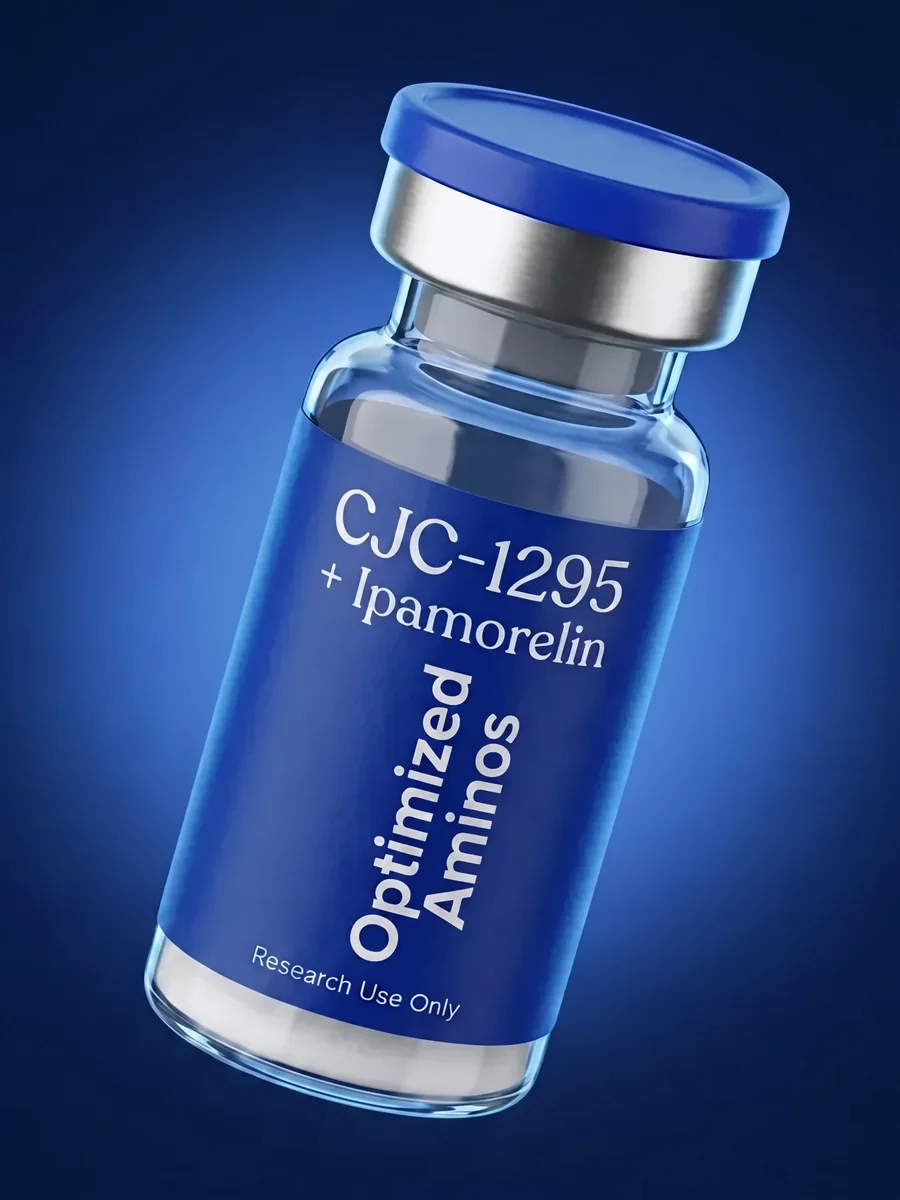
Certain compounds are almost universally studied in tandem. If you have ever browsed research journals on secretagogues, you have seen CJC-1295 and Ipamorelin discussed together. The pairing is not a coincidence — it is a masterclass in biological synergy. This article covers the research rationale as mechanism education only; no stacking or dosing advice.
Endogenous growth hormone production pathways
Growth hormone (GH) secretion is not a steady stream. It is governed by three chemical messengers from the hypothalamus and pituitary:
- GHRH — the "accelerator": signals the pituitary somatotroph cells to synthesize and release GH.
- Somatostatin (SRIF) — the "brake": inhibits GH release.
- Ghrelin — the "catalyst": binds pituitary receptors to stimulate GH release and simultaneously suppress somatostatin.
The importance of pulsatile secretion
The pituitary releases GH in distinct pulses, primarily during deep, slow-wave sleep. Between pulses, GH drops to near-undetectable levels. That trough is vital: it prevents receptor downregulation and preserves metabolic homeostasis. Modern research aims to amplify natural pulses without erasing the trough.
CJC-1295: the GHRH analog
CJC-1295 is a synthetic, modified version of the naturally occurring 44-amino-acid GHRH. The foundational research version is often called modified GRF (1–29), containing only the first 29 amino acids — the region required to bind pituitary receptors. It activates a G-protein-coupled receptor, stimulating adenylyl cyclase, raising intracellular cAMP, activating Protein Kinase A, and promoting transcription of the GH gene. In simple terms: it tells the pituitary to manufacture more GH and prepare it for release.
Without DAC vs. with DAC
- Without DAC (Modified GRF 1–29): half-life ~30 minutes. Sharp, rapid amplification of the natural GH pulse, then clears quickly. Preferred for mimicking natural pulsatile rhythms.
- With DAC: binds blood albumin, extending half-life to several days. Creates a continuous "GH bleed" rather than a pulse.
When CJC-1295 is discussed in combination with rapid-acting peptides, researchers almost always mean the without-DAC version.
Ipamorelin: the selective GHRP
Ipamorelin belongs to the growth hormone-releasing peptides (GHRPs) — structurally distinct from GHRH, they mimic ghrelin. Ipamorelin targets the ghrelin receptor with such precision that it triggers GH release without corresponding spikes in cortisol or prolactin, making it ideal for clean, controlled laboratory studies.
GHRH analog vs. GHRP at the cellular level
- GHRH analog (CJC-1295): ↑ cAMP → promotes GH gene transcription → synthesizes new GH.
- GHRP (Ipamorelin): ↑ intracellular Ca²⁺ → promotes immediate release of stored GH → inhibits somatostatin.
Neither is inherently "better" — they perform different biological functions that share the same endpoint.
Why specifically CJC-1295 and Ipamorelin?
Other GHRH analogs exist (Sermorelin, Tesamorelin) and many GHRPs exist (Hexarelin, GHRP-2, GHRP-6). What sets this pair apart is clean synergy: robust GH amplification without elevating stress hormones (cortisol, prolactin) or accelerating receptor burnout. That makes the pair a benchmark methodology in academic literature.
A simple analogy
CJC-1295 is the factory manager building inventory. Ipamorelin is the key that unlocks the door (inhibits somatostatin) and turns on the conveyor belt (calcium influx) to ship the product out. Alone, the manager stockpiles inventory that stays locked in the warehouse. Alone, the key opens the door on empty shelves. Together, maximum output.
Disclaimer: This article discusses in-vitro / animal-model research methodology only. It is not stacking or dosing advice for human use.
For laboratory and research use only. Not for human or animal consumption.
Related research compounds
Compounds referenced in this article, available as research-grade lyophilized peptides with third-party tested COA.