Research Blog
Sermorelin vs CJC-1295 vs Tesamorelin vs Ipamorelin: GH-Axis Research Peptides Compared
Published
Sermorelin, CJC-1295 and tesamorelin are GHRH analogs; ipamorelin is a ghrelin-receptor secretagogue. How the four differ in structure and stabilisation.
For laboratory research use only. This article compares growth-hormone-axis research peptides by mechanism and structure, as described in the published literature. It is educational only and describes no human or veterinary use, dosing, or outcomes.
Sermorelin, CJC-1295, tesamorelin and ipamorelin all act on the growth-hormone axis, but they are two different kinds of molecule. Sermorelin, CJC-1295 and tesamorelin are GHRH analogs: engineered versions of growth-hormone-releasing hormone that act at the GHRH receptor and differ mainly in how they are protected from enzymatic breakdown. Ipamorelin is a growth-hormone secretagogue that acts at a different receptor, the ghrelin receptor (GHS-R1a). Once that split is clear, every pairing and comparison between them makes sense.
Two families, one axis
The growth-hormone axis has two complementary inputs. Growth-hormone-releasing hormone (GHRH) is the primary stimulatory signal, acting at the GHRH receptor. A separate class of molecules, the growth-hormone secretagogues, acts at the ghrelin receptor and provides a second, independent input. Sermorelin, CJC-1295 and tesamorelin belong to the first family; ipamorelin belongs to the second.
The GHRH analogs: one problem, three solutions
Native GHRH is cleared within minutes, mainly because the enzyme dipeptidyl peptidase-4 (DPP-4) cleaves it near its N-terminus. Each GHRH analog is a different answer to that instability.
Sermorelin
Sermorelin is GHRH(1-29): the first 29 amino acids of the 44-residue hormone, the shortest sequence that keeps the parent's activity at the receptor. It is the closest of the group to the natural molecule and, like native GHRH, is short-lived because nothing protects it from DPP-4.
CJC-1295
CJC-1295 keeps the GHRH(1-29) scaffold and adds four amino-acid substitutions, at positions 2, 8, 15 and 27, that make it more resistant to enzymatic and chemical breakdown. It exists in two forms:
- Without DAC, also called modified GRF(1-29), relies on those substitutions alone and has a working window measured in minutes rather than days, though longer than sermorelin's. This is the form in the CJC-1295 no-DAC + Ipamorelin research blend.
- With DAC (Drug Affinity Complex) adds a reactive linker that binds covalently to circulating albumin, and the literature describes its half-life as extending to several days.
The DAC question is a study in half-life engineering on its own; see CJC-1295 with DAC versus without DAC.
Tesamorelin
Tesamorelin takes a different approach. It keeps the full 44-residue GHRH sequence and adds a trans-3-hexenoyl group at the N-terminus, which sterically hinders DPP-4 at its cleavage site while leaving the receptor-binding region largely intact. It is a "minimal modification" strategy: protect the vulnerable end, leave the rest of the native sequence alone. Its reported half-life falls in the same short range as CJC-1295 without DAC, in the order of tens of minutes.
Ipamorelin: a selective secretagogue
Ipamorelin is not a GHRH analog. It is a pentapeptide that acts at the ghrelin receptor, and it is best known for its selectivity. Earlier secretagogues such as GHRP-6 and GHRP-2 also stimulate the release of other hormones, including ACTH and cortisol, as a side effect of engaging their target. The study that introduced ipamorelin, published in the European Journal of Endocrinology in 1998, described it as the first selective growth-hormone secretagogue because, in animal models, it produced little of that spillover. For research that needs to isolate a single receptor's contribution, fewer confounding pathways means cleaner data. The older secretagogues are compared in GHRP-6 vs GHRP-2 vs hexarelin vs ipamorelin.
Why a GHRH analog and ipamorelin are so often paired
Because a GHRH analog and a secretagogue engage two separate receptors on the same axis, researchers study them together to observe how the two independent inputs interact. That two-input logic is why CJC-1295 and ipamorelin are combined in a single research product; the rationale is unpacked in why CJC-1295 and ipamorelin are discussed together. Pairing two GHRH analogs, by contrast, means studying two molecules aimed at the same receptor, which answers a different question.
Side-by-side summary
| Compound | Family | Receptor | Structure | Stabilisation |
|---|---|---|---|---|
| Sermorelin | GHRH analog | GHRH receptor | GHRH(1-29) | None; closest to native |
| CJC-1295 (no DAC) | GHRH analog | GHRH receptor | GHRH(1-29), 4 substitutions | Protease-resistant substitutions |
| CJC-1295 (DAC) | GHRH analog | GHRH receptor | As above, plus albumin-binding linker | Albumin binding; half-life in days |
| Tesamorelin | GHRH analog | GHRH receptor | GHRH(1-44), N-terminal hexenoyl group | Shields the DPP-4 cleavage site |
| Ipamorelin | Secretagogue | Ghrelin receptor (GHS-R1a) | Pentapeptide | Noted for receptor selectivity |
Handling and documentation
All are supplied as lyophilized powder and reconstituted with standard gentle technique and cold storage; see the reconstitution guide. Because these compounds are often studied in combination, label each vial's concentration and batch carefully to keep multi-component work traceable. In a blend vial, each component has its own concentration: the ratio chart shows how to work it out. The CJC-1295 + Ipamorelin blend and Tesamorelin each have a published Janoshik Analytical certificate in the COA archive, reporting HPLC purity and measured content.
Frequently Asked Questions
What is the difference between sermorelin and CJC-1295?
Both are built on GHRH(1-29). Sermorelin is the unmodified fragment and is broken down quickly. CJC-1295 carries four substitutions that make it more resistant to breakdown, and its DAC form also binds albumin, extending its half-life to days.
Is tesamorelin the same as CJC-1295?
No. Both are stabilised GHRH analogs, but tesamorelin keeps the full 44-residue sequence and protects its N-terminus with a hexenoyl group, while CJC-1295 uses the 29-residue fragment with amino-acid substitutions.
Why is ipamorelin described as selective?
Because in the animal studies that introduced it, ipamorelin stimulated its target pathway with little release of other hormones such as ACTH and cortisol, unlike earlier secretagogues such as GHRP-6 and GHRP-2.
Further reading
- GHRP-6 vs GHRP-2 vs hexarelin vs ipamorelin: the secretagogue family compared.
- CJC-1295 with DAC versus without: half-life engineering in detail.
- The CJC-1295 and ipamorelin pairing: the two-input rationale.
For laboratory and research use only. Not for human or animal consumption.
Related research compounds
Compounds referenced in this article, available as research-grade lyophilized peptides with third-party tested COA.
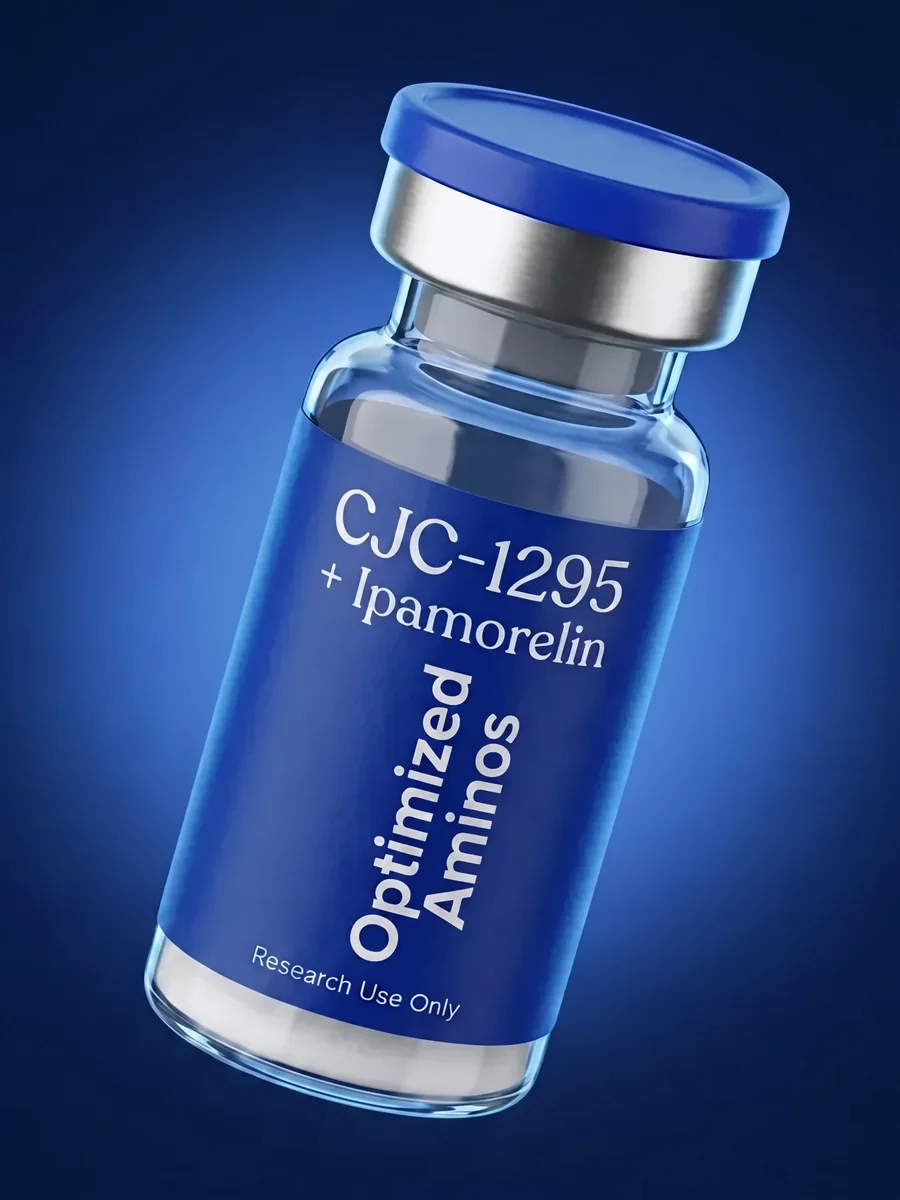
Research-grade lyophilized blend of CJC-1295 without DAC (mod GRF 1-29, MW 3367.97 Da) and Ipamorelin (MW 711.85 Da). Both peptides are synthesized at >98% purity and verified by third-party HPLC analysis. Studied in published in-vitro and preclinical literature on growth hormone secretagogue signaling. Supplied as lyophilized powder in a sealed sterile vial; store frozen at -20°C. Reconstitute with bacteriostatic water for laboratory use. For laboratory and analytical research use only. Not for human or animal consumption, ingestion, injection, therapeutic, cosmetic, or diagnostic use. Not an FDA-approved product.
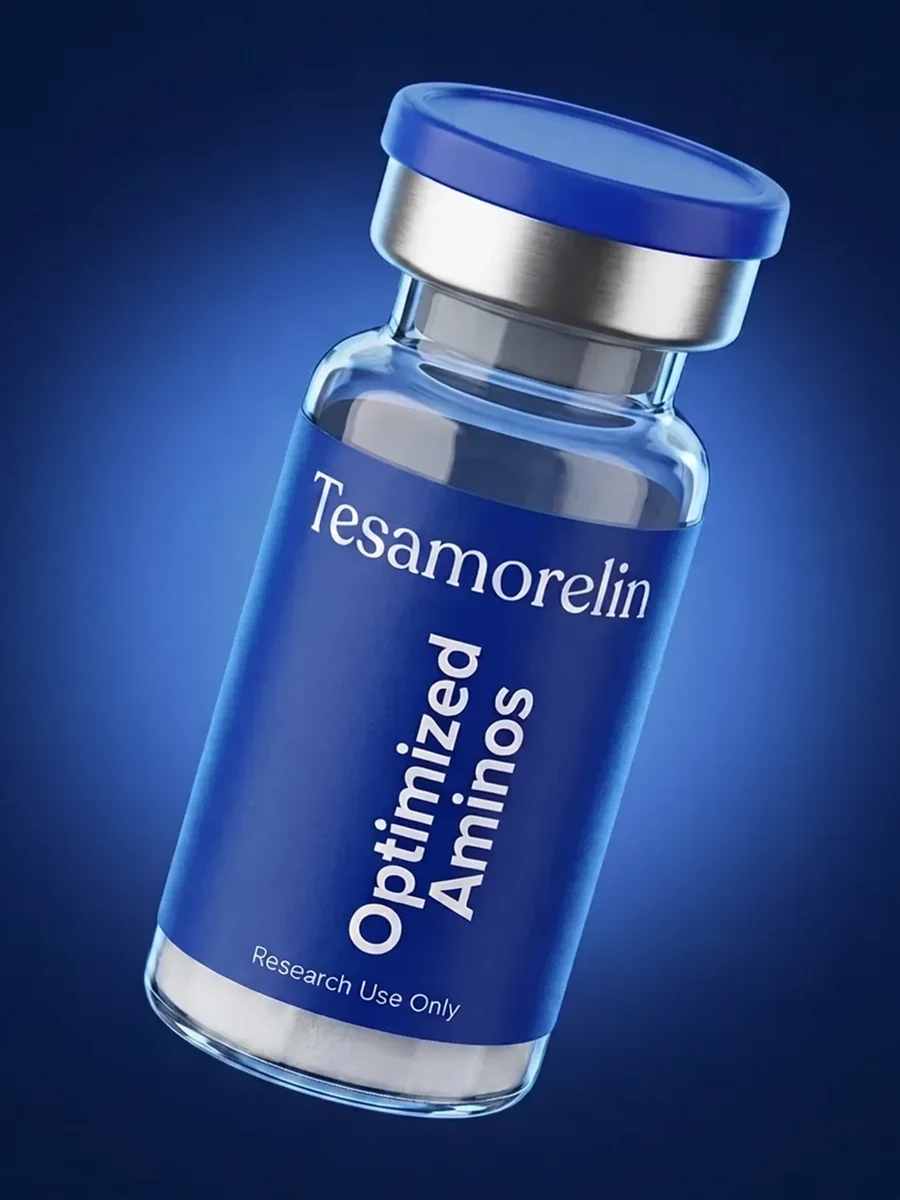
View productTesamorelin reference peptide — synthetic GRF analog of 44 amino acids with a trans-3-hexenoic acid modification (MW ~5135.8 Da). Produced at >98% purity with structural confirmation via peptide mapping and MALDI-TOF. Referenced in published preclinical endocrinology literature. Temperature-sensitive — requires cold-chain storage at -20°C; cold-pack shipping recommended. Reconstitute with bacteriostatic water. For in-vitro laboratory and analytical research use only. Not a drug, supplement, or therapeutic product. Not for human or animal consumption, ingestion, injection, or any clinical use. Not FDA-approved.
View product