Research Blog
The GH Stack Explained: CJC-1295 (No DAC) + Ipamorelin + Tesamorelin in One Research Kit
Published
What's inside the GH Stack research kit, how CJC-1295 (no DAC), Ipamorelin, and Tesamorelin differ mechanistically, and the reconstitution math for all three vials.
For laboratory and research use only. Not for human consumption.
The GH Stack pairs two research kits built around the same axis: CJC-1295 (no DAC) + Ipamorelin and Tesamorelin. All three peptides converge on growth-hormone secretion, but through different receptor mechanisms, which is the reason protocol designers stack them rather than picking one. This overview lays out what each vial contributes, how the mechanisms differ, and the reconstitution math needed to run all three in a single research design.
Why These Three Peptides Are Combined
Growth-hormone release in vivo is governed by two separate signaling inputs: growth-hormone-releasing hormone (GHRH) acting on the GHRH receptor, and ghrelin/GH secretagogues acting on the separate GHS-R1a receptor. Published pharmacology on CJC-1295 and Ipamorelin describes exactly this combination: CJC-1295 (no DAC) is a GHRH(1-29) analog with a short in vivo half-life that models pulsatile GHRH signaling, while Ipamorelin is a selective GHS-R1a agonist that amplifies the resulting GH pulse without the cortisol and prolactin co-release seen with older secretagogues like GHRP-6.
Tesamorelin sits in the same GHRH-receptor family as CJC-1295 but is a longer, stabilized 44-amino-acid GHRH(1-44) analog rather than a fragment. Research comparing the two, summarized in Tesamorelin vs CJC-1295, frames Tesamorelin as the molecule studied most extensively in visceral-adiposity models, giving researchers designing a GH-axis protocol a second GHRH-receptor reference point alongside the CJC-1295/Ipamorelin pairing. A broader survey of this receptor landscape is available in the GH secretagogues hub.
What's in the Vial
| Component | Receptor Target | Molecular Class | Typical Research Role |
|---|---|---|---|
| CJC-1295 (no DAC) | GHRH receptor | 29-amino-acid GHRH fragment analog | Models pulsatile GHRH signaling |
| Ipamorelin | GHS-R1a (ghrelin receptor) | Pentapeptide secretagogue | Selective GH-pulse amplification |
| Tesamorelin | GHRH receptor | 44-amino-acid stabilized GHRH analog | Extended GHRH-receptor reference model |
Reconstitution Math for the Stack
Each vial in the GH Stack is reconstituted independently — this is a multi-vial kit, not a single premixed solution. The general formula for any lyophilized peptide vial is:
Concentration (mg/mL) = Peptide mass (mg) ÷ Diluent volume added (mL)
For the CJC-1295 no DAC + Ipamorelin vial (5mg of each peptide co-lyophilized), adding 2 mL of bacteriostatic water yields 2.5 mg/mL of each peptide. Adding 5 mL instead yields 1 mg/mL of each. For the Tesamorelin 10mg vial, adding 2 mL yields 5 mg/mL; adding 5 mL yields 2 mg/mL. Researchers should record the exact diluent volume used per vial in their lab notebook, since the two vials in this kit are reconstituted to independent concentrations and are not interchangeable on a per-mL basis.
What the Published Literature Describes
Each component of the GH Stack has its own body of published pharmacology, and researchers combining them typically cite each molecule's literature independently rather than treating the stack as a single studied entity — no published study has evaluated this specific three-peptide combination as a unit. CJC-1295's GHRH-receptor binding and short in vivo half-life in its no-DAC form are described in receptor-binding assays and rodent pharmacokinetic models. Ipamorelin's selectivity for GHS-R1a over other secretagogue receptors has been characterized in comparative binding studies against older-generation GHRPs, which is the basis for its designation as a "selective" secretagogue in the literature. Tesamorelin's stabilized structure and extended plasma half-life relative to unmodified GHRH(1-29) fragments have been documented in pharmacokinetic and receptor-binding studies, and it remains the most extensively published molecule of the three, with data spanning multiple preclinical model systems.
Researchers designing a combined-vial protocol should treat these as three independently characterized inputs rather than assume that findings from one molecule's literature transfer to the combination. Documenting which published model system a given finding comes from — receptor-binding assay, rodent pharmacokinetic study, or in vitro cell-culture model — is standard practice when citing GH-axis peptide literature in a research write-up.
Protocol Design Considerations
Because the GH Stack ships as two separately reconstituted vials targeting two distinct receptor systems, protocol designs typically log each vial's reconstitution date, diluent volume, and resulting concentration as separate data points rather than a single combined figure. Some GH-axis research designs stagger administration of the GHRH-receptor agonist and the GHS-R1a agonist by a short interval to model the sequential nature of endogenous GH pulse generation described in the secretagogue literature; others administer them concurrently. Either approach should be documented explicitly in the protocol's methods section, since the interval chosen affects how results are interpreted relative to published reference studies.
Storage and Handling Notes
Once reconstituted, all three peptides are handled as standard lyophilized-peptide solutions: refrigerate at 2-8°C, protect from light, and use bacteriostatic water (not sterile water) if the solution will be drawn from multiple times over several days. Single-use protocols can use sterile water. Reconstituted peptide stability varies by molecule and storage condition, so researchers should consult the certificate of analysis for lot-specific guidance rather than assuming a fixed shelf life across all three components.
Frequently Asked Questions
Is the GH Stack a single vial or multiple vials?
It ships as separate vials — one containing co-lyophilized CJC-1295 (no DAC) and Ipamorelin, and one containing Tesamorelin. Each is reconstituted on its own.
What's the difference between CJC-1295 and Tesamorelin if both target the GHRH receptor?
Both are GHRH-receptor agonists, but they differ in structure and length: CJC-1295 (no DAC) is a 29-amino-acid fragment modeling short-acting pulsatile GHRH release, while Tesamorelin is a stabilized 44-amino-acid analog studied extensively in its own published literature. See the full comparison for mechanism detail.
Why include Ipamorelin alongside two GHRH-receptor analogs?
Ipamorelin acts on a different receptor (GHS-R1a) than CJC-1295 or Tesamorelin (GHRH receptor). Combining a GHRH-receptor agonist with a GHS-R1a agonist is a well-documented pairing in GH-axis pharmacology because the two receptor pathways act on separate, complementary steps of GH pulse generation.
Does research on CJC-1295 no DAC differ from research on CJC-1295 with DAC?
Yes. The DAC (Drug Affinity Complex) modification extends the parent molecule's half-life substantially. The GH Stack uses the no-DAC form specifically to model shorter-acting, pulsatile GHRH signaling rather than sustained receptor occupancy.
How should the two vials be stored between reconstitution sessions?
Refrigerate both reconstituted vials at 2-8°C, protect from light, and label each with the reconstitution date and concentration used, since the two vials in this kit are not reconstituted to matching concentrations.
Reviewed by the Optimized Aminos research team — last updated August 15, 2026.
For laboratory and research use only. Not for human consumption.
Related research compounds
Compounds referenced in this article, available as research-grade lyophilized peptides with third-party tested COA.
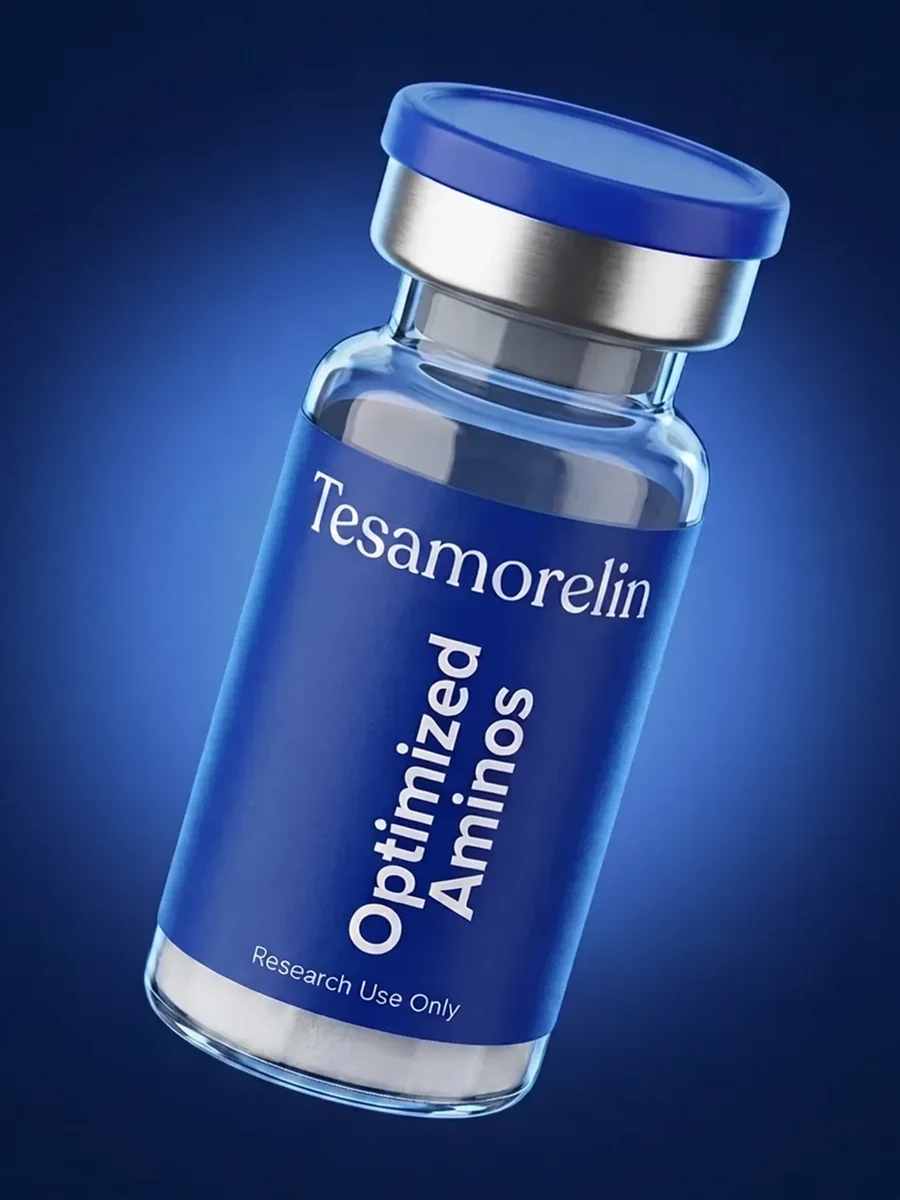
Tesamorelin reference peptide — synthetic GRF analog of 44 amino acids with a trans-3-hexenoic acid modification (MW ~5135.8 Da). Produced at >98% purity with structural confirmation via peptide mapping and MALDI-TOF. Referenced in published preclinical endocrinology literature. Temperature-sensitive — requires cold-chain storage at -20°C; cold-pack shipping recommended. Reconstitute with bacteriostatic water. For in-vitro laboratory and analytical research use only. Not a drug, supplement, or therapeutic product. Not for human or animal consumption, ingestion, injection, or any clinical use. Not FDA-approved.
View product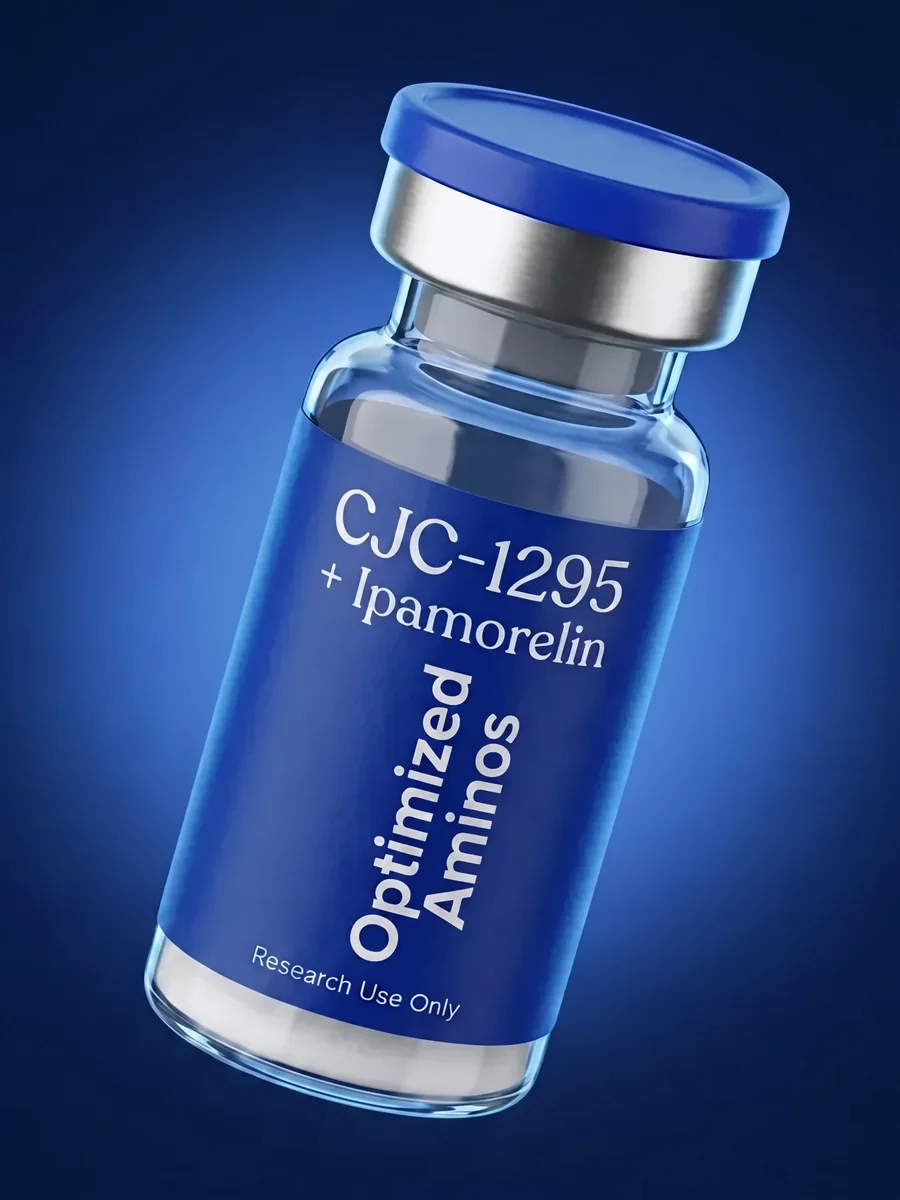
Research-grade lyophilized blend of CJC-1295 without DAC (mod GRF 1-29, MW 3367.97 Da) and Ipamorelin (MW 711.85 Da). Both peptides are synthesized at >98% purity and verified by third-party HPLC analysis. Studied in published in-vitro and preclinical literature on growth hormone secretagogue signaling. Supplied as lyophilized powder in a sealed sterile vial; store frozen at -20°C. Reconstitute with bacteriostatic water for laboratory use. For laboratory and analytical research use only. Not for human or animal consumption, ingestion, injection, therapeutic, cosmetic, or diagnostic use. Not an FDA-approved product.
View product