Research Blog
GH Secretagogues Explained: Ipamorelin, Hexarelin, GHRPs, Sermorelin, CJC-1295, and the Growth-Hormone-Axis Research Landscape
Published
A research-use-only overview of the two GH-secretagogue mechanism classes — GHRH receptor analogs and GHS-R1a ghrelin mimetics — and how they are studied.
For laboratory and research use only. Not for human consumption.
GH Secretagogues Explained: Ipamorelin, Hexarelin, GHRPs, Sermorelin, CJC-1295, and the Growth-Hormone-Axis Research Landscape
"Growth hormone secretagogue" is an umbrella term covering two mechanistically distinct families of research compounds that share one downstream target — stimulating growth hormone (GH) release from the pituitary — but reach it through two different receptors. Understanding which class a given peptide belongs to, and why studies often combine one from each class, is the most useful organizing framework for this category. This hub page walks through both classes and links to every compound-specific and comparison article on the site.
Key Facts
- GH secretagogues split into two mechanism classes: GHRH receptor analogs (Sermorelin, CJC-1295, Tesamorelin) and GHS-R1a ghrelin-receptor agonists (Ipamorelin, Hexarelin, GHRP-2, GHRP-6, MK-677).
- The GHS-R1a receptor subtype was identified via photoaffinity labeling by Ong et al. (1998), giving the ghrelin-mimetic class its distinct pharmacological target.
- Ipamorelin was described by Raun et al. (1998) as the first selective growth hormone secretagogue, contrasted against earlier, less-selective GHRPs like Hexarelin.
- CJC-1295 is studied in a DAC and a no-DAC form, with the DAC modification linked to prolonged GH/IGF-1 stimulation in Teichman et al. (2006).
- Because the two classes act on different receptors, research protocols frequently pair a GHRH analog with a ghrelin mimetic — e.g., CJC-1295 and Ipamorelin — to study combined secretory effects.
Two receptors, one downstream axis
All growth hormone secretagogue research ultimately converges on the same output — GH release measured in a study model — but the compounds get there via two separate receptor systems, and conflating them is the most common source of confusion in this category.
Class one: GHRH receptor analogs
The first class is built on the structure of growth-hormone-releasing hormone (GHRH) itself. Sermorelin, CJC-1295, and Tesamorelin are analogs designed around the GHRH receptor, the same pituitary target endogenous GHRH acts on. CJC-1295 is the best-documented member of this group: Teichman et al. (2006) evaluated a long-acting GHRH-receptor analog and reported prolonged stimulation of growth hormone and insulin-like growth factor I (IGF-1) secretion in healthy adult study participants, describing an extended-duration profile distinct from native GHRH's short half-life. Tesamorelin, engineered for greater stability relative to native GHRH, was studied by Falutz et al. (2007) in a trial examining metabolic effects of a GHRH-based research factor in an HIV-associated lipodystrophy population. Its structural differences from unmodified GHRH are broken down further in Tesamorelin's structure and stability compared to native GHRH. Sermorelin, a truncated GHRH-receptor analog, is also part of this class and is referenced descriptively throughout the site's comparison articles, though this page does not attach a standalone citation to it.
Class two: GHS-R1a ghrelin-receptor agonists (GHRPs)
The second class acts on an entirely separate receptor — the growth hormone secretagogue receptor, GHS-R1a — the same receptor endogenous ghrelin binds. Ong et al. (1998) identified this receptor subtype using photoaffinity labeling, establishing the target shared by every compound in this class. Ipamorelin, Hexarelin, GHRP-2, GHRP-6, and MK-677 are all ghrelin-receptor agonists, sometimes grouped under the older label "growth hormone releasing peptides" (GHRPs) or, for the orally active MK-677, "ghrelin mimetics."
Ipamorelin is the most selectivity-studied compound in this class: Raun et al. (1998) characterized it as the first selective growth hormone secretagogue, meaning its activity in the study models examined was concentrated on GH release without the broader hormonal activity seen in earlier GHRPs. Its mechanism is covered in Ipamorelin's research mechanism overview. Hexarelin, one of the earlier GHRPs developed, was described by Deghenghi et al. (1994) in infant and adult rat models as a GH-releasing peptide; its cardiovascular research profile was later tied to CD36 receptor binding by Bodart et al. (2002), a mechanism distinct from its GHS-R1a activity. The full picture is laid out in Hexarelin's research mechanism overview. GHRP-2, another ghrelin-mimetic in this class, is covered structurally in the GHRP-2 mechanism overview. GHRP-6 was studied by Frieboes et al. (1995), whose work in normal male subjects associated the peptide with sleep-architecture changes alongside GH, ACTH, and cortisol release — a broader hormonal footprint than selective Ipamorelin. MK-677, the orally active member of this class, was examined by Murphy et al. (1998) in a diet-induced catabolism model, and by Nass et al. (2008) in a randomized trial of healthy older adults measuring body composition and clinical outcomes.
Why research designs combine both classes
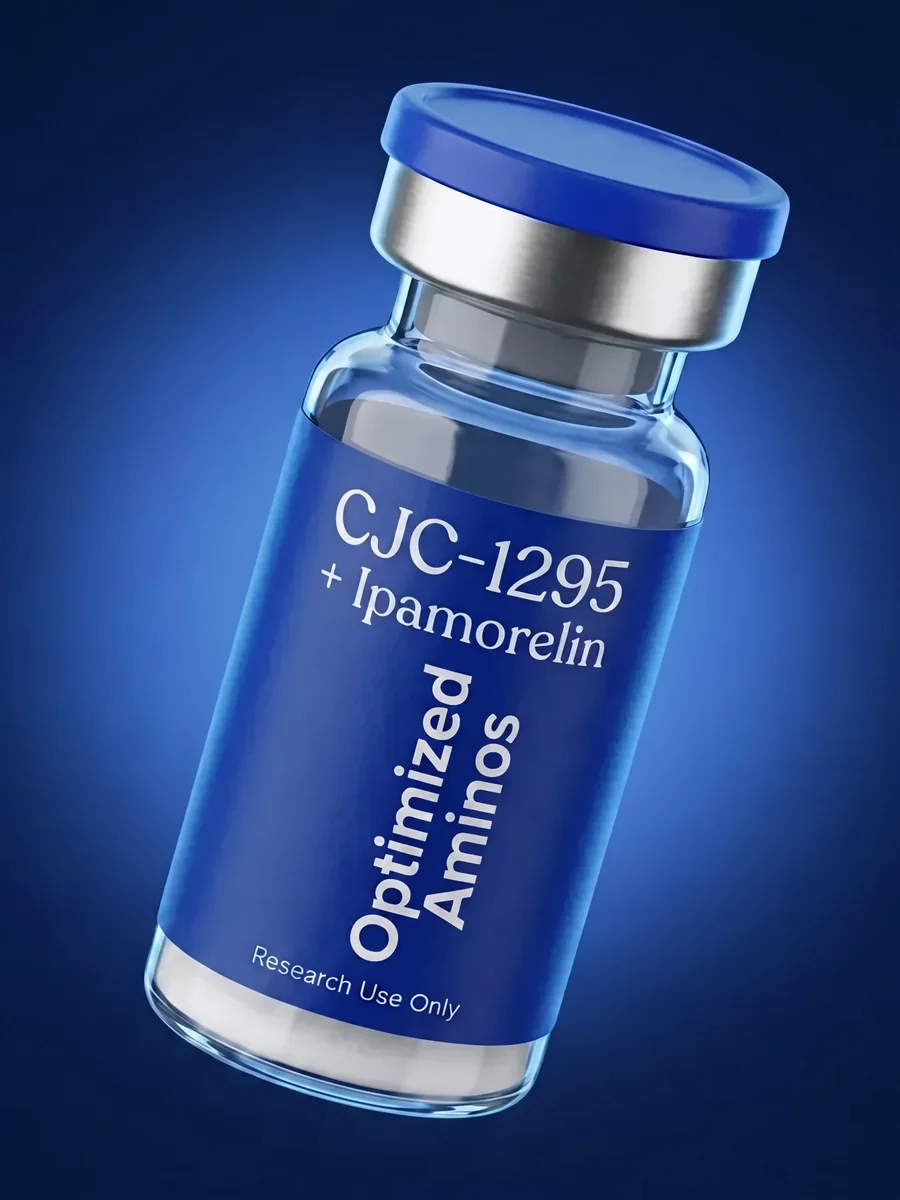
Because GHRH analogs and GHS-R1a agonists act through separate receptors, study designs frequently combine one compound from each class to examine whether the two pathways produce additive or synergistic effects on GH secretion patterns compared to either compound alone. This rationale is the basis for the CJC-1295-and-Ipamorelin pairing, one of the most frequently referenced combinations in the research literature and in commercially available research blends. The reasoning behind pairing a GHRH analog with a ghrelin mimetic is detailed in the CJC-1295 and Ipamorelin combination rationale, and the broader concept of combining multiple research peptides into a single formulation is explained in what a peptide blend is and how researchers evaluate one. A pre-combined research formulation reflecting this pairing is listed as CJC-1295 (no-DAC) 5mg / Ipamorelin 5mg.
Comparing compounds within and across classes
Side-by-side comparison is often the clearest way to see what distinguishes one research compound from another — receptor selectivity, secondary hormonal activity, or half-life. Within the ghrelin-mimetic class, GHRP-6 versus GHRP-2 and GHRP-6 versus Ipamorelin both contrast an older, broader-acting GHRP against a more targeted option, while Ipamorelin versus Hexarelin lines up the class's most selective agent against one of its earliest members. Ipamorelin versus MK-677 compares an injectable GHS-R1a agonist against the orally active ghrelin mimetic studied by Murphy et al. (1998) and Nass et al. (2008).
Cross-class comparisons are just as common, since a GHRH analog and a GHRP are mechanistically distinct even when the measured outcome (GH release) looks similar on paper. Ipamorelin versus Sermorelin and Sermorelin versus CJC-1295 versus Ipamorelin both set a GHRH-receptor analog against a GHS-R1a agonist. Tesamorelin versus Sermorelin stays within the GHRH-analog class, contrasting a stabilized, longer-studied agent against a shorter native-sequence analog, while Tesamorelin versus Ipamorelin crosses into the ghrelin-mimetic class entirely.
Pharmacokinetic and structural engineering considerations
Within the GHRH-analog class specifically, structural modifications matter for how long a compound is studied to remain active in circulation. CJC-1295 exists in two structural variants distinguished by the presence or absence of a drug affinity complex (DAC), a modification associated with extended circulating half-life in the Teichman et al. (2006) data. The practical difference between these two variants — and what the DAC modification is chemically doing — is broken down in CJC-1295 DAC versus no-DAC and half-life. Tesamorelin represents a parallel engineering approach applied to a different GHRH-analog backbone: its structural modifications relative to native GHRH, and how those relate to stability in study conditions, are covered in Tesamorelin's structure and stability versus native GHRH.
Sourcing and verification for this compound category
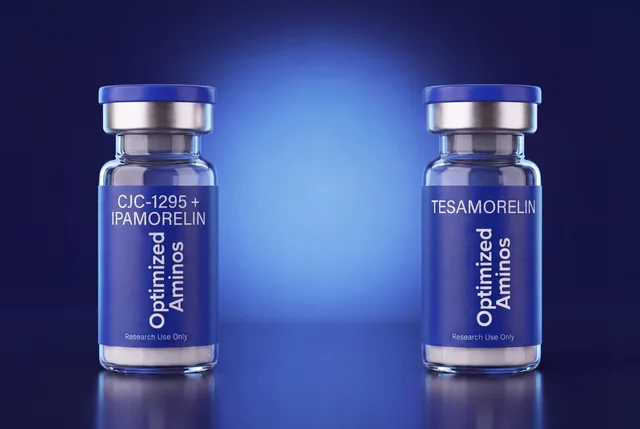
Every compound named here — GHRH analogs and GHS-R1a agonists alike — is sold on this site strictly as a research-use-only material, with batch-level documentation on the testing and certificate-of-analysis page. For lyophilized material, the reconstitution calculator supports concentration math across this category. Tesamorelin is listed as Tesamorelin 10mg, and the combined formulation discussed above is listed as CJC-1295 (no-DAC) 5mg / Ipamorelin 5mg.
Frequently Asked Questions
What is the difference between a GHRH analog and a ghrelin-receptor agonist?
GHRH analogs such as Sermorelin, CJC-1295, and Tesamorelin are modeled on endogenous growth-hormone-releasing hormone and act on the GHRH receptor in the pituitary. Ghrelin-receptor agonists — also called GHRPs or ghrelin mimetics — such as Ipamorelin, Hexarelin, GHRP-2, GHRP-6, and MK-677 act on a structurally distinct receptor, GHS-R1a, identified by Ong et al. (1998). The two classes stimulate growth hormone release through separate receptor pathways in model systems, which is why research protocols frequently study them in combination.
Why are GHRH analogs and GHRPs often studied together in research designs?
Because they act on different receptors, GHRH analogs and ghrelin-receptor agonists are frequently combined in preclinical and clinical research designs to examine potential additive or synergistic effects on growth-hormone secretion patterns. The CJC-1295-and-Ipamorelin pairing is one of the most commonly referenced combinations in the literature discussing this rationale.
Is Ipamorelin considered selective within the ghrelin-mimetic class?
Ipamorelin was characterized by Raun et al. (1998) as the first selective growth hormone secretagogue in its class, distinguishing it from earlier ghrelin mimetics such as Hexarelin and GHRP-6 in receptor-binding and secretory-profile studies.
What differentiates CJC-1295 with DAC from CJC-1295 without DAC?
Both are GHRH-receptor-analog research compounds, but they differ in their drug-affinity-complex (DAC) modification, which studies associate with differences in circulating half-life. Teichman et al. (2006) evaluated a long-acting GHRH analog formulation and reported prolonged stimulation of growth hormone and IGF-1 secretion in study participants.
Are GH secretagogues approved for human therapeutic use?
No. The compounds discussed on this page are sold and described here strictly as research chemicals. Tesamorelin is the one agent in this category with an approved clinical formulation studied in specific patient populations (Falutz et al., 2007), but the products referenced on this site are RUO materials, not that approved drug product, and are not intended for human or animal use.
References
- Raun K, Hansen BS, Johansen NL, et al. (1998). Ipamorelin, the first selective growth hormone secretagogue. European Journal of Endocrinology, 139(5):552-561. PMID 9849822.
- Deghenghi R, Cananzi M, Torsello A, et al. (1994). GH-releasing activity of Hexarelin, a new growth hormone releasing peptide, in infant and adult rats. Life Sciences. PMID 7910650.
- Bodart V, et al. (2002). CD36 mediates the cardiovascular action of growth hormone-releasing peptides in the heart. Circulation Research. PMID 11988484.
- Frieboes RM, Murck H, et al. (1995). Growth hormone-releasing peptide-6 stimulates sleep, growth hormone, ACTH and cortisol release in normal man. Neuroendocrinology. PMID 7617137.
- Ong H, McNicoll N, Escher E, et al. (1998). Identification of a pituitary growth hormone-releasing peptide (GHRP) receptor subtype by photoaffinity labeling. Endocrinology. PMID 9421445.
- Teichman SL, Neale A, Lawrence B, et al. (2006). Prolonged Stimulation of Growth Hormone (GH) and Insulin-Like Growth Factor I Secretion by CJC-1295, a Long-Acting Analog of GH-Releasing Hormone, in Healthy Adults. Journal of Clinical Endocrinology & Metabolism, 91(3):799-805. PMID 16352683.
- Murphy MG, Plunkett LM, et al. (1998). MK-677, an orally active growth hormone secretagogue, reverses diet-induced catabolism. Journal of Clinical Endocrinology & Metabolism. PMID 9467534.
- Nass R, Pezzoli SS, et al. (2008). Effects of an oral ghrelin mimetic on body composition and clinical outcomes in healthy older adults: a randomized trial. Annals of Internal Medicine, 149(9). PMID 18981485.
- Falutz J, Allas S, et al. (2007). Metabolic effects of a growth hormone-releasing factor in patients with HIV. New England Journal of Medicine, 357(23):2359-2370. PMID 18057338.
For laboratory and research use only. Not for human consumption.
Related research compounds
Compounds referenced in this article, available as research-grade lyophilized peptides with third-party tested COA.