Research Blog
CJC-1295 Research Overview: What Published Pharmacology Describes About the DAC-Modified GHRH Analog
Published
CJC-1295 research overview: DAC-modified GHRH(1-29) analog, albumin-binding mechanism, and what the Teichman (2006) JCEM trial measured. RUO only.
For laboratory and research use only. Not for human consumption.
CJC-1295 Research Overview: What Published Pharmacology Describes About the DAC-Modified GHRH Analog
CJC-1295 is one of the more frequently cited synthetic analogs of growth hormone-releasing hormone (GHRH) in the peptide research literature, largely because of a single engineering choice: the addition of a Drug Affinity Complex (DAC) that lets the molecule bind circulating albumin. This overview summarizes what published pharmacology describes about the compound's structure, its DAC modification mechanism, and the key human-subjects trial that characterized its pharmacokinetic profile — framed strictly as background for research study design, not as guidance for use.
What CJC-1295 Is
CJC-1295 is built on the GHRH(1-29) backbone — the 29-amino-acid N-terminal fragment of native growth hormone-releasing hormone that retains full receptor-binding activity in the parent molecule. Several point substitutions are introduced into this backbone to resist enzymatic degradation, and a DAC moiety is conjugated to the peptide, most commonly at the lysine side chain. This DAC group is what differentiates "CJC-1295" as commonly discussed in the literature from the unmodified, short-acting variant of the same backbone (often labeled CJC-1295 without DAC, or Modified GRF 1-29). The site's dedicated article, CJC-1295 DAC vs No-DAC: Half-Life Comparison, walks through that structural distinction and the reported half-life divergence between the two variants in detail — this overview will not re-derive that comparison and instead focuses on the DAC-bearing molecule itself.
The DAC Mechanism: Albumin Binding as a Half-Life Strategy
The core engineering problem DAC was designed to solve is one common to many small peptides used in research: native GHRH has a circulating half-life measured in single-digit minutes, because it is rapidly cleared by peptidases and renal filtration. A peptide that is degraded that quickly is difficult to study over extended observation windows without repeated administration.
DAC addresses this by giving the peptide a chemical "handle" — a reactive group that forms a covalent bond with a specific residue on human serum albumin, the most abundant protein in blood plasma. Once bound, the peptide is effectively shielded inside a much larger, slowly cleared carrier molecule. Instead of being filtered and degraded within minutes, the DAC-conjugated peptide's clearance now tracks much closer to that of albumin itself, which persists in circulation for days. This is the same general strategy (protein-binding half-life extension) used across a range of unrelated therapeutic and research peptide classes, though the specific chemistry differs from compound to compound.
From a research-design standpoint, this matters because a molecule's half-life determines how frequently a study protocol needs to reintroduce it to maintain a target exposure window, and how sampling intervals should be spaced to capture meaningful pharmacodynamic data. None of this is dosing guidance for use in a person or animal — it is a description of variables that appear in the published pharmacokinetic literature and that researchers account for when designing in vitro or in vivo protocols.
What the Teichman et al. (2006) Trial Measured
The primary human-subjects characterization of CJC-1295 comes from Teichman and colleagues, published in the Journal of Clinical Endocrinology & Metabolism in 2006 (Teichman et al., 2006). The trial administered subcutaneous CJC-1295 to healthy adult volunteers and tracked circulating growth hormone (GH) and insulin-like growth factor I (IGF-I) concentrations over time, comparing outcomes across different administered doses.
The reported findings described sustained, dose-dependent elevations in both GH and IGF-I following administration — a marked contrast to the transient GH pulse that follows a bolus of unmodified GHRH, which fades within roughly an hour as the native peptide is cleared. The authors also reported an extended circulating half-life for the DAC-modified molecule, consistent with the albumin-binding mechanism described above, and multiple days long rather than the minutes-long half-life associated with native GHRH.
A Companion Question: Does Continuous Stimulation Flatten Pulsatility?
Because DAC-mediated binding keeps the peptide in circulation continuously rather than as a single transient pulse, a natural pharmacological question follows: does that continuous GHRH receptor stimulation flatten the body's normal pulsatile GH secretion pattern into something closer to a constant elevation, or does the underlying pulsatile architecture of the GH axis persist regardless? A companion JCEM study published in 2006 examined exactly this question for CJC-1295, and its title — "Pulsatile Secretion of Growth Hormone (GH) Persists during Continuous Stimulation by CJC-1295, a Long-Acting GH-Releasing Hormone Analog" — describes its reported conclusion directly: the pulsatile pattern was preserved rather than eliminated. This is a distinction relevant to researchers designing GH-axis sampling protocols, since it implies the underlying hypothalamic-pituitary pulse generator (rather than the exogenous ligand alone) continues to shape the secretion pattern even under sustained receptor engagement.
Why This Matters for Study Design
Taken together, these two findings — a multi-day half-life via albumin binding, and preserved rather than flattened GH pulsatility — are the reason CJC-1295 (DAC) shows up in the literature discussion of study-design considerations distinct from short-half-life GHRH analogs or ghrelin-receptor secretagogues. A protocol built around a compound with a multi-day half-life requires different reintroduction intervals and sampling windows than one built around a compound cleared in minutes. This is also why CJC-1295 (typically the non-DAC variant, for a tighter observation window) is frequently discussed alongside a ghrelin-receptor agonist in combined-axis research designs — see CJC-1295 and Ipamorelin Research Rationale for that mechanistic pairing, and Ipamorelin Research Mechanism Overview for background on the secretagogue side of that combination. For the sibling GHRH(1-29) analog without a DAC modification, see Sermorelin Research Overview. For the broader category context, see the GH Secretagogues Research Hub.
Key Facts
- CJC-1295 is a synthetic analog of GHRH(1-29), the active N-terminal fragment of native growth hormone-releasing hormone.
- The DAC (Drug Affinity Complex) modification allows covalent binding to circulating albumin, extending circulating half-life from minutes (native GHRH) to multiple days in published pharmacokinetic descriptions.
- Teichman et al. (2006, JCEM) reported sustained, dose-dependent GH and IGF-I elevations in healthy adult volunteers following subcutaneous CJC-1295 administration.
- A companion 2006 JCEM study reported that pulsatile GH secretion persisted rather than flattened during continuous DAC-mediated stimulation.
- CJC-1295 with DAC is structurally and pharmacokinetically distinct from CJC-1295 without DAC; see the dedicated comparison article for details.
- All figures here describe published research findings, not dosing recommendations for human or animal use.
Handling and Verification for Research Use
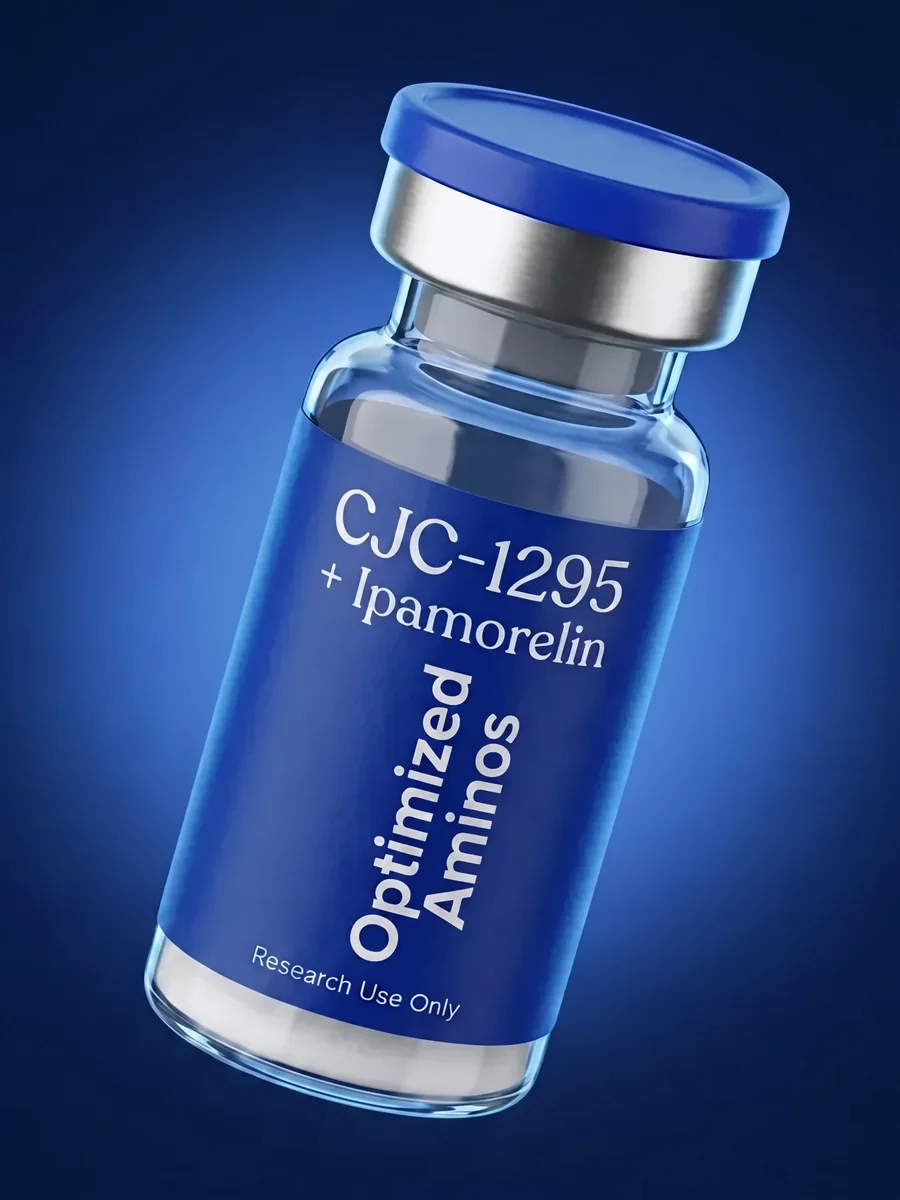
CJC-1295 ships as a lyophilized powder and is reconstituted with an appropriate diluent prior to laboratory use; the reconstitution calculator is built to help researchers work out concentration math (mg per mL) for a given vial and diluent volume — it is a unit-conversion tool for protocol setup, not a dosing instrument. Before use in any protocol, researchers should confirm each vial's identity and purity against its certificate of analysis; see /testing for COA access and methodology. The GHRH-analog blend referenced in this article's combined-axis discussion is available as CJC-1295 (No DAC) + Ipamorelin 5mg for laboratory research use.
Frequently Asked Questions
What does DAC stand for in CJC-1295?
DAC stands for Drug Affinity Complex, a chemical modification (a maleimidopropionic acid linker) attached to the GHRH(1-29) analog backbone that allows the molecule to covalently bind circulating albumin, which is the modification responsible for its extended half-life in research models compared to unmodified GHRH.
Is CJC-1295 the same as CJC-1295 without DAC?
No. CJC-1295 with DAC and CJC-1295 without DAC (sometimes called Modified GRF 1-29) share the same GHRH(1-29) analog backbone but differ in the albumin-binding modification, which produces markedly different half-life profiles in published pharmacokinetic descriptions. The site's dedicated comparison article covers this distinction in detail.
What did the Teichman et al. 2006 study measure?
The Teichman et al. (2006) trial, published in the Journal of Clinical Endocrinology & Metabolism, measured growth hormone and IGF-I concentrations in healthy adult volunteers following subcutaneous administration of CJC-1295, reporting sustained, dose-dependent elevations and an extended circulating half-life relative to native GHRH.
Does continuous GHRH receptor stimulation flatten the natural pulsatile pattern of GH secretion?
A companion JCEM study (2006) examined this question specifically for CJC-1295 and reported that pulsatile GH secretion persisted during continuous DAC-mediated stimulation rather than becoming flattened into a constant elevation, a distinction of interest to researchers designing sampling protocols.
Is CJC-1295 approved for human or veterinary use?
No. CJC-1295 is not approved by the FDA or any regulatory body for human or veterinary use. It is sold and described here strictly for laboratory and research use, and nothing in this article should be read as dosing or administration guidance.
References
Teichman SL, Neale A, Lawrence B, Gagnon C, Castaigne JP, Frohman LA (2006). "Prolonged Stimulation of Growth Hormone (GH) and Insulin-Like Growth Factor I Secretion by CJC-1295, a Long-Acting Analog of GH-Releasing Hormone, in Healthy Adults." Journal of Clinical Endocrinology & Metabolism, 91(3):799-805. PMID: 16352683.
"Pulsatile Secretion of Growth Hormone (GH) Persists during Continuous Stimulation by CJC-1295, a Long-Acting GH-Releasing Hormone Analog." Journal of Clinical Endocrinology & Metabolism, 91(12):4792. (Companion trial; referenced by title only.)
For laboratory and research use only. Not for human consumption.
Related research compounds
Compounds referenced in this article, available as research-grade lyophilized peptides with third-party tested COA.