Research Blog
Tesamorelin vs CJC-1295: Comparing Two Stabilized GHRH-Analog Research Peptides
Published
A structural and pharmacokinetic comparison of Tesamorelin and CJC-1295 — two engineered GHRH-analog research peptides and how each resists enzymatic degradation.
For laboratory and research use only. Not for human consumption.
Tesamorelin and CJC-1295 are both engineered analogs of growth hormone-releasing hormone (GHRH) developed to address the same underlying problem — rapid enzymatic degradation of the native peptide — using two structurally distinct strategies. This article compares what published structural and pharmacokinetic literature describes about each approach in model systems.
Key Facts
- Native GHRH is degraded rapidly by the enzyme dipeptidyl peptidase-4 (DPP-4), which cleaves the peptide near its N-terminal end and is described in pharmacokinetic literature as the primary driver of its short measured half-life.
- Tesamorelin is GHRH(1-44) modified with an added trans-3-hexenoic acid group at the N-terminus, a structural change reported to reduce DPP-4 cleavage susceptibility.
- CJC-1295 is a GHRH(1-29) analog carrying amino acid substitutions designed for protease resistance, available in research literature as both a DAC-conjugated form and a non-conjugated ("no-DAC") form.
- The DAC (Drug Affinity Complex) technology used in CJC-1295 involves a linker that covalently binds circulating albumin, which published studies describe as extending measured half-life to several days.
- CJC-1295 without DAC lacks the albumin-binding linker and has been reported with a substantially shorter measured half-life, closer to that of other short-acting GHRH analogs.
- Reconstitution concentration (mg-to-mL) rather than any human dosing schedule is the relevant calculation for laboratory handling of either lyophilized peptide.
Structural Basis: Why Native GHRH Is Unstable
Growth hormone-releasing hormone in its native form, whether the full-length GHRH(1-44) or the shorter, still-active GHRH(1-29) fragment used in pharmacology research, is rapidly cleaved by dipeptidyl peptidase-4 (DPP-4), an enzyme that removes dipeptides from the N-terminus of susceptible peptide sequences. This cleavage is described in pharmacokinetic literature as the principal reason native GHRH has a very short measured half-life in circulation, which limits its usefulness as a stable research tool for studying sustained GHRH-receptor signaling in model systems. Both Tesamorelin and CJC-1295 were engineered specifically to address this degradation pathway, but they do so through different structural strategies, which is what makes a side-by-side structural comparison useful for researchers selecting a stabilized analog for a given protocol.
Tesamorelin's Stabilization Strategy
Tesamorelin is built on the GHRH(1-44) backbone with a trans-3-hexenoic acid group added at the N-terminus. Structural pharmacology literature describes this modification as creating steric interference with DPP-4's ability to bind and cleave the peptide at its normal cleavage site, without altering the receptor-binding region further along the sequence. This is described as a "minimal modification" stabilization strategy: the core GHRH(1-44) sequence responsible for receptor engagement is left largely intact, while the vulnerable N-terminal region is chemically shielded from enzymatic attack.
CJC-1295's Stabilization Strategy: DAC and No-DAC Forms
CJC-1295 takes a different structural approach, starting from the shorter GHRH(1-29) fragment and introducing four amino acid substitutions (commonly described in the literature as occurring at positions 2, 8, 15, and 27) that reduce susceptibility to enzymatic and chemical degradation more broadly, not just DPP-4 cleavage specifically. This substituted sequence is available in two forms described in published literature. The base form, often referred to as "no-DAC" or as modified GRF(1-29), relies solely on these substitutions for its stability profile and is reported with a measured half-life on the order of minutes, broadly similar in magnitude to Tesamorelin. The second form adds a Drug Affinity Complex (DAC): a maleimidopropionic acid linker that forms a covalent bond with circulating albumin. This albumin-binding mechanism is structurally unrelated to DPP-4 resistance — it works by attaching the peptide to a large, slowly cleared plasma protein — and is described in pharmacokinetic studies as extending the measured half-life to several days rather than minutes.
Half-Life and Pharmacokinetics Reported in the Literature
Because Tesamorelin and CJC-1295 (no-DAC) rely on similar categories of stabilization — structural resistance to enzymatic cleavage rather than a large protein carrier — their reported half-lives in pharmacokinetic literature fall into a broadly comparable short range, generally described in terms of tens of minutes. CJC-1295 with DAC stands apart mechanistically: its half-life extension comes from an entirely different physical principle, namely slow clearance of the large albumin-peptide complex from circulation, and is reported in the literature as measured in days rather than minutes. Researchers designing comparative in vitro or rodent-model protocols involving these compounds typically account for this mechanistic distinction when interpreting any pharmacokinetic data drawn from the published literature, since a DAC-linked and non-DAC-linked analog are not directly interchangeable in terms of exposure duration in a model system.
Reconstitution and Concentration Math for Comparative Research Use
For bench-level handling of lyophilized Tesamorelin or CJC-1295 (no-DAC) paired with Ipamorelin, the relevant calculation for laboratory recordkeeping is converting a vial's peptide mass and a chosen diluent volume into a working mg/mL concentration — not a human dosing schedule. The reconstitution calculator is designed to support that conversion consistently across different vial sizes and diluent volumes, which is useful when a comparative protocol calls for matched concentrations of both compounds. Researchers looking for more detail on each compound's structural background can review the companion articles on Tesamorelin's structure and stability relative to native GHRH and on the CJC-1295 research overview.
Frequently Asked Questions
Why is native GHRH unstable in research and pharmacology literature?
Native GHRH(1-44) and its truncated GHRH(1-29) fragment are rapidly broken down by the enzyme dipeptidyl peptidase-4 (DPP-4), which cleaves the peptide near its N-terminus. Published pharmacokinetic literature describes this enzymatic cleavage as the primary reason native GHRH has a very short measured half-life in model systems.
How does Tesamorelin's structural modification differ from native GHRH?
Tesamorelin is GHRH(1-44) modified with a trans-3-hexenoic acid group added at the N-terminus. Published structural literature describes this modification as sterically hindering DPP-4 cleavage, which is reported to extend the measured half-life relative to native GHRH in pharmacokinetic studies.
What is the difference between CJC-1295 and CJC-1295 without DAC?
CJC-1295 is a GHRH(1-29) analog carrying amino acid substitutions for protease resistance. The DAC (Drug Affinity Complex) version adds a maleimidopropionic acid linker that covalently binds circulating albumin, which published pharmacokinetic studies describe as extending the measured half-life substantially beyond the no-DAC form, which lacks this albumin-binding linker.
How do the measured half-lives of Tesamorelin and CJC-1295 compare in the literature?
Published pharmacokinetic studies report Tesamorelin's half-life in the range of roughly 25-38 minutes, reflecting its DPP-4-resistance-based stabilization strategy. CJC-1295 without DAC has been reported with a similarly short measured half-life, while the DAC-conjugated form has been described in the literature as extending to several days due to albumin binding.
For laboratory and research use only. Not for human consumption.
Related research compounds
Compounds referenced in this article, available as research-grade lyophilized peptides with third-party tested COA.
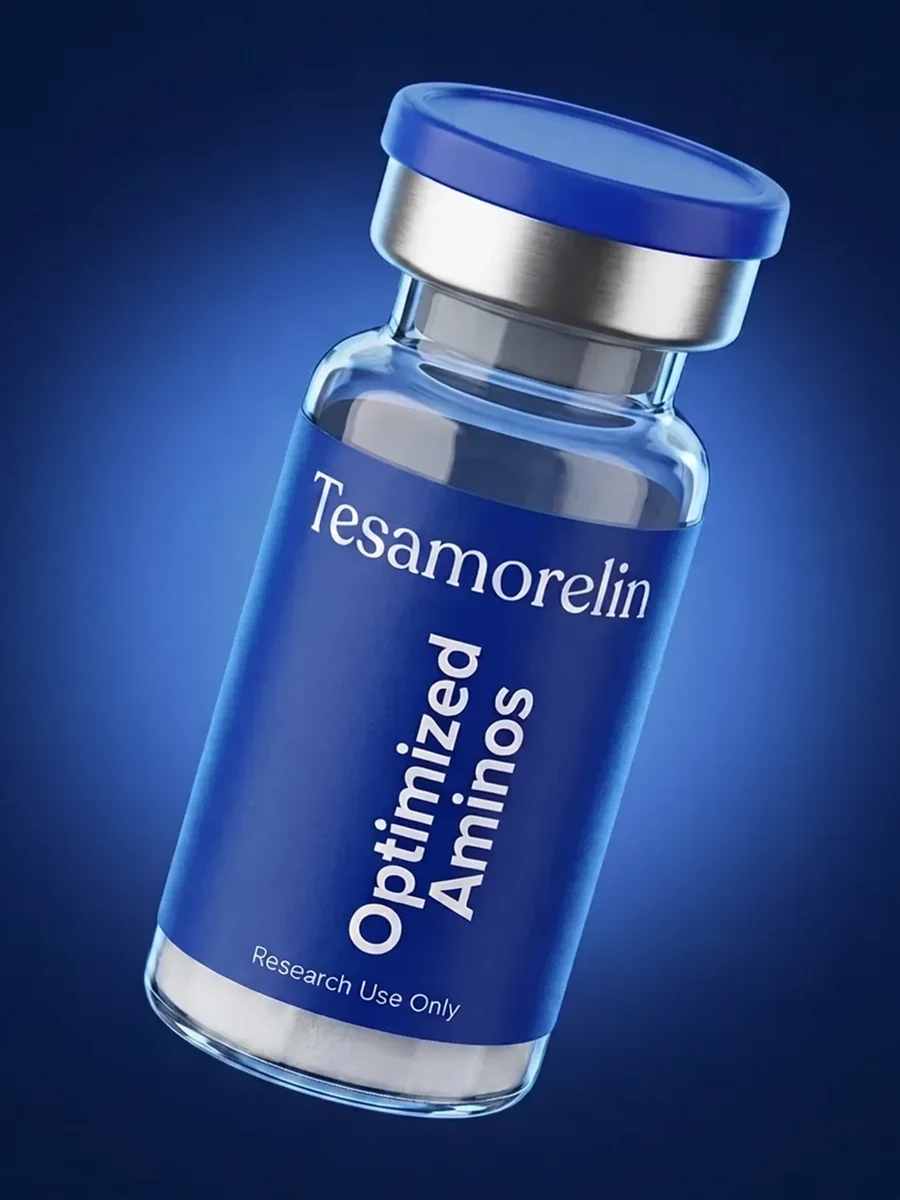
Tesamorelin reference peptide — synthetic GRF analog of 44 amino acids with a trans-3-hexenoic acid modification (MW ~5135.8 Da). Produced at >98% purity with structural confirmation via peptide mapping and MALDI-TOF. Referenced in published preclinical endocrinology literature. Temperature-sensitive — requires cold-chain storage at -20°C; cold-pack shipping recommended. Reconstitute with bacteriostatic water. For in-vitro laboratory and analytical research use only. Not a drug, supplement, or therapeutic product. Not for human or animal consumption, ingestion, injection, or any clinical use. Not FDA-approved.
View product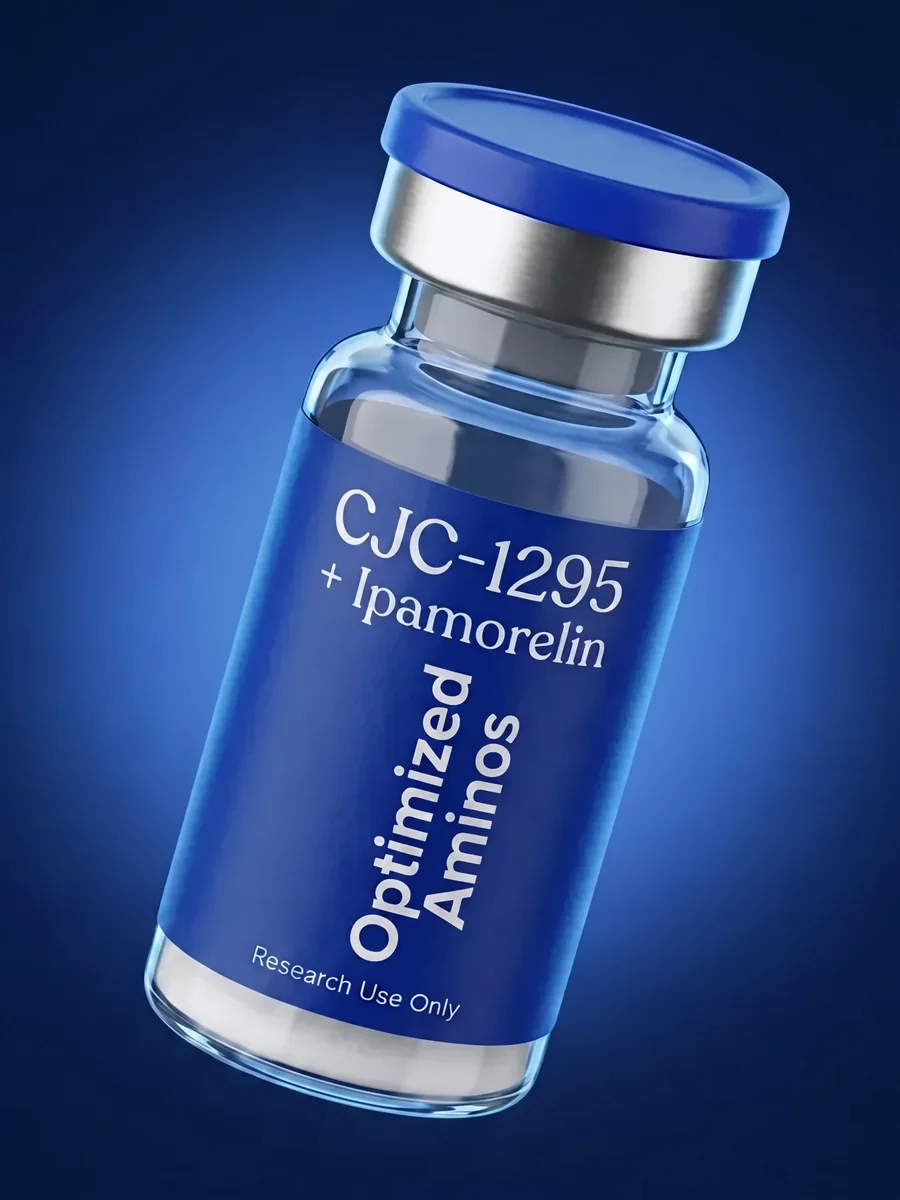
Research-grade lyophilized blend of CJC-1295 without DAC (mod GRF 1-29, MW 3367.97 Da) and Ipamorelin (MW 711.85 Da). Both peptides are synthesized at >98% purity and verified by third-party HPLC analysis. Studied in published in-vitro and preclinical literature on growth hormone secretagogue signaling. Supplied as lyophilized powder in a sealed sterile vial; store frozen at -20°C. Reconstitute with bacteriostatic water for laboratory use. For laboratory and analytical research use only. Not for human or animal consumption, ingestion, injection, therapeutic, cosmetic, or diagnostic use. Not an FDA-approved product.
View product