Research Blog
AOD-9604 vs Tesamorelin: Fat-Metabolism Research Peptides Compared
Published
AOD-9604 and Tesamorelin compared as fat-metabolism research peptides: structure, mechanism, and what published studies have measured in model systems.
For laboratory and research use only. Not for human consumption.
AOD-9604 and Tesamorelin are two of the most frequently searched fat-metabolism research peptides, and they're often mentioned in the same breath because both are studied in relation to fat tissue. But they come from different structural families and are proposed to act through different mechanisms. This comparison lays out what distinguishes them at the molecular level and what published research has actually measured in model systems for each.
As with all research compounds discussed here, everything below describes laboratory and preclinical findings, not outcomes in people, and none of it should be read as guidance for any human use.
Key Facts
- AOD-9604 is a 15-amino-acid fragment derived from the C-terminal (177-191) region of the human growth hormone sequence.
- Tesamorelin is a 44-amino-acid synthetic analog of growth hormone-releasing hormone (GHRH), stabilized against rapid enzymatic degradation.
- AOD-9604 was originally researched for its potential to isolate the fat-metabolism-related activity of growth hormone from its glucose- and growth-related effects.
- Tesamorelin acts upstream, on GHRH receptors in the pituitary, to stimulate the body's own growth hormone release rather than supplying a GH fragment directly.
- Both compounds have been studied in relation to lipolysis and fat-tissue markers, but through distinct proposed pathways and in different research contexts.
- Neither compound is approved for human fat-loss treatment through the research-supply channel these products are sold in; Tesamorelin's only approved pharmaceutical use is a separate, prescription drug product, distinct from RUO research material.
Structural Differences
AOD-9604: A Growth Hormone Fragment
AOD-9604 is not GHRH and not full-length growth hormone. It's a synthesized fragment corresponding to amino acids 177-191 of the human growth hormone sequence — specifically the region researchers identified as associated with growth hormone's effects on fat metabolism, distinct from the region associated with growth-promoting and glucose-related effects. The goal of isolating this fragment in early research was to study whether the fat-metabolism activity could be separated from those other effects.
Tesamorelin: A Stabilized GHRH Analog
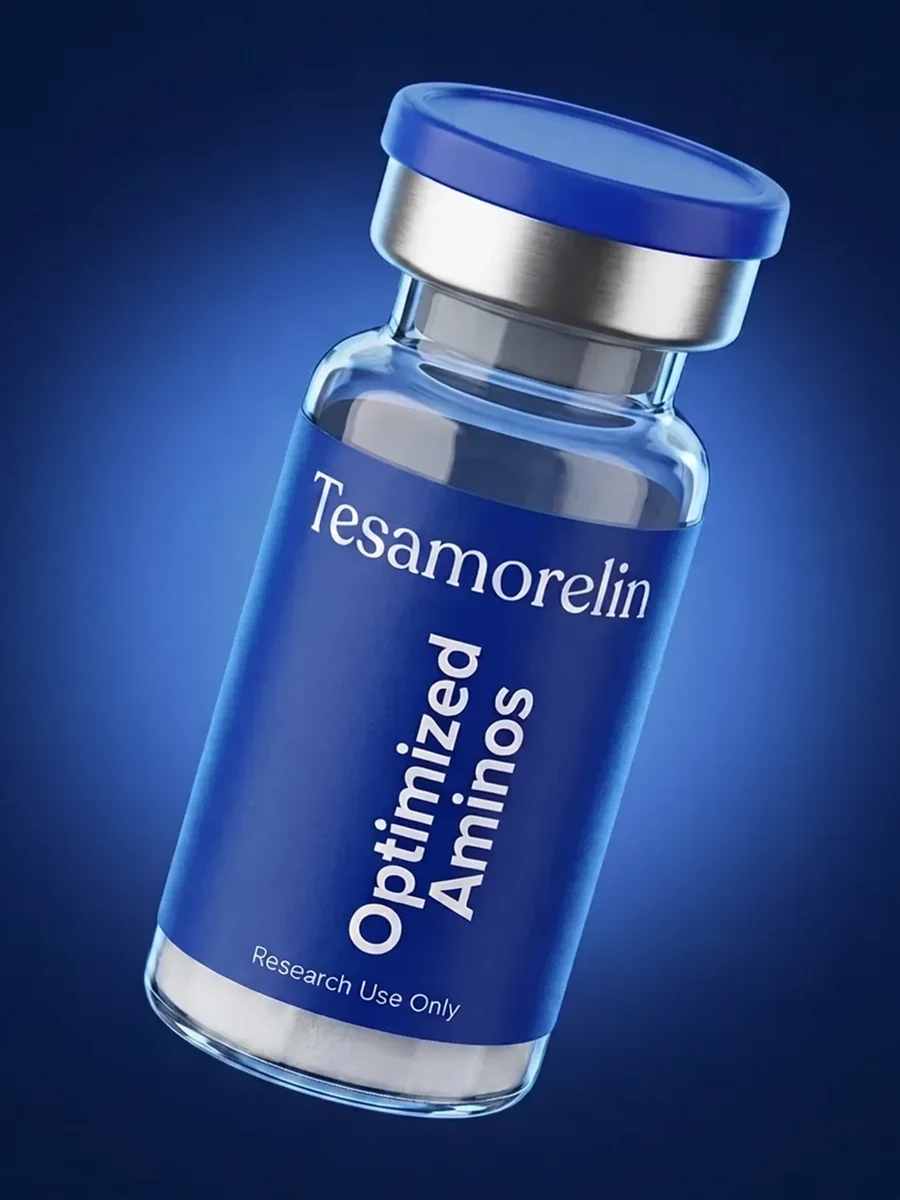
Tesamorelin, by contrast, is a 44-amino-acid peptide built on the GHRH backbone, with structural modification added specifically to resist rapid enzymatic breakdown compared to native GHRH. Because it acts on GHRH receptors rather than mimicking growth hormone directly, its mechanism runs through the pituitary-GH axis rather than bypassing it. Our structural deep-dive, Tesamorelin's structure and stability compared to native GHRH, breaks down exactly what that modification changes at the molecular level.
Mechanistic Comparison
How AOD-9604 Is Proposed to Act
Research models have investigated AOD-9604 for effects on lipolysis (the breakdown of stored fat) and inhibition of lipogenesis (fat storage), the theory being that this fragment carries the fat-metabolism signal of growth hormone without the receptor interactions responsible for GH's effects on blood glucose and skeletal tissue growth in those models.
How Tesamorelin Is Proposed to Act
Because Tesamorelin works through GHRH receptors, its studied mechanism runs through the hypothalamic-pituitary axis: it prompts the pituitary to increase its own growth hormone output, and downstream research has measured resulting changes in visceral fat markers in the study populations examined. This upstream mechanism is mechanistically distinct from AOD-9604's proposed direct fragment activity.
Where the Research Overlaps and Where It Diverges
Both peptides are studied in the fat-metabolism space, which is why they're frequently compared, but the overlap is more about the outcome researchers are measuring (fat-tissue markers) than about a shared mechanism. AOD-9604 research has centered on isolated fragment activity at the level of fat cells; Tesamorelin research has centered on stimulating an endogenous hormonal axis. Anyone designing a comparative research protocol should treat these as mechanistically distinct tools rather than interchangeable options.
Practical Research Handling: Reconstitution, Not Dosing
Because both compounds ship as lyophilized powder, the practical question for any lab handling them is reconstitution math, not a use instruction. Reconstitution means dissolving a known mass of powder (in mg) into a known volume of diluent (in mL) to arrive at a defined concentration (mg/mL) for use in an experimental protocol. Our AOD-9604 reconstitution lab-protocol guide walks through that process step by step, and our reconstitution calculator can help you work out the concentration math for either compound based on vial size and diluent volume.
Sourcing Considerations
Because Tesamorelin in particular has both a prescription pharmaceutical form and a separate RUO research-material supply chain, sourcing documentation matters more than usual. Our 2026 buyer's guide to sourcing Tesamorelin for research covers what to check before ordering, including batch documentation and COA availability. Current research-grade Tesamorelin and AOD-9604 listings are available on our products page.
Frequently Asked Questions
Are AOD-9604 and Tesamorelin the same type of molecule?
No. AOD-9604 is a modified fragment derived from the C-terminal region of human growth hormone, while Tesamorelin is a synthetic analog of growth hormone-releasing hormone (GHRH). They are structurally distinct and are studied through different proposed mechanisms.
What has research measured for AOD-9604?
Preclinical studies have measured AOD-9604's effects on lipolysis (fat breakdown) and lipogenesis inhibition in model systems, without the effects on blood glucose or growth-related tissue that are associated with full-length growth hormone in those same models.
What has research measured for Tesamorelin?
Tesamorelin has been studied for its ability to stimulate the pituitary gland's release of growth hormone by acting on GHRH receptors, with downstream research measuring changes in visceral fat markers in clinical study populations. It works upstream of growth hormone release rather than acting as a direct growth-hormone fragment.
How should reconstitution be approached for these research peptides?
Reconstitution is a matter of concentration math — milligrams of lyophilized powder dissolved into milliliters of bacteriostatic or sterile diluent to reach a known mg/mL concentration for laboratory use. It is not a human dosing instruction, and a reconstitution calculator can help work out that math accurately.
For laboratory and research use only. Not for human consumption.
Related research compounds
Compounds referenced in this article, available as research-grade lyophilized peptides with third-party tested COA.