Research Blog
Tesamorelin's Structure: What Makes It More Stable Than Standard GHRH
Published
Endogenous GHRH(1-44) is cleared in minutes. The trans-3-hexenoyl N-terminal modification on tesamorelin blocks DPP-IV cleavage, extending reported half-life to ~60 minutes — a case study in peptide engineering.
For laboratory research use only. This article is a structural and pharmacokinetic summary of publicly available peptide-chemistry literature, provided for reference. It is not medical, veterinary, or dosing guidance and makes no health, therapeutic, or outcome claims. These materials are intended for qualified researchers handling compounds in controlled laboratory settings.
A persistent problem in peptide chemistry is enzymatic breakdown: a sequence that is active in principle can be cleared from solution or plasma faster than anything can be measured. Tesamorelin is a well-documented case study in solving that problem with a single, well-placed structural modification, and it is the reason it appears in stability literature alongside — rather than interchangeably with — other GHRH analogues.
The baseline: endogenous GHRH(1-44)
Growth Hormone-Releasing Hormone (GHRH) is a 44-amino-acid peptide that acts on the pituitary. Its reported plasma half-life is roughly 1–2 minutes. Enzymes recognise the peptide's exposed N-terminus and cleave the amino-acid bonds rapidly, which is why the native sequence is impractical to study over any meaningful observation window and why analogue engineering became the next step in the literature.
Tesamorelin: same sequence, one critical modification
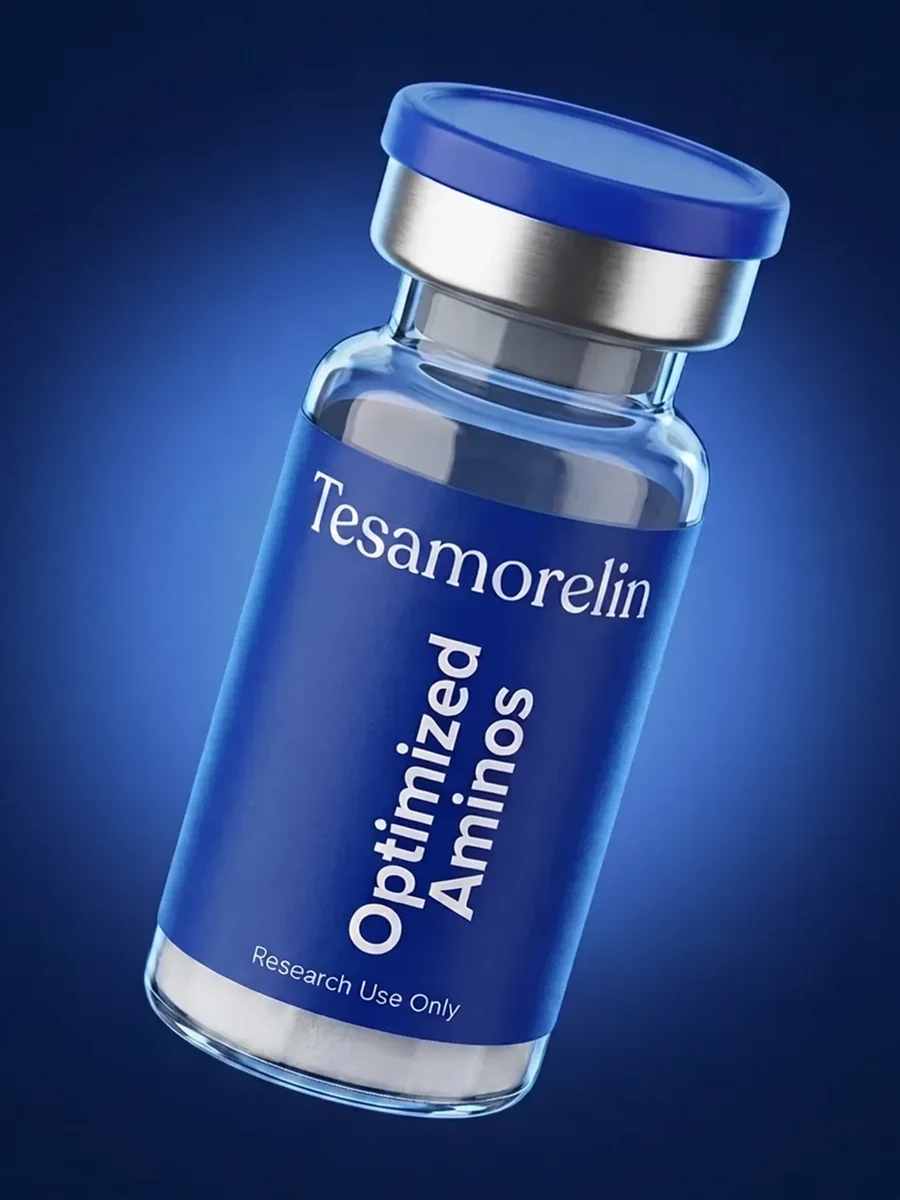
Tesamorelin preserves the full 44-amino-acid GHRH sequence. The engineering sits at the very front of the molecule: a trans-3-hexenoic acid group, a fatty-acid-like moiety, is covalently attached to the N-terminus.
Why that group changes the stability profile
The principal enzyme reported to degrade GHRH is dipeptidyl peptidase-IV (DPP-IV), which recognises specific amino-acid arrangements at the N-terminus. The trans-3-hexenoyl group functions as a steric shield:
- Enzyme blocking — DPP-IV cannot engage the modified N-terminus.
- Prolonged circulation — the shielded peptide persists measurably longer in the systems in which it has been characterised.
- Serum-protein binding — the added hydrophobic character improves albumin binding, further extending the window over which the intact molecule can be detected.
Half-life comparison
Approximate reported plasma half-lives for three GHRH-family molecules:
| Molecule | Approx. half-life | Relative stability |
|---|---|---|
| Endogenous GHRH(1-44) | 1–2 minutes | Very low |
| Sermorelin (GHRH 1-29) | ~10–20 minutes | Moderate |
| Tesamorelin | ~60 minutes | High |
For background on why this number shapes how a compound can be studied at all, see our explanation of peptide half-life in research solutions.
Tesamorelin versus sermorelin
Sermorelin is a truncated GHRH analogue: the first 29 amino acids, which is the minimum fragment reported to activate the pituitary receptor. It lacks the N-terminal shield, so DPP-IV cleaves it comparatively quickly. Tesamorelin retains the full sequence and the N-terminal modification — a structural difference, not a difference in kind. Our tesamorelin versus sermorelin comparison covers how the two are treated in the published literature side by side.
What the modification means at the bench
- Assay windows. A ~60-minute half-life and a ~2-minute half-life demand completely different sampling schedules; protocols written for native GHRH do not transfer.
- Analytical handling. The added hydrophobic moiety changes chromatographic behaviour, which matters when reading an HPLC trace for identity and purity.
- Analogue selection. Where metabolic stability is the variable under study, the trans-3-hexenoyl modification is the reason tesamorelin rather than native GHRH appears in the literature.
Handling and storage notes
- Storage: lyophilized tesamorelin acetate is kept out of direct light and refrigerated prior to reconstitution.
- Reconstitution: reconstitute with bacteriostatic water, swirling rather than shaking — peptide solutions are shear-sensitive and aggregation confounds downstream analysis. The mg-to-mL arithmetic for a 10mg vial is worked through in our tesamorelin reconstitution guide.
- Verification: confirm identity and purity against the certificate for the material in hand before beginning work — third-party testing records are published in our COA archive.
Conclusion
Tesamorelin illustrates how one N-terminal modification converts a sequence that is cleared in about two minutes into one that survives an hour of characterisation. That is a chemistry result about stability, and it is the whole of what the structural literature establishes.
For laboratory and research use only. Not for human consumption. Nothing here is intended for human or animal use. All materials referenced are supplied strictly for in-vitro and other controlled preclinical research by qualified professionals and are third-party tested for identity and purity.
Related research compounds
Compounds referenced in this article, available as research-grade lyophilized peptides with third-party tested COA.