Research Blog
CJC-1295 (No DAC) + Ipamorelin Reconstitution: Concentration Math for a Dual-Peptide Vial
Published
How to calculate mg-per-mL for a combined 5mg CJC-1295 (no DAC) + 5mg Ipamorelin vial, why a dual-peptide vial changes the arithmetic, and how to read the result on a U-100 syringe.
For laboratory and research use only. Not for human consumption.
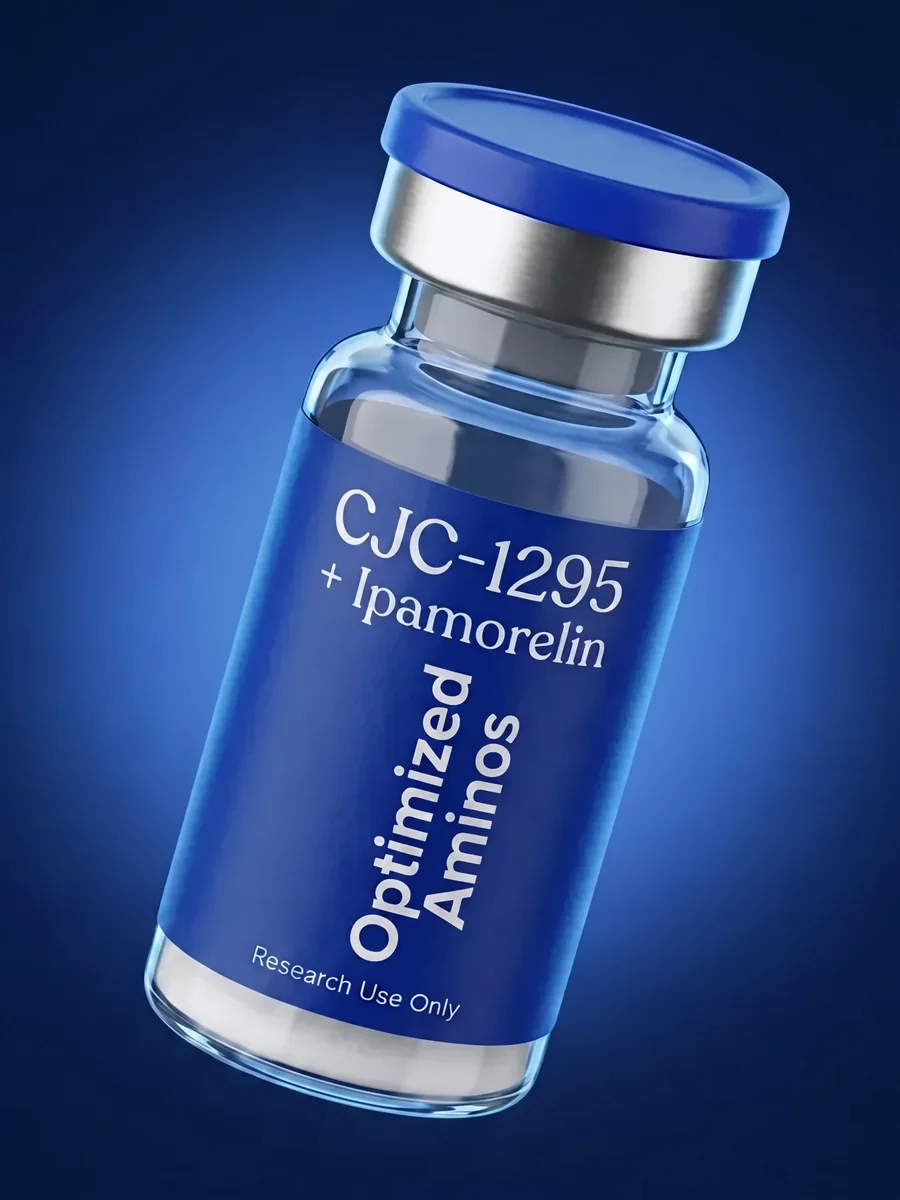
A combined CJC-1295 (no DAC) + Ipamorelin vial is one of the few research products that contains two distinct peptides lyophilised together. That single fact changes the reconstitution arithmetic in a way that catches people out: the number written on the label is not the number you divide by.
Why a Dual-Peptide Vial Is Different
A single-compound vial is simple. A 10mg vial of one peptide reconstituted with 2 mL of bacteriostatic water gives 5 mg/mL of that peptide, and every measured volume contains only that compound.
A dual-peptide vial holds two masses in one cake. A 5mg + 5mg presentation is 10mg of total peptide mass, but it is not 10mg of either compound. When you reconstitute it, you are producing two concentrations simultaneously in the same solution, and they move together — you cannot change one without changing the other.
This is the single most common arithmetic error with blends: treating the combined mass as though it belonged to one compound, which overstates each individual concentration by a factor of two.
The Core Formula
The base relationship is unchanged from any other reconstitution:
Concentration (mg/mL) = peptide mass (mg) ÷ diluent volume (mL)
For a dual-peptide vial you apply it twice — once per compound — using each compound''s own mass, not the total:
- CJC-1295 concentration = 5mg ÷ diluent volume
- Ipamorelin concentration = 5mg ÷ diluent volume
Because both masses are equal in this presentation, the two concentrations are always equal to each other, and each is exactly half the combined figure.
Worked Values for a 5mg + 5mg Vial
| Bacteriostatic water added | Total peptide | CJC-1295 | Ipamorelin | Per 0.1 mL |
|---|---|---|---|---|
| 1 mL | 10 mg/mL | 5 mg/mL | 5 mg/mL | 500 mcg + 500 mcg |
| 2 mL | 5 mg/mL | 2.5 mg/mL | 2.5 mg/mL | 250 mcg + 250 mcg |
| 3 mL | 3.33 mg/mL | 1.67 mg/mL | 1.67 mg/mL | 167 mcg + 167 mcg |
| 5 mL | 2 mg/mL | 1 mg/mL | 1 mg/mL | 100 mcg + 100 mcg |
Note the pattern in the final column: whatever volume you draw, it contains equal masses of both peptides. There is no reconstitution volume that changes their ratio. If a protocol calls for a different ratio between the two compounds, a combined vial cannot produce it — that requires separate vials, which is how the GH Stack research kit is constructed.
Reading the Result as a Working Volume
Most measurement error in peptide work happens at this step, because insulin syringes are graduated in units rather than millilitres. On a U-100 syringe:
- 1 mL = 1,000 µL
- 0.1 mL = 100 µL
- 0.01 mL = 10 µL
So at a 2 mL reconstitution, each unit on the barrel corresponds to 25 mcg of CJC-1295 and 25 mcg of Ipamorelin. At a 5 mL reconstitution, the same one-unit graduation corresponds to 10 mcg of each. The syringe has not changed; the solution behind it has.
This is why the reconstitution volume is worth recording alongside the vial. A syringe marking is meaningless without knowing what concentration it is measuring, and a vial reconstituted weeks earlier tells you nothing on its own.
Choosing a Reconstitution Volume
There is no chemically correct volume — the peptide mass is fixed, so the choice is entirely about measurement resolution and handling convenience. Two practical considerations apply.
Resolution. A larger diluent volume spreads the same mass across more graduations, so small differences become easier to measure accurately. Very concentrated solutions push the target volume down to two or three units, where the relative error of a single unit is large.
Vial capacity and stability. The physical vial limits total volume, and reconstituted peptide in solution is less stable than lyophilised powder. A volume that will not be consumed within the solution''s useful window means holding material in its least stable form for longer than necessary. Our IGF-1 LR3 reconstitution walkthrough covers the same trade-off for a single-compound vial.
Checking Your Own Arithmetic
A quick way to verify any reconstitution result: multiply the concentration back by the total volume and confirm you recover the label mass. If 2.5 mg/mL × 2 mL returns 5mg of CJC-1295, the figure is internally consistent. If it returns 10mg, the combined mass has been applied to a single compound — the error described at the top of this article.
Our peptide reconstitution calculator performs the same arithmetic and is a useful cross-check against a hand calculation, particularly for the unit conversions where transcription mistakes are easy to make.
Why These Two Compounds Appear Together
The pairing is not arbitrary. CJC-1295 (no DAC) and Ipamorelin act on different receptors in growth-hormone-axis literature, which is why published discussions of one frequently reference the other. We cover that mechanistic background separately in why CJC-1295 and Ipamorelin are almost always discussed together. This article is concerned only with the measurement side.
Frequently Asked Questions
Is a 5mg + 5mg vial the same as a 10mg vial?
No. It contains 10mg of total peptide mass but only 5mg of each compound. Dividing 10mg by your diluent volume gives the combined concentration, not the concentration of either individual peptide.
Can I reconstitute the two peptides to different concentrations?
Not from a combined vial. Both compounds are lyophilised in the same cake and dissolve into the same solution, so their concentrations are locked to the same diluent volume. Independent concentrations require separately packaged vials.
What diluent is used for reconstitution?
Bacteriostatic water is the standard laboratory diluent for lyophilised research peptides. It differs from sterile water in that it contains a preservative, which is why it is used where a vial will be accessed more than once.
How do I convert milligrams to micrograms?
Multiply by 1,000. A concentration of 2.5 mg/mL is 2,500 mcg/mL, so a 0.1 mL volume contains 250 mcg. Research literature on these compounds is usually written in micrograms, while vial labels are in milligrams, so this conversion comes up constantly.
Does the reconstitution volume change how much peptide is in the vial?
No. The mass is fixed at manufacture and lyophilisation. Diluent volume changes only the concentration — how that fixed mass is distributed through the solution, and therefore what volume you measure to obtain a given mass.
Reviewed by the Optimized Aminos research team — last updated 18 August 2026.
For laboratory and research use only. Not for human consumption.
Related research compounds
Compounds referenced in this article, available as research-grade lyophilized peptides with third-party tested COA.