Research Blog
KLOW Blend Reconstitution: mg-to-mL Concentration Math for a Multi-Peptide Vial
Published
How to calculate total and per-component concentration for the KLOW multi-peptide blend vial, and why the COA — not the label — is the source of truth.
For laboratory and research use only. Not for human consumption.
KLOW-style blends combine more than one peptide into a single lyophilized vial, and that changes how the reconstitution math works compared to a single-compound vial. Our breakdown of what's actually in a Klow blend covers the individual components; this article covers the arithmetic side — how to calculate total concentration for a multi-peptide vial, why per-component concentration is different from total concentration, and how to read a blend's Certificate of Analysis before doing the math.
Total Mass vs. Per-Component Mass
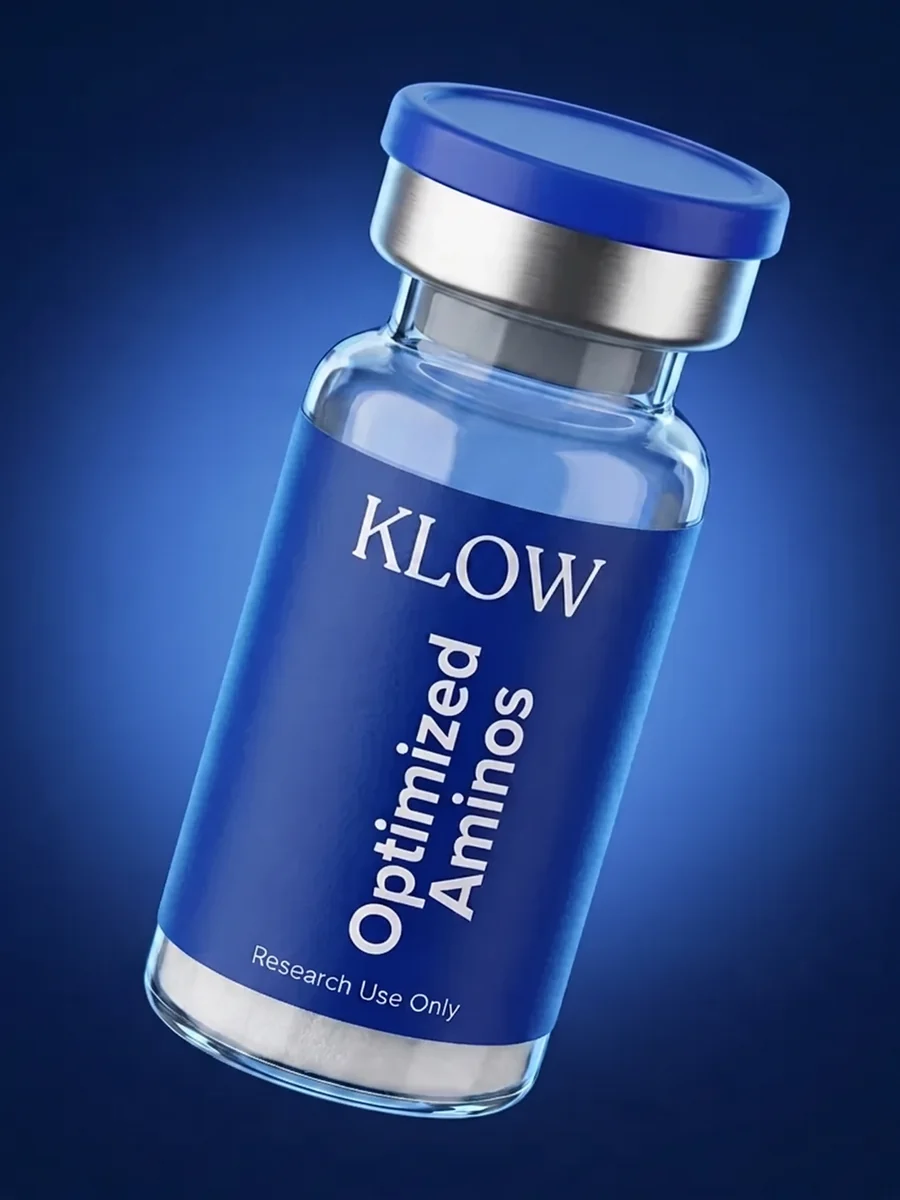
A single-peptide vial labeled "10 mg" means 10 mg of one compound. A blended vial labeled with a combined mass — such as our KLOW 80mg research blend — means the labeled figure is the sum of multiple peptides freeze-dried together in the same vial, not the mass of any single one. Before doing any concentration math on a blend, the first step is separating "total labeled mass" from "mass of the specific peptide a protocol needs to measure."
Why the COA Matters More for Blends Than Single Compounds
For a single-peptide vial, the label mass and the researched compound are the same number. For a blend, the label mass has to be cross-referenced against the Certificate of Analysis to find the individual component masses, because different suppliers formulate blends with different ratios even when the total labeled mass is identical. A legitimate blend COA lists each peptide by name with its own per-vial mass and its own LC-MS identity confirmation — without that breakdown, it is not possible to calculate an accurate per-component concentration, only a total-solution concentration.
Calculating Total Solution Concentration
Total concentration follows the same formula used for any lyophilized vial:
Total concentration (mg/mL) = Total labeled peptide mass (mg) ÷ Diluent volume added (mL)
| Diluent added | Total solution concentration |
|---|---|
| 1 mL | 80 mg/mL |
| 2 mL | 40 mg/mL |
| 4 mL | 20 mg/mL |
This tells a researcher how much total peptide mass is in each mL of reconstituted solution — useful for tracking overall vial depletion, but it does not by itself say how much of any single component is present in a given draw.
Calculating Per-Component Concentration
To find an individual peptide's concentration within the same reconstituted volume, apply the same formula using only that component's mass from the COA, divided by the same diluent volume used for the whole vial. If a blend's COA lists, for example, a GHK-Cu fraction and a TB-500 fraction as separate masses, each fraction is divided by the total diluent volume independently — both components share the same solution volume, so the diluent figure in the denominator does not change between the two calculations, only the numerator (the component's own mass) does.
Why Blend Ratios Cannot Be Adjusted After Reconstitution
Because a blend is freeze-dried as a fixed mixture, reconstitution changes the total volume and therefore the concentration of every component proportionally — it cannot change the ratio between components. A researcher who needs to titrate one peptide independently of another is working with the wrong format; that use case calls for separately reconstituting single-compound vials rather than a pre-mixed blend.
Storage After Reconstitution
The KLOW blend vial is supplied lyophilized in a sealed sterile vial and specified for storage at 2-8°C, protected from moisture, prior to reconstitution. As with any multi-peptide solution, once reconstituted it should be stored refrigerated, used within the window appropriate to bacteriostatic-water-based solutions, and labeled with a preparation date so total-mass depletion can be tracked across withdrawals.
Sanity-Checking the Math Against the Label
Once a total concentration figure is calculated, it is worth checking it against the vial label as a sanity check before moving on to per-component work. If the label states an 80 mg combined mass and the COA's individual component masses do not sum to that figure, the discrepancy should be resolved — by contacting the supplier for clarification or defaulting to the COA's individual figures rather than the label total — before those numbers are used in any downstream calculation. Treating the COA as the authoritative source for per-component data, rather than the marketing label, is the safer default whenever the two disagree.
Frequently Asked Questions
Does a blend's labeled mass refer to one peptide or the combined total?
For a multi-peptide blend, the labeled mass on the vial is the combined total of every peptide freeze-dried together, not the mass of any single component. The per-component breakdown has to come from the Certificate of Analysis.
How is per-component concentration different from total concentration?
Total concentration is the entire labeled mass divided by diluent volume. Per-component concentration uses only that single peptide's mass (from the COA) divided by the same diluent volume — both numbers describe the same reconstituted solution, but answer different questions.
Can the ratio between peptides in a blend be changed by adding more or less diluent?
No. Diluent volume changes the concentration of every component proportionally but cannot change the fixed ratio the peptides were freeze-dried in. Adjusting individual peptide ratios requires reconstituting separate single-compound vials instead.
What should a blend's Certificate of Analysis include?
Each peptide should be listed by name with its own per-vial mass and LC-MS identity confirmation, along with third-party HPLC purity per component and an endotoxin result. A blend COA that only reports a single combined purity number without a per-component breakdown does not provide enough information to calculate individual concentrations.
Is the reconstitution formula different for a blend than for a single peptide?
The underlying formula (mass divided by volume) is identical. The difference is that a blend requires running the calculation once for the total labeled mass and again, separately, for each individual component's mass from the COA.
What should a researcher do if the COA's component masses don't add up to the vial's labeled total?
Treat the individual component masses on the COA as authoritative for any per-component concentration calculation, flag the discrepancy with the supplier, and avoid relying on the label's combined figure until the mismatch is resolved.
Reviewed by the Optimized Aminos research team — last updated August 13, 2026.
References
- Pickart L, Margolina A. "Regenerative and Protective Actions of the Gly-His-Lys (GHK) Peptide in the Light of the New Gene Data." Int J Mol Sci. 2018;19(7):1987. pubmed.ncbi.nlm.nih.gov/29986520
- Goldstein AL, Hannappel E, Kleinman HK. "Thymosin beta4: actin-sequestering protein moonlights to repair injured tissues." Trends Mol Med. 2005;11(10):421-429. pubmed.ncbi.nlm.nih.gov/15709904
See also our BPC-157 reconstitution concentration-math guide for the single-compound version of this calculation, and our component-by-component breakdown of Klow-style blends. The KLOW blend referenced throughout is available on our KLOW 80mg product page.
For laboratory and research use only. Not for human consumption.
Run the numbers for your own vial
The reconstitution calculator takes a labeled vial mass and a solvent volume and returns the resulting concentration in mg/mL, along with the aliquot volume in microlitres for any target mass — the same arithmetic worked through above, without the decimal-place risk of doing it from memory. Bacteriostatic water (10 mL) is the diluent used in these worked examples, and every compound referenced here is third-party tested with a published COA.
Related research compounds
Compounds referenced in this article, available as research-grade lyophilized peptides with third-party tested COA.