Research Blog
What's Actually in a Klow Blend: Breaking Down the Individual Peptide Components
Published
A component-by-component breakdown of the peptides typically found in Klow-style research blends — GHK-Cu, BPC-157, TB-500, and supplier-dependent additions — with links to the individual research pages.
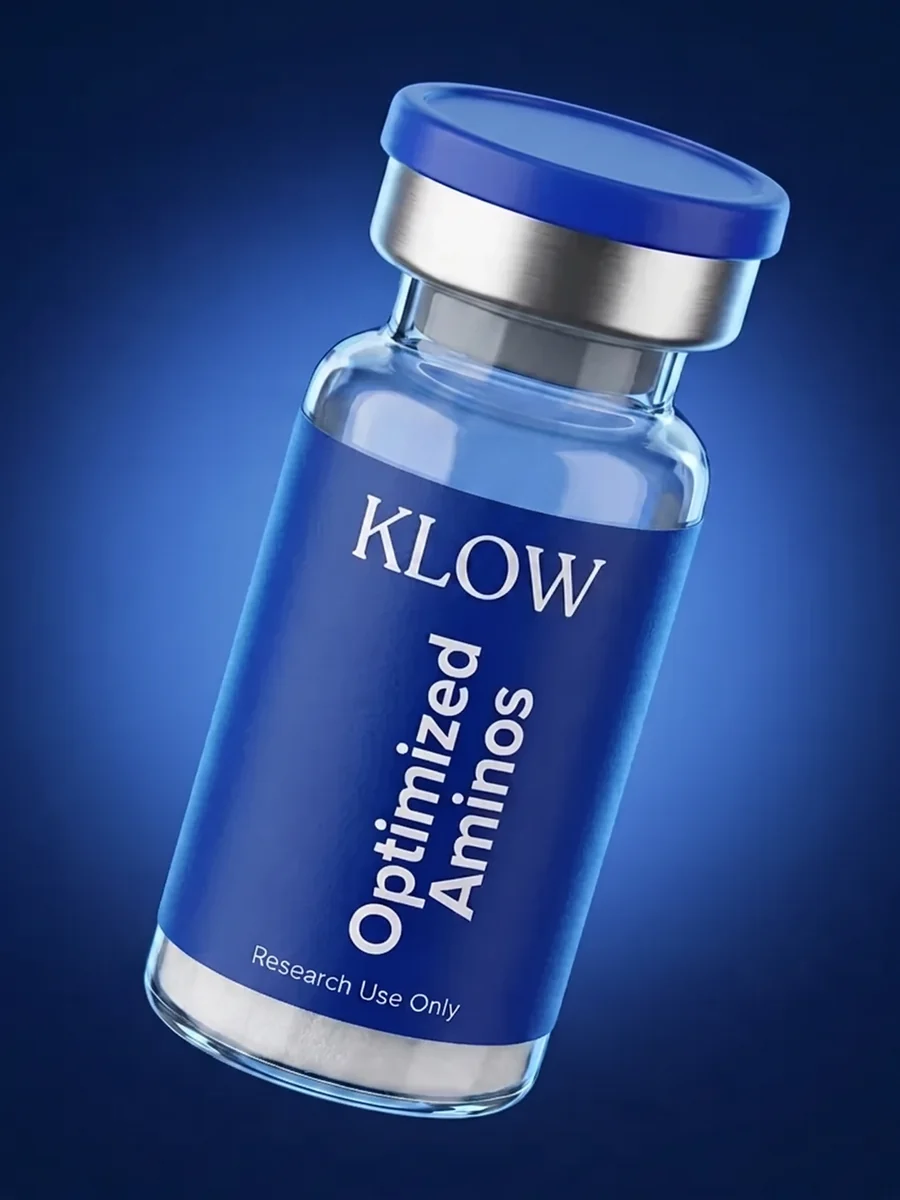
"Klow" blends are one of the most-searched multi-peptide reference formulations in the research-peptide space. Because the exact composition is supplier-dependent, understanding what is actually in a Klow blend — component by component — is the only way to make sense of the research literature attached to each piece.
This article breaks down the individual peptides that most commonly appear in a Klow-style research blend and links each one to its own mechanism-level research page.
The core trio
1. GHK-Cu — the copper-tripeptide component
GHK-Cu (Glycyl-L-Histidyl-L-Lysine complexed with copper II) is the naturally occurring tripeptide that most Klow-style blends are built around. In in-vitro research it has been characterised for its role in collagen and elastin gene upregulation, dermal-fibroblast signalling, and antioxidant activity through its copper-binding coordination chemistry.
Molecular signature: sequence Gly-His-Lys, formula C14H24N6O4Cu, molecular weight ~387.9 g/mol. The copper(II) ion is coordinated by four donor atoms — two nitrogen donors from the histidine imidazole ring, one from the lysine amine, and one oxygen from the deprotonated carboxylate — which is what makes the complex biologically active in dermal repair-pathway studies.
2. BPC-157 — the tissue-repair signalling component
BPC-157 (Body Protection Compound 157) is a 15-amino-acid partial sequence derived from a gastric protein. In in-vitro and animal models it has been studied for angiogenesis induction, upregulation of growth-hormone receptor expression, and effects on tendon, ligament and gut epithelial repair pathways. It is included in Klow-style blends as the deep-tissue repair-signalling component, complementing GHK-Cu's dermal-structural role.
3. TB-500 — the cellular-migration component
TB-500 is a synthetic fragment corresponding to a bioactive region of Thymosin Beta-4. Its documented research focus is actin-binding and cellular migration, which is why it is often paired with GHK-Cu (structural remodelling) and BPC-157 (angiogenic signalling) in multi-peptide blends.
Supplier-dependent additions
Beyond the core trio, Klow-style research blends frequently include one or more of the following:
- CJC-1295 (no-DAC) + Ipamorelin — a GHRH/GHRP pair used together in growth-hormone-axis research to trigger pulsatile GH release. See our full breakdown in CJC-1295 With DAC vs. Without DAC: The Half-Life Difference Explained.
- Selank — a heptapeptide studied for mood, anxiety, and cognitive-pathway research.
- Epitalon (Epithalon) — an ultra-short bioregulator peptide studied for telomere and pineal-gland pathway research.
- PEG-MGF — pegylated mechano-growth-factor variant with an extended half-life.
Any of these can appear on a supplier's Certificate of Analysis for a "peptide blend" product. Always match the label to the batch-specific COA.
Why the blend format exists at all
Rather than reconstituting five separate vials, a blended reference sample lets a lab study synergy across pathways in a single preparation — dermal + repair + regenerative signalling in one vial. The tradeoff is precision: fixed ratios mean you cannot titrate individual components independently.
Reading a Klow-blend COA
A legitimate blend COA should list each peptide by name, its per-vial mass, and the LC-MS confirmation for each component. Look for:
- Third-party HPLC purity at 98% or higher, per component.
- LC-MS identity confirmation matching the expected mass of each peptide.
- Endotoxin below 1.0 EU/mg.
- Salt form disclosed (acetate is preferred over TFA salts).
If a supplier ships a "blend" without a per-component breakdown, treat it as an unknown mixture — not a research-grade reference material.
Research use only
Every compound described here is offered strictly for in-vitro laboratory research and educational study. None of the descriptions above constitute therapeutic, dietary, or clinical guidance.
For laboratory and research use only. Not for human consumption.
Related research compounds
Compounds referenced in this article, available as research-grade lyophilized peptides with third-party tested COA.