Research Blog
PT-141 and Melanotan II: What Receptor-Pathway Research Has Measured
Published
Mechanism-level reporting on PT-141 (bremelanotide) and Melanotan II — melanocortin receptor selectivity, cAMP cascade activation, and the pharmacological differences that separate them.
For laboratory research use only. This article is a mechanism-level summary of publicly available receptor-pharmacology literature, provided for reference. It is not medical, veterinary, or dosing guidance and makes no health, therapeutic, or outcome claims. These materials are intended for qualified researchers handling compounds in controlled laboratory settings.
PT-141 (bremelanotide) and Melanotan II (MT-II) are two of the most heavily studied synthetic melanocortin-receptor agonists. Both were engineered from the same biological precursor — alpha-MSH — but small structural changes give them very different receptor-pathway profiles. This article is a mechanism-level summary of what receptor-pathway research has actually measured for the two compounds.
The melanocortin system in one paragraph
The melanocortin receptors (MC1R–MC5R) are a family of five G-protein-coupled receptors. MC1R sits on melanocytes and drives pigmentation. MC2R is adrenal and binds ACTH exclusively. MC3R and MC4R are predominantly CNS and mediate energy-homeostasis and feeding-behaviour pathways, and (through MC4R–oxytocin signalling in the paraventricular nucleus) arousal-related neural circuits. MC5R is exocrine, tied to sebum and thermoregulation.
Endogenous alpha-MSH is cleaved from a POMC precursor and activates MC1R, MC3R, MC4R, and MC5R — but has a half-life measured in minutes, which is why synthetic analogues were developed. For background on why half-life shapes how a compound is studied, see our explanation of peptide half-life in research solutions.
Melanotan II — non-selective, broad-spectrum
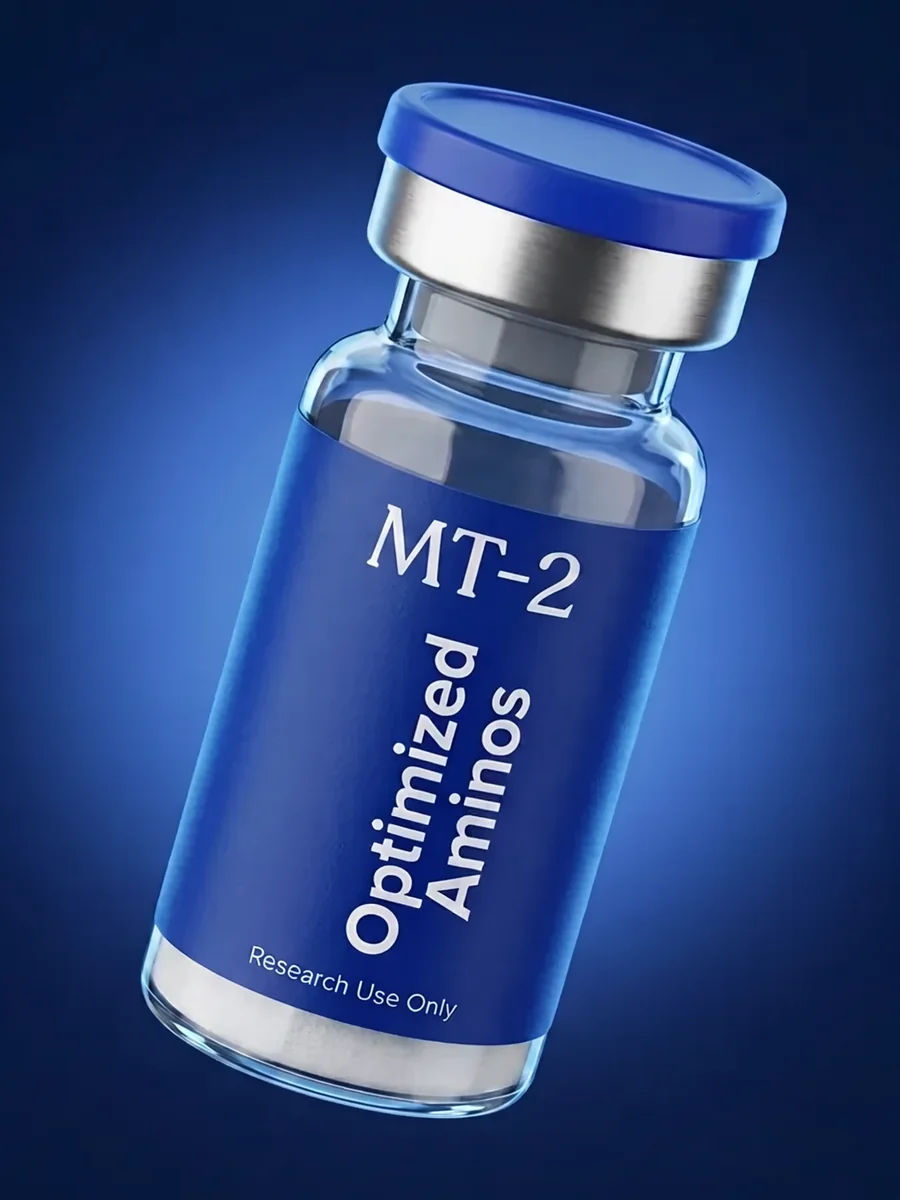
MT-II is a cyclic lactam analogue of alpha-MSH originally developed at the University of Arizona in the 1980s. In receptor-binding assays it binds with high affinity to MC1R, MC3R, MC4R, and MC5R — i.e. it is a non-selective melanocortin-receptor agonist.
At MC1R, MT-II drives the canonical melanogenesis cascade: receptor binding → Gαs activation → adenylate cyclase → elevated cAMP → PKA-mediated phosphorylation of CREB → transcription of MITF, tyrosinase, TRP-1 and TRP-2. The downstream shift is from pheomelanin to eumelanin production.
Because MT-II is small, cyclic, and moderately lipophilic, it crosses the blood-brain barrier and secondarily activates central MC3R/MC4R — which is why research on MT-II consistently notes off-target activity in appetite-regulation and arousal pathways alongside the pigmentation-pathway primary endpoint.
PT-141 — MC4R-selective, CNS-directed
PT-141 (bremelanotide) is a metabolite of MT-II with the C-terminal amide removed. That single structural change dramatically shifts the receptor-affinity profile toward the MC3R/MC4R axis and away from MC1R.
The characterised mechanism proceeds through the paraventricular nucleus of the hypothalamus: PT-141 crosses the blood-brain barrier, binds MC4R on hypothalamic neurons, triggers oxytocinergic activation, and downstream signalling projects to the lumbosacral spinal cord where it modulates autonomic tone. This MC4R–oxytocin circuit is the pathway most emphasized in the published PT-141 receptor literature.
Relative binding affinity — side by side
Reported approximate relative binding affinity (as a percent of maximum):
| Receptor | Melanotan II | PT-141 |
|---|---|---|
| MC1R | 100 | 2 |
| MC2R | 15 | 1 |
| MC3R | 25 | 80 |
| MC4R | 35 | 15 |
The takeaway: MT-II is a broad-spectrum melanocortin agonist with a strong MC1R (pigmentation) pull and secondary CNS activity. PT-141 is CNS-directed and MC3R-heavy, with minimal MC1R engagement.
Design implications for in-vitro study
- Route matters. PT-141''s mechanism requires BBB crossing, and different reconstitution and delivery routes produce different pharmacokinetic profiles in model systems.
- Off-target effects. MT-II''s MC5R activity affects sebum-pathway readouts; MC3R/MC4R activation confounds appetite and blood-pressure endpoints.
- Comparator selection. Comparing PT-141 to other pathway agonists in animal models requires accounting for CNS-mediated versus vascular-mediated pathways — they are not the same mechanism of action.
Handling and verification for research
Both compounds ship as lyophilized powder and are reconstituted before use with a fluid such as bacteriostatic water; our guide on how much bacteriostatic water to add during reconstitution applies directly. As with any research peptide, confirm identity and purity against a batch certificate before beginning work — you can review third-party testing records in our COA archive and check what a trustworthy certificate should contain in how to spot a fake peptide COA.
For laboratory research use only. Nothing here is intended for human or animal use. All materials referenced are supplied strictly for in-vitro and other controlled preclinical research by qualified professionals and are third-party tested for identity and purity. Every statement above is mechanism-level reporting drawn from published in-vitro and receptor-binding research, and asserts no health, therapeutic, or performance outcome.
For laboratory and research use only. Not for human consumption.
Related research compounds
Compounds referenced in this article, available as research-grade lyophilized peptides with third-party tested COA.