Research Blog
How Much Bacteriostatic Water to Add: Peptide Reconstitution Ratios and mg/mL Chart
Published
How much bacteriostatic water to add to a peptide vial: the mg/mL formula both ways, plus a concentration chart for every vial size, from 1 mg to 40 mg.
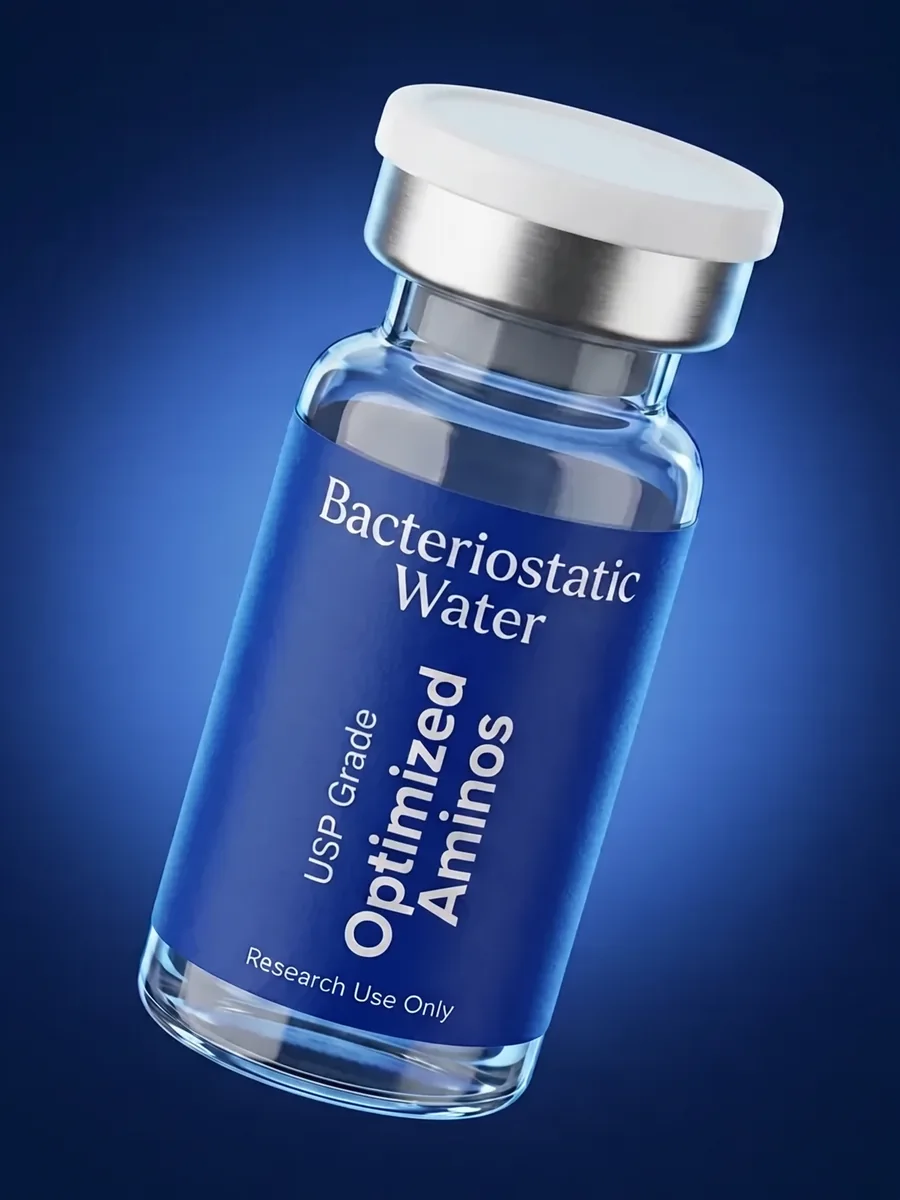
For laboratory research use only. This article covers reconstitution volume and concentration arithmetic for in-vitro laboratory handling. It is not medical or veterinary guidance and contains no dosing or human-use information.
There is no single correct amount of bacteriostatic water to add to a peptide vial. The volume you add sets the concentration, using one formula: concentration (mg/mL) = vial mass (mg) ÷ volume added (mL). A 10 mg vial with 2 mL of water gives 5 mg/mL; the same vial with 1 mL gives 10 mg/mL. Decide the concentration your work needs, divide the vial mass by it to get the volume, and record what you did. The chart below works that out for every vial size sold on this site.
The formula, both ways round
Concentration (mg/mL) = peptide mass in the vial (mg) ÷ volume of diluent (mL)
Volume to add (mL) = peptide mass in the vial (mg) ÷ target concentration (mg/mL)
The total mass of peptide in the vial never changes. Adding more liquid only spreads the same mass through a larger volume, lowering the concentration. To reach 2 mg/mL from a 10 mg vial: 10 ÷ 2 = 5 mL. To find the concentration of a 5 mg vial given 2 mL: 5 ÷ 2 = 2.5 mg/mL.
Prefer not to do the division by hand? The peptide reconstitution calculator takes the vial mass and either a volume or a target concentration and returns the other.
mg/mL chart by vial size
Concentrations below are the direct output of the formula, rounded to two decimals. Vial sizes are the ones sold on this site.
| Vial | + 1 mL | + 2 mL | + 3 mL |
|---|---|---|---|
| IGF-1 LR3 1 mg | 1 mg/mL | 0.5 mg/mL | 0.33 mg/mL |
| BPC-157 10 mg, Selank 10 mg, Semax 10 mg, DSIP 10 mg, Tesamorelin 10 mg, MT-2 10 mg, MOTS-c 10 mg, GLP-3 RT 10 mg | 10 mg/mL | 5 mg/mL | 3.33 mg/mL |
| GLP2-TR 20 mg, GLP-3 RT 20 mg | 20 mg/mL | 10 mg/mL | 6.67 mg/mL |
| GLP-3 RT 30 mg | 30 mg/mL | 15 mg/mL | 10 mg/mL |
| MOTS-c 40 mg | 40 mg/mL | 20 mg/mL | 13.33 mg/mL |
| CJC-1295 no DAC 5 mg + Ipamorelin 5 mg (each component) | 5 mg/mL | 2.5 mg/mL | 1.67 mg/mL |
Blends. In a blend vial, each component has its own concentration: divide that component's mass, not the combined total, by the volume. 2 mL in the CJC-1295 + Ipamorelin vial gives 2.5 mg/mL of each.
High-mass vials. GHK-Cu 100 mg and NAD+ 500 mg and 1000 mg hold far more material than a small peptide vial. The formula is the same, but 1–3 mL would give concentrations that may exceed what the compound will dissolve at, so check solubility and the vial's fill capacity first, and use the calculator for larger volumes.
Solvent. IGF-1 LR3 and MOTS-c do not fully dissolve in plain bacteriostatic water and are usually reconstituted with an acetic acid solution. The arithmetic does not change with the solvent.
How to choose a volume
Three practical constraints decide it.
- Round numbers. 1, 2 or 5 mg/mL is easy to reason about and hard to mis-transcribe; 4.37 mg/mL invites mistakes. Pick a volume that lands on a tidy figure.
- Measuring precision. Concentration and transfer volume move in opposite directions. A more dilute stock means larger, easier-to-measure transfers for the same mass of peptide; a concentrated stock means small transfers, where each graduation you misread is a larger share of the total.
- Vial capacity. A standard 3 mL peptide vial will not accept 5 mL of liquid, which caps how dilute a single-vial stock can be. If you need a lower concentration, prepare a modest stock and make a serial dilution in a separate labelled container instead of overfilling the original.
A mid-range concentration such as 5 mg/mL is a sensible default for most bench work. Very dilute stocks are not safer or better; they trade concentration for volume, and a larger volume can outlast the solution's usable window in the fridge.
Which diluent
Bacteriostatic water contains 0.9% benzyl alcohol, which suppresses microbial growth and is what allows a refrigerated vial to be entered more than once over days or weeks. Plain sterile water has no preservative and suits a solution used the same day. The volume decision and the diluent decision are separate: see bacteriostatic versus sterile water for research use for that trade-off.
Adding the water without damaging the peptide
Whatever the volume, add it slowly down the inside wall of the vial rather than onto the powder, then let the vial stand and swirl gently until clear. Never shake it. The full procedure is in our step-by-step reconstitution guide.
Record the volume you chose
Because one vial can become many different concentrations, the volume is data. A label reading "10 mg + 2 mL = 5 mg/mL, reconstituted 2026-09-17" removes all ambiguity for anyone who later works from that vial. Where a product has a published certificate in the COA archive, note its batch alongside: the certificate records the measured amount of peptide in the tested vial, which can differ from the labelled amount.
Frequently Asked Questions
How much bacteriostatic water do I add to a 10 mg vial?
Whatever gives the concentration your work needs: 1 mL gives 10 mg/mL, 2 mL gives 5 mg/mL, and 3 mL gives 3.33 mg/mL. 2 mL is a common choice because it lands on a round 5 mg/mL.
Does adding more water weaken the peptide?
No. The total mass of peptide in the vial is the same; more liquid spreads it through a larger volume, so each millilitre holds less. The molecule itself is unchanged.
Is the chart specific to one peptide?
No. The formula applies to any lyophilized vial. What differs between compounds is the solvent they need and how concentrated a solution they will form, not the arithmetic.
Further reading
- How to reconstitute research peptides: the full bench procedure.
- Peptide reconstitution calculator: any vial mass, any volume.
- How to store research peptides: keeping a reconstituted solution usable.
For laboratory and research use only. Not for human or animal consumption.
Related research compounds
Compounds referenced in this article, available as research-grade lyophilized peptides with third-party tested COA.