Research Blog
Bacteriostatic vs Sterile Water: Which Reconstitution Fluid for Which Research Use
Published
Bacteriostatic and sterile water differ by a single ingredient. Here is which reconstitution fluid fits which peptide-research workflow, and why.
For laboratory research use only. This article describes laboratory handling of reconstitution fluids for in-vitro research. It contains no dosing, human-use, veterinary, or clinical guidance and makes no health or benefit claims.
Two clear fluids that are not interchangeable
On a research bench, two small vials of clear liquid can look identical: bacteriostatic water and sterile water. They are not the same reagent, and choosing the wrong one can compromise a reconstituted peptide stock long before any assay begins. Understanding the difference is one of the first things a new researcher should get right, because the fluid you dissolve a lyophilized peptide into becomes part of the experimental system for as long as that solution is in use.
The short version: sterile water contains nothing but purified, sterilized water. Bacteriostatic water is sterile water with a small amount of a bacteriostatic agent added — most commonly 0.9% benzyl alcohol. That single additive is the entire practical distinction, and it drives when each fluid is the appropriate choice.
What "bacteriostatic" actually means
The prefix is precise. A bactericidal agent kills bacteria; a bacteriostatic agent inhibits their growth without necessarily killing them. Benzyl alcohol at 0.9% is bacteriostatic: it suppresses microbial proliferation in a multi-use container, which is why bacteriostatic water is the standard choice when a reconstituted stock will be sampled repeatedly over days or weeks. Each time a container is opened and drawn from, there is an opportunity for contamination. The bacteriostatic agent is what makes a multi-draw workflow viable in a research setting.
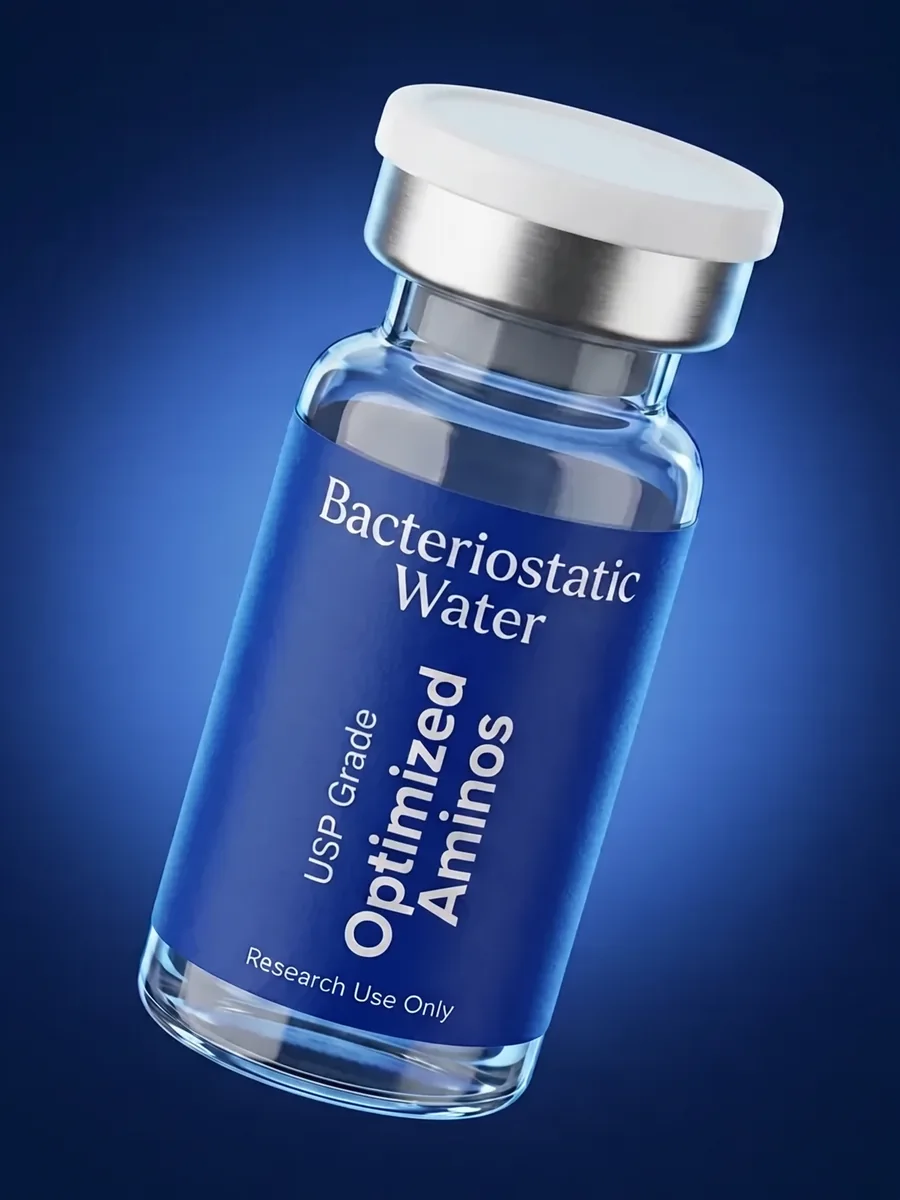
Sterile water carries no such protection. Once its seal is broken, it offers no ongoing resistance to microbial growth, which makes it best suited to single-use scenarios where the entire volume is consumed at once. For anyone building multi-day peptide stocks, bacteriostatic water — such as our 10 mL bacteriostatic water for research reconstitution — is the more common bench choice for exactly this reason.
Why the additive matters for peptide stocks
Reconstituting a lyophilized research peptide is not a one-and-done event. Many laboratory workflows draw small aliquots from a single reconstituted vial across an extended series of experiments. A fluid that resists bacterial growth over that window helps keep the stock's composition stable and the downstream data clean. This is why so much peptide-handling literature defaults to bacteriostatic water for compounds that ship as powder, including widely studied peptides like BPC-157 and GHK-Cu.
There is a compatibility caveat, though. Benzyl alcohol is a small organic molecule, and for a minority of sensitive peptides or specialized assays, researchers may prefer to avoid any additive entirely. In those cases a preservative-free fluid removes a variable from the system. The general framework covered in our guide to reconstituting research peptides walks through how to weigh these trade-offs against the specific compound on the bench.
When sterile (preservative-free) water is the better call
Preservative-free water tends to be preferred when the full reconstituted volume will be used immediately, when an assay is known to be sensitive to benzyl alcohol, or when a protocol specifically calls for a fluid with no additives. Because there is no bacteriostatic agent, any leftover solution is generally not held for extended multi-day sampling the way a bacteriostatic-water stock might be.
When bacteriostatic water is the better call
Bacteriostatic water is generally preferred when a single vial will be sampled multiple times over days or weeks, when the goal is to preserve the integrity of a stock across a longer experimental series, and when the peptide and assay are known to tolerate a trace of benzyl alcohol. For most general-purpose reconstitution of research peptides that arrive as a lyophilized powder, it is the workhorse fluid.
Why peptides arrive dry in the first place
Both of these fluids exist in the workflow because research peptides are shipped as a freeze-dried powder rather than a ready-made solution. Lyophilization removes water to stabilize the peptide for storage and transit, which means the researcher is responsible for adding the fluid back at the bench. We cover the science of that process in our explainer on why research peptides ship as a lyophilized powder. The takeaway for fluid selection is simple: because you are the one reconstituting, you are also the one deciding which water becomes part of the experiment.
Handling and documentation
Whichever fluid a protocol calls for, the same bench discipline applies. Introduce the fluid gently down the side of the vial rather than directly onto the peptide pellet, avoid aggressive agitation, and record the fluid type, volume, and date on the vial and in the lab notebook so that stock concentration is traceable later. Documentation matters because the choice of reconstitution fluid is a real experimental variable — a reviewer or a future you will want to know whether a stock was built with bacteriostatic or preservative-free water.
It is also worth confirming the identity and purity of the peptide itself before reconstitution. Every compound should be accompanied by third-party testing data; you can review the analytical documentation for our catalog in the certificate of analysis archive. Knowing the starting material is verified means that any variability you later observe can be attributed to the experiment rather than to an unknown input.
Bottom line
Bacteriostatic and sterile water differ by a single ingredient — a bacteriostatic agent, usually 0.9% benzyl alcohol — and that ingredient decides the use case. Reach for bacteriostatic water when a reconstituted stock will be sampled repeatedly over time, and for preservative-free sterile water when a protocol needs no additives or the volume is used at once. Match the fluid to the compound and the assay, document the choice, and start from verified, third-party-tested material.
For laboratory research use only. Not for human or veterinary use. The information above describes laboratory reagent handling for in-vitro research and is not medical, clinical, or dosing guidance.
Run the numbers for your own vial
The reconstitution calculator takes a labeled vial mass and a solvent volume and returns the resulting concentration in mg/mL, along with the aliquot volume in microlitres for any target mass — the same arithmetic worked through above, without the decimal-place risk of doing it from memory. Bacteriostatic water (10 mL) is the diluent used in these worked examples, and every compound referenced here is third-party tested with a published COA.
For laboratory and research use only. Not for human consumption.
Related research compounds
Compounds referenced in this article, available as research-grade lyophilized peptides with third-party tested COA.