Research Blog
Lyophilization: Why Research Peptides Ship as a Powder
Published
Why research peptides are supplied as a lyophilized (freeze-dried) powder — how freeze-drying preserves the molecule, what the powder should look like, and the two-state storage rule. Research use only.
For laboratory research use only. This article explains why research peptides are supplied as a freeze-dried powder and what that means for handling. It describes laboratory practice only and contains no dosing, human-use, veterinary, or clinical guidance.
Why your vial arrives as a powder, not a liquid
Open a research peptide vial and you'll find a small amount of dry, often near-invisible powder or a thin film at the bottom — not a ready-to-use solution. That's by design. The powder is lyophilized, or freeze-dried, and it's the single most important reason a peptide can survive shipping and storage without degrading. Understanding lyophilization explains almost everything about how peptides should be handled, stored, and prepared.
What lyophilization actually is
Lyophilization is a drying process that removes water from a frozen sample by sublimation — turning ice directly into vapor under vacuum, without passing through a liquid phase. The peptide is dissolved, frozen solid, then placed under low pressure so the ice evaporates away, leaving behind a dry, porous cake of pure peptide. Because the material never sits warm and wet, the delicate molecular structure is preserved far better than it would be by heat-drying or by shipping it in solution.
Why peptides need it
Peptides are chains of amino acids held together in a specific structure, and in water that structure is vulnerable. Dissolved peptides are exposed to hydrolysis (water slowly breaking bonds), oxidation, aggregation, and microbial growth — all of which degrade the material over days to weeks. Freeze-drying sidesteps all of it:
- Stability: a dry peptide has no water to drive hydrolysis, so it stays intact far longer.
- Shipping: a powder tolerates temperature swings in transit that would ruin a solution.
- Shelf life: lyophilized powder, stored cold and dark, is the most stable form the peptide can take.
- Accuracy: a known dry mass in the vial is what lets a researcher calculate an exact concentration at reconstitution.
What the powder should look like
A properly lyophilized peptide usually appears as a small white-to-off-white cake, film, or fluffy deposit. Because the starting quantity is small — often just a few milligrams — it can be hard to see at all, and some vials look almost empty. That's normal; the mass is confirmed on the product's Certificate of Analysis, not by eye. What you don't want to see is discoloration or a wet, gummy residue, which can indicate a handling or storage problem.
From powder to usable solution
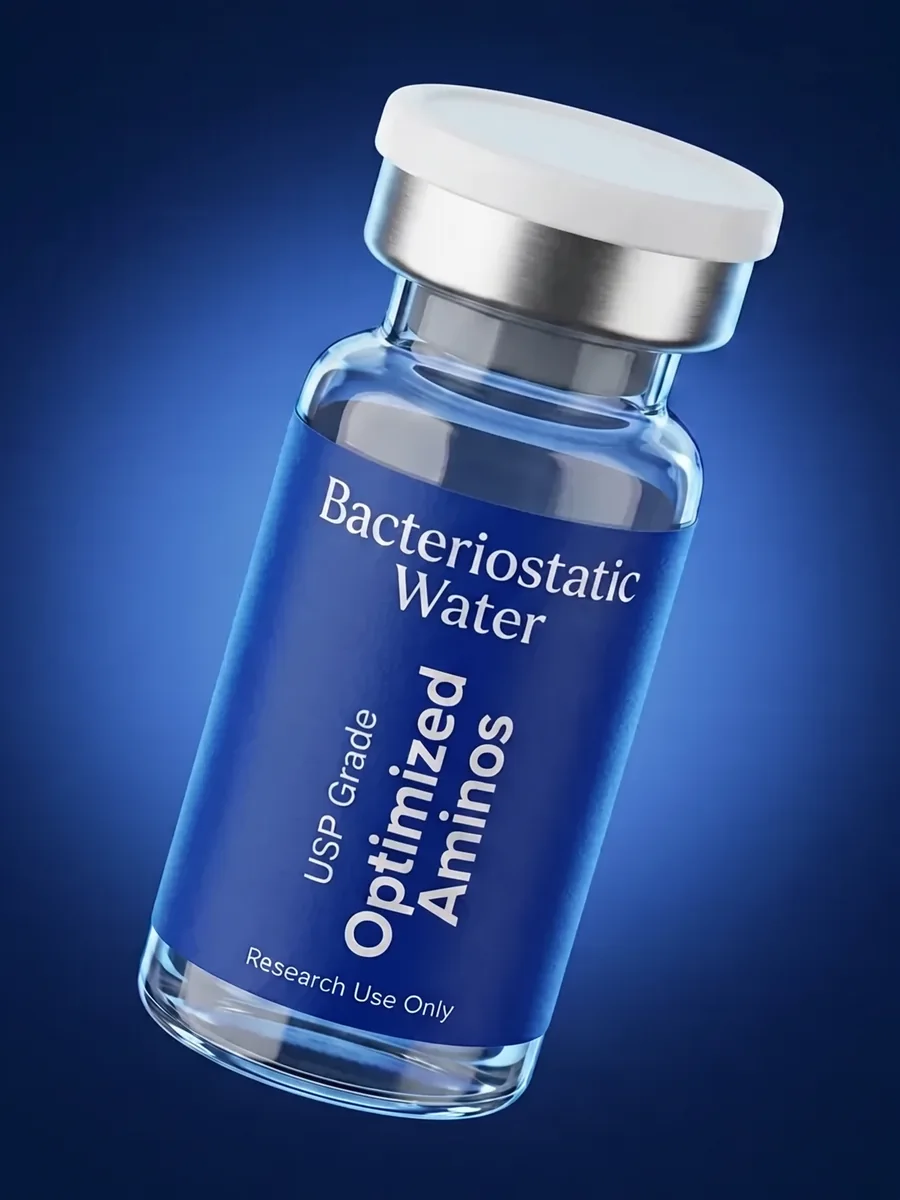
Because it ships dry, a lyophilized peptide has to be reconstituted before use — dissolved back into a known volume of liquid to create a solution of a known concentration. The standard diluent is bacteriostatic water, and the technique matters: add the water gently down the glass wall, swirl rather than shake, and record the concentration. Our full walk-through is here: how to reconstitute research peptides.
Storage: the two-state rule
Lyophilization creates a simple rule of thumb — dry and reconstituted peptides follow different storage logic:
- Dry (lyophilized) powder is the stable form. Unopened vials are typically kept refrigerated, and many peptides tolerate freezer storage for long-term holding. Keep them dark and dry.
- Reconstituted solution is far less stable. It belongs in the fridge (2–8 °C) and should be used within a few weeks, since it's back in the vulnerable, water-exposed state.
This is exactly why researchers reconstitute only what a given experiment needs and leave the rest of the material dry until it's required. Cold-chain-sensitive compounds such as retatrutide warrant extra care — store the dry vial as cold as its documentation specifies.
Why this connects to quality
A clean lyophilized cake and an accurate labeled mass both depend on the material being what it claims to be in the first place. That's what a batch-specific Certificate of Analysis verifies — our peptides are third-party tested, with each COA matched by lot number to the exact vial you receive. Because the dry mass on that report is what your reconstitution math relies on, the powder and the paperwork are two halves of the same thing. Every product's report is published in the COA archive.
The takeaway
Peptides ship as a freeze-dried powder because it's the only practical way to keep a fragile molecule stable through shipping and storage. Treat the dry vial as the durable form, reconstitute gently and only as needed, keep the solution cold and short-lived, and lean on the COA for the exact mass your calculations depend on. Handle the powder with that logic and the material will perform the way it was tested to.
Further reading
- How to reconstitute research peptides — turning the powder into a usable, known-concentration solution.
- How to read an HPLC chromatogram — verifying the material behind the powder.
- Bacteriostatic water 10ml — the standard diluent for reconstitution.
All information on this page is provided for laboratory research and educational use only. Optimized Aminos products are not intended for human or veterinary use, and nothing here should be read as dosing or administration guidance.
For laboratory and research use only. Not for human consumption.