Research Blog
DSIP Reconstitution: mg-to-mL Concentration Math for Research
Published
A worked walkthrough of DSIP reconstitution math — mg-to-mL concentration, diluent volume selection, and syringe-unit reading for a 10 mg research vial.
For laboratory and research use only. Not for human consumption.
DSIP (Delta Sleep-Inducing Peptide) ships as a lyophilized powder, and every downstream measurement in a research protocol depends on getting the reconstitution math right the first time. A 10 mg vial is not a 10 mg dose — it is a fixed mass of peptide that has to be dissolved into a known volume before any concentration figure means anything. This walkthrough covers the arithmetic, the diluent-volume tradeoffs, and the syringe-reading conversions researchers use when preparing DSIP stock solutions for in-vitro and bench work.
Why Concentration Math Matters for a Neuropeptide Reference Standard
DSIP has been studied since the 1970s as a nonapeptide isolated from rabbit brain perfusate, and it remains a reference compound in neuroendocrine and delta-wave sleep literature. Because published protocols report concentrations in molar or mg/mL terms, a research team working from a vial label first has to convert "10 mg per vial" into a working stock concentration that matches whatever assay or model system the protocol specifies. An arithmetic error at this step propagates through every serial dilution that follows.
Reading the DSIP 10 mg Vial Label
The number on the vial is total peptide mass, not concentration. A DSIP 10 mg vial contains 10 mg of lyophilized peptide and effectively zero volume until a diluent is added — the freeze-dried cake takes up negligible liquid space. Concentration only exists once a specific volume of bacteriostatic water (or another specified diluent) has been added.
The mg-to-mL Formula
The underlying formula is simple:
Concentration (mg/mL) = Total peptide mass (mg) ÷ Diluent volume added (mL)
For a 10 mg vial:
| Diluent added | Resulting concentration |
|---|---|
| 1 mL | 10 mg/mL |
| 2 mL | 5 mg/mL |
| 2.5 mL | 4 mg/mL |
| 5 mL | 2 mg/mL |
Each row is the same 10 mg of peptide, just distributed across a different volume — more diluent means a more dilute stock, not less peptide.
Choosing a Diluent Volume
The right diluent volume depends on what the downstream protocol needs, not on convenience alone. A 1 mL reconstitution produces a concentrated stock that is easy to store in small aliquots and further dilute later; a larger volume like 5 mL produces a more dilute working solution but leaves less room for error when small volumes are being measured with a syringe. Bacteriostatic water is the standard diluent choice referenced on the product label because its benzyl alcohol content inhibits bacterial growth across multiple withdrawals from the same vial, which matters for any protocol involving repeated sampling over days.
Reading the Result as a Working Volume
Once a stock concentration is fixed, translating a target mass into a syringe volume is the next calculation. Working volumes are recorded in microlitres, where 1 mL equals 1,000 µL. At a 5 mg/mL stock (2 mL added to the 10 mg vial), each unit on the syringe corresponds to 0.05 mg of peptide. At a 10 mg/mL stock (1 mL added), each unit corresponds to 0.1 mg. Confirming this unit-to-mg conversion before drawing any volume avoids a tenfold error, which is the single most common mistake in peptide-handling protocols.
Storage After Reconstitution
DSIP is referenced for storage at -20°C prior to reconstitution and each vial is sealed under nitrogen to limit oxidative degradation before use. Once reconstituted, peptide stock solutions are generally more temperature- and light-sensitive than the lyophilized powder, so protocols typically call for refrigeration at 2-8°C for short-term use and amber or foil-wrapped storage to limit photodegradation. Reconstituted stock should be logged with a preparation date so any concentration drift from evaporation or degradation can be tracked against the original calculation.
Common Arithmetic Mistakes
The most frequent errors researchers report are: confusing total vial mass with concentration; forgetting to re-derive the mg-per-unit figure after switching to a different diluent volume; and misreading a U-100 syringe as if it were a 1 mL tuberculin syringe with different unit markings. Recalculating from the formula above — rather than reusing a mg-per-unit figure from a previous vial or a different compound — is the simplest way to catch these before they affect a result.
Frequently Asked Questions
How much bacteriostatic water should be added to a DSIP 10 mg vial?
There is no single correct volume — it depends on the target concentration the protocol requires. Common reference points are 1 mL for a 10 mg/mL stock or 2 mL for a 5 mg/mL stock; researchers should calculate the volume that produces the concentration their specific model system calls for.
Does the reconstituted concentration change over time?
The calculated concentration reflects the moment of reconstitution. Peptide stability research indicates solution-phase peptides can degrade gradually depending on storage temperature and light exposure, so concentration should be treated as a starting point that assumes fresh preparation and proper storage.
Can DSIP be reconstituted with sterile water instead of bacteriostatic water?
Sterile water lacks the antimicrobial preservative in bacteriostatic water, so a vial reconstituted with sterile water is typically treated as single-use or short-window use only, since it offers no protection against microbial growth across repeated withdrawals.
Why does a U-100 syringe reading matter if the peptide isn't being dosed to a subject?
Even in bench and in-vitro work, transferring a precise mass into a reaction volume or dilution series relies on accurately reading a syringe or micropipette. The unit-to-mg conversion is the same math whether the withdrawn volume goes into an assay well or a further dilution step.
What happens if too much diluent is added by mistake?
The peptide mass in the vial does not change, but the concentration drops below the intended value. Since the formula is linear, the actual concentration can still be calculated from the real volume added and used going forward — the vial does not need to be discarded, only the concentration figure recalculated.
Is DSIP concentration measured differently in molar terms?
Some published protocols report DSIP concentrations in molar units (M or µM) rather than mg/mL. Converting requires DSIP's molecular weight (approximately 848.9 g/mol for the nonapeptide); mg/mL divided by molecular weight (in g/mmol) gives mmol/mL, which converts to molarity once mL is expressed as L.
Reviewed by the Optimized Aminos research team — last updated August 13, 2026.
References
- Schoenenberger GA, Monnier M. "Characterization of a delta-electroencephalogram(-sleep)-inducing peptide." Proc Natl Acad Sci U S A. 1977;74(3):1282-1286. pubmed.ncbi.nlm.nih.gov/268629
- Graf MV, Kastin AJ. "Delta-sleep-inducing peptide (DSIP): an update." Peptides. 1986;7(6):1165-1187. pubmed.ncbi.nlm.nih.gov/3554955
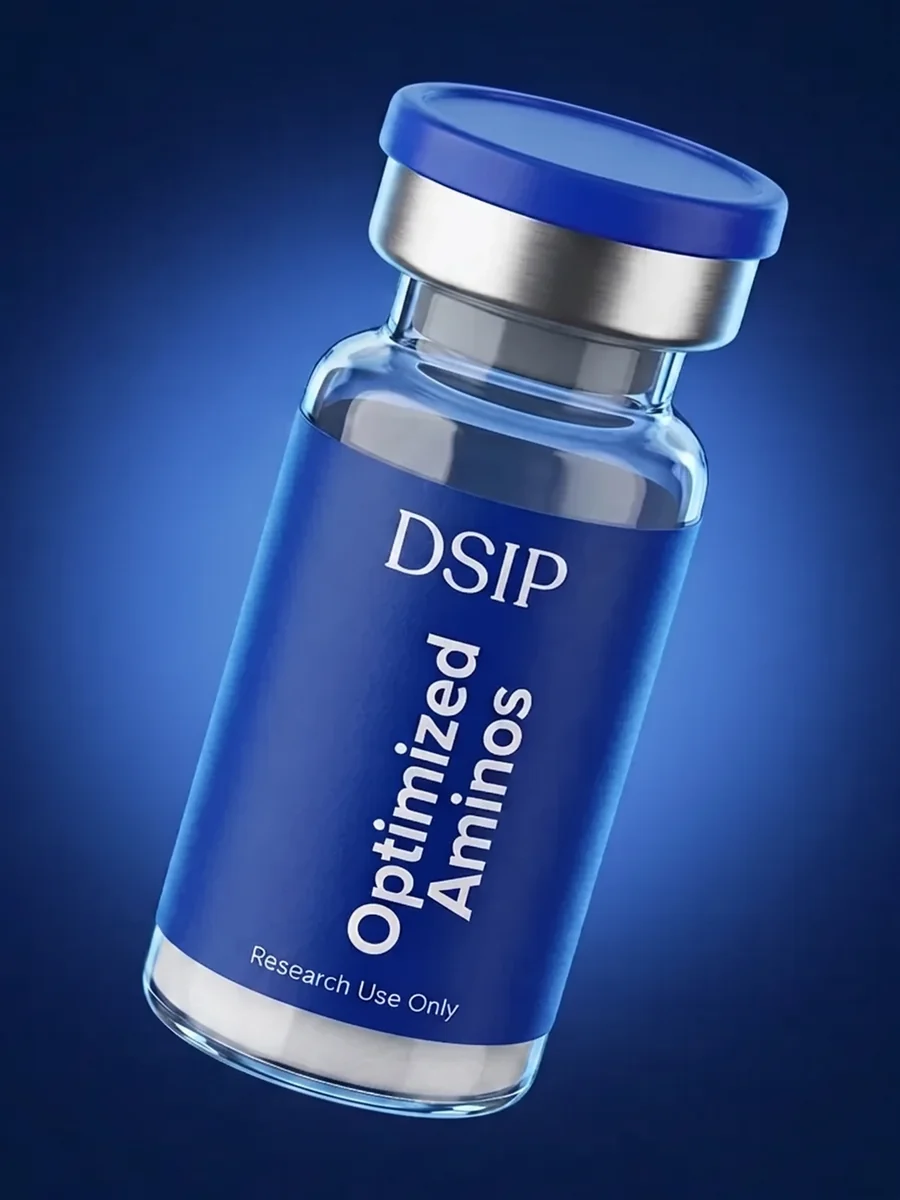
For related reading, see our breakdown of DSIP and sleep research literature and the general guide to reconstituting research peptides with bacteriostatic water. The DSIP 10 mg reference vial referenced throughout this article is available on our DSIP 10mg product page.
For laboratory and research use only. Not for human consumption.
Run the numbers for your own vial
The reconstitution calculator takes a labeled vial mass and a solvent volume and returns the resulting concentration in mg/mL, along with the aliquot volume in microlitres for any target mass — the same arithmetic worked through above, without the decimal-place risk of doing it from memory. Bacteriostatic water (10 mL) is the diluent used in these worked examples, and every compound referenced here is third-party tested with a published COA.
Related research compounds
Compounds referenced in this article, available as research-grade lyophilized peptides with third-party tested COA.