Research Blog
MOTS-c Reconstitution: mg-to-mL Concentration Math for Research
Published
A worked walkthrough of MOTS-c reconstitution math: mg-to-mL concentration, diluent volume selection, and vial-size considerations across the 10 mg and 40 mg research vials.
For laboratory and research use only. Not for human consumption.
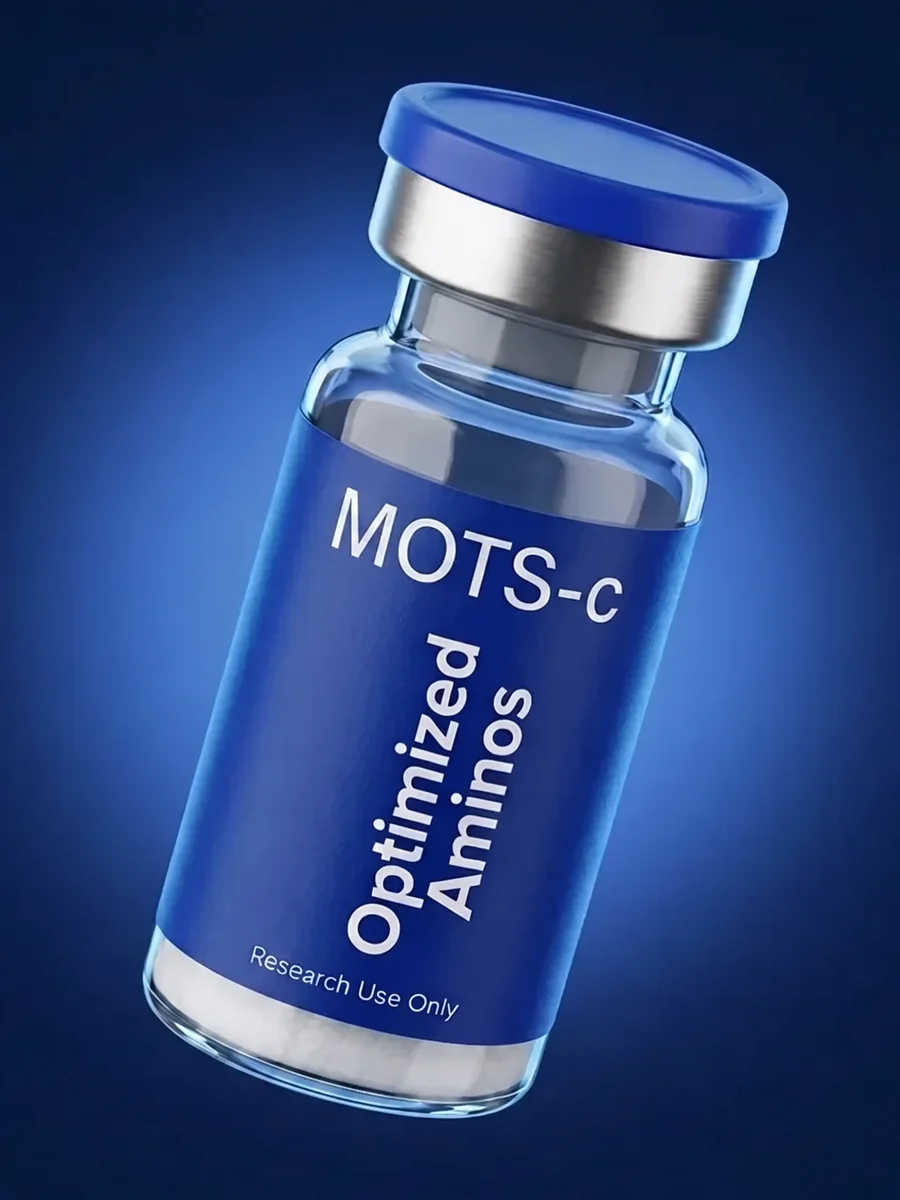
MOTS-c ships as a lyophilized powder in two vial sizes on this catalog — 10 mg and 40 mg — and neither number is a concentration until a diluent has been added. This walkthrough covers the mg-to-mL arithmetic, diluent-volume tradeoffs across both vial sizes, and the syringe-reading conversions researchers use when preparing MOTS-c stock solutions for in-vitro and bench work.
What Makes MOTS-c a Distinct Reconstitution Case
MOTS-c is a 16-amino-acid mitochondrial-derived peptide encoded within the mitochondrial 12S rRNA region rather than the nuclear genome — a structural origin that sets it apart from the growth-hormone-axis and tissue-repair peptides more commonly discussed in reconstitution guides. It is referenced in published in-vitro literature examining AMPK signaling, mitochondrial-metabolism markers, and glucose-uptake behavior in cell-culture models. Because this catalog stocks two different vial masses of the same peptide, getting the reconstitution math right means tracking which vial is on the bench, not applying a single memorized ratio to both.
Reading the MOTS-c Vial Label
The number on a MOTS-c vial — 10 mg or 40 mg — is total peptide mass, not concentration. The freeze-dried cake occupies negligible volume until a specified diluent is added, so “10 mg” and “40 mg” describe how much peptide is present in the vial, not how concentrated a working solution will be once fluid is introduced.
The mg-to-mL Formula
Concentration (mg/mL) = Total peptide mass (mg) ÷ Diluent volume added (mL)
Applied to both vial sizes sold on this catalog:
| Vial | Diluent added | Resulting concentration |
|---|---|---|
| 10 mg | 1 mL | 10 mg/mL |
| 10 mg | 2 mL | 5 mg/mL |
| 10 mg | 2.5 mL | 4 mg/mL |
| 40 mg | 2 mL | 20 mg/mL |
| 40 mg | 4 mL | 10 mg/mL |
| 40 mg | 8 mL | 5 mg/mL |
Note that a 4 mL addition to the 40 mg vial and a 1 mL addition to the 10 mg vial both land on 10 mg/mL — the same working concentration reached from two different starting masses. Confusing which vial is on the bench before recalculating is the fastest way to introduce a fourfold arithmetic error.
Choosing a Diluent Volume
The right diluent volume depends on the downstream protocol, not on convenience. A smaller diluent volume produces a concentrated stock that is easier to aliquot and dilute further; a larger volume produces a more dilute working solution but leaves less room for measurement error in small-volume steps. Bacteriostatic water is the standard diluent referenced on the product label — its benzyl alcohol content inhibits bacterial growth across multiple withdrawals from the same vial, which matters for any protocol involving repeated sampling over several days. See our general guide on how much bacteriostatic water to add during reconstitution for the underlying tradeoffs.
Reading the Result as a Working Volume
Once a stock concentration is fixed, translating a target mass into a syringe volume is the next step. Working volumes are recorded in microlitres, where 1 mL equals 1,000 µL. At a 10 mg/mL stock, each unit corresponds to 0.1 mg of peptide; at a 5 mg/mL stock, each unit corresponds to 0.05 mg. Re-deriving this unit-to-mg figure every time the vial size or diluent volume changes — rather than reusing a figure from a previous preparation — avoids the tenfold and fourfold errors that are among the most common mistakes in peptide-handling protocols.
Storage Prior to Reconstitution and Afterward
MOTS-c is referenced for storage frozen at -20°C or below prior to reconstitution, protected from moisture and light. Once reconstituted, stock solutions are generally more temperature- and light-sensitive than the lyophilized powder, so protocols typically call for refrigeration at 2-8°C for short-term use. Logging each reconstituted vial with a preparation date, source vial size, and calculated concentration keeps later concentration figures traceable to the original arithmetic rather than to memory.
Common Arithmetic Mistakes
The most frequent errors researchers report with a multi-size catalog like this one are: applying the 10 mg ratio to a 40 mg vial (or vice versa) without recalculating; forgetting to re-derive the mg-per-unit figure after switching diluent volume; and misreading a U-100 syringe as if it were a differently marked tuberculin syringe. Working from the formula above for the specific vial in hand is the simplest way to catch these before they affect a result.
Frequently Asked Questions
How much bacteriostatic water should be added to a MOTS-c 10 mg vial?
There is no single correct volume — it depends on the target concentration the protocol requires. Common reference points are 1 mL for a 10 mg/mL stock or 2 mL for a 5 mg/mL stock; researchers should calculate the volume that produces the concentration their specific model system calls for.
Does the reconstitution math change for the 40 mg vial?
The formula is the same, but the mass entering it is four times larger. A 40 mg vial reconstituted with 4 mL produces a 10 mg/mL stock — the same concentration as a 10 mg vial reconstituted with 1 mL — so the diluent volume, not the formula, is what has to scale with vial size.
Can MOTS-c be reconstituted with sterile water instead of bacteriostatic water?
Sterile water lacks the antimicrobial preservative in bacteriostatic water, so a vial reconstituted with sterile water is typically treated as single-use or short-window use only, since it offers no protection against microbial growth across repeated withdrawals.
Why is MOTS-c stored frozen before reconstitution?
The lyophilized powder is referenced for storage at -20°C or below to preserve the peptide's structural integrity ahead of use; catalog documentation for this compound also notes protection from moisture and light as an additional handling consideration prior to reconstitution.
What happens if too much diluent is added by mistake?
The peptide mass in the vial does not change, but the concentration drops below the intended value. Because the formula is linear, the actual concentration can be recalculated from the real volume added — the vial does not need to be discarded, only the concentration figure recalculated.
Reviewed by the Optimized Aminos research team — last updated August 26, 2026.
For related reading, see our overview of MOTS-c's mitochondrial-DNA-encoded origin and our summary of what metabolic research on MOTS-c has actually measured. The MOTS-c reference vials described throughout this article are available on our MOTS-c product page.
For laboratory and research use only. Not for human consumption.
Run the numbers for your own vial
The reconstitution calculator takes a labeled vial mass and a solvent volume and returns the resulting concentration in mg/mL, along with the aliquot volume in microlitres for any target mass — the same arithmetic worked through above, without the decimal-place risk of doing it from memory. Bacteriostatic water (10 mL) is the diluent used in these worked examples, and every compound referenced here is third-party tested with a published COA.
Related research compounds
Compounds referenced in this article, available as research-grade lyophilized peptides with third-party tested COA.