Research Blog
What Metabolic Research on MOTS-c Has Actually Measured
Published
MOTS-c is a 16-amino-acid mitochondrial-derived peptide encoded in 12S rRNA. Here's what has actually been measured in labs — AMPK activation, GLUT4 translocation, fat oxidation — versus what remains speculative.
For laboratory research use only. This article summarizes preclinical research literature on a mitochondrial-derived peptide. It describes laboratory and animal-model findings only and contains no dosing, human-use, veterinary, or clinical guidance, and makes no health or benefit claims.
A micro-peptide encoded inside the mitochondrion
Mitochondria are best known as the cell's power plants, but they are also signaling hubs. A notable advance in mitochondrial biology was the discovery of small peptides encoded within the mitochondrial genome itself — short open reading frames inside the 12S rRNA region. One of these is MOTS-c, a mitochondrial-derived peptide that has become a frequent subject of metabolic-pathway research. This overview organizes what that preclinical literature has actually measured, without extrapolating beyond it.
Mechanisms measured in cell and animal models
When researchers study MOTS-c alongside humanin — another mitochondrial-derived peptide — the reported pattern is that MOTS-c is examined largely in the context of skeletal muscle. Measurements that recur across cell-culture and rodent studies include:
- AMPK signaling — MOTS-c is associated with changes in the cellular AMP/ATP ratio and phosphorylation of AMPK, a central energy-sensing kinase.
- GLUT4 translocation — assays have measured movement of GLUT4 glucose transporters toward the muscle-cell surface, linked to insulin-independent glucose uptake in these models.
- Fatty-acid oxidation — muscle-cell preparations exposed to MOTS-c have shown shifts in lipid-fuel utilization.
- Mitochondrial biogenesis pathways — downstream AMPK signaling has been associated with upregulation of biogenesis regulators such as PGC-1α.
These are mechanistic observations in laboratory systems, not statements about outcomes in humans.
Bioenergetics endpoints in the literature
Beyond glucose handling, MOTS-c bioenergetics research in animal models has reported measurements of skeletal-muscle fatty-acid oxidation and of ectopic lipid accumulation in liver and other tissue. Rodent studies have also measured markers of exercise capacity, which is the origin of the peptide's informal "exercise-mimetic" description in the research community. Every one of these endpoints comes from a preclinical model rather than from human data.
Why age is a recurring research angle
Reports that endogenous MOTS-c abundance changes with age in animal models are part of why age-related metabolic questions became an active MOTS-c research area. This is a description of a studied association in the literature — not a claim about any intervention, population, or result in people.
What is not established
The honest boundary of this literature is worth stating plainly:
- Human dose-response relationships are not established.
- Long-term safety and immunogenicity data in humans are not established.
- Head-to-head comparisons against other metabolic-pathway molecules for defined endpoints are limited.
- Findings in one model system do not automatically generalize to another.
MOTS-c remains a molecule studied for mechanism. The value of the current literature is in characterizing pathways — AMPK, GLUT4, fatty-acid oxidation, mitochondrial biogenesis — rather than in supporting any applied conclusion.
How this fits the wider mitochondrial picture
MOTS-c is one probe among several used to study how mitochondria regulate cellular energy. For a side-by-side look at how it compares with a very different mitochondrial-research molecule, see our comparison of MOTS-c vs NAD+. Readers interested in how metabolic-pathway molecules are contrasted more broadly may also find our retatrutide vs semaglutide metabolic-research comparison useful.
Sourcing for reproducible research
Because MOTS-c is studied for subtle effects on cellular energy, material quality directly affects data quality. Research-grade MOTS-c should be third-party tested, with its identity and purity documented. The HPLC and mass-spectrometry results for our catalog are available in the certificate of analysis archive, so that the starting material is verified before it enters an experiment.
Bottom line
Preclinical MOTS-c research has measured associations with AMPK signaling, GLUT4 translocation, fatty-acid oxidation, and mitochondrial biogenesis in cell and animal models. These are mechanistic findings in laboratory systems, not human, clinical, or benefit claims — and the most useful way to read the literature is to focus on the measured pathways and to source verified, third-party-tested material for any research use.
For laboratory research use only. Not for human or veterinary use. The information above summarizes preclinical research literature and is not medical, clinical, or dosing guidance.
For laboratory and research use only. Not for human consumption.
Related research compounds
Compounds referenced in this article, available as research-grade lyophilized peptides with third-party tested COA.

Dilute acetic acid solution for laboratory reconstitution of peptides with poor solubility in bacteriostatic water. For laboratory research use only. Not for human or animal consumption.
View product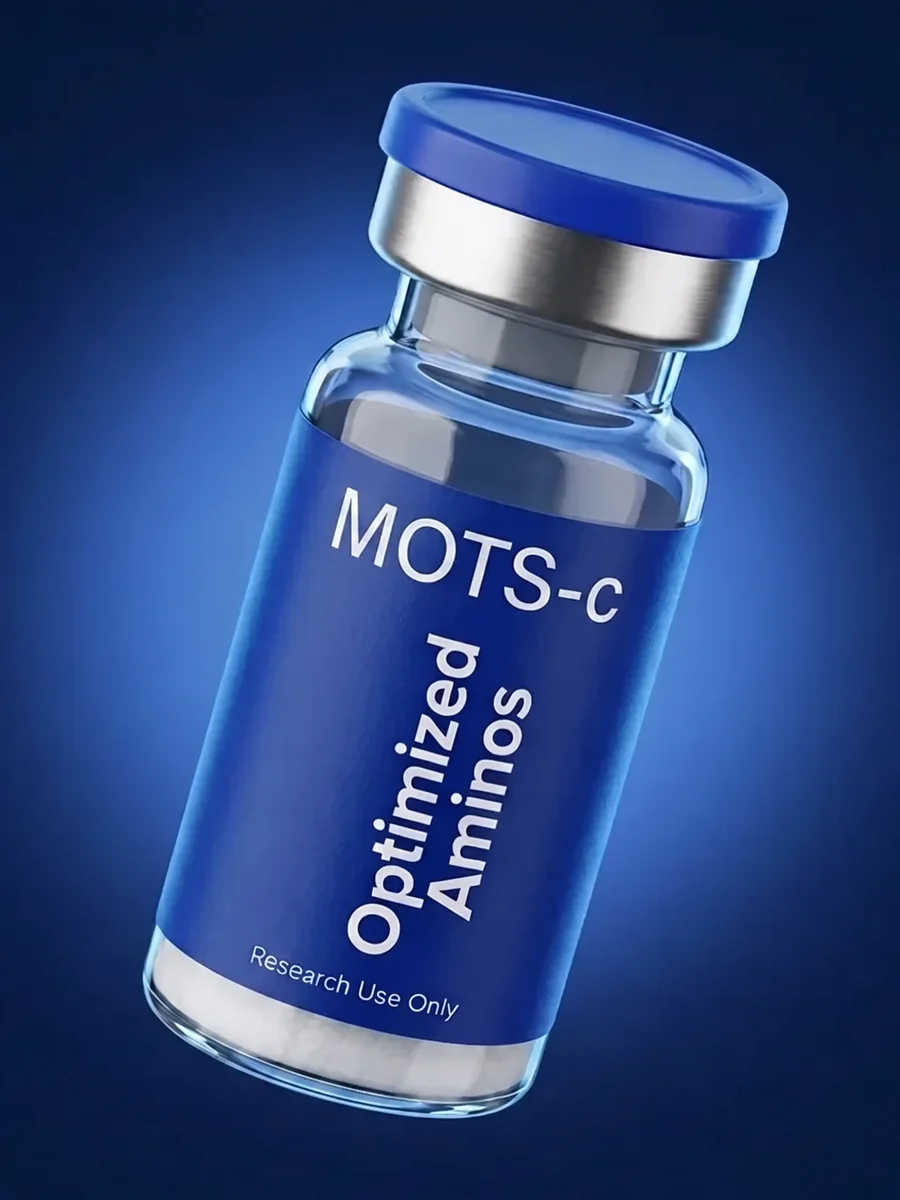
MOTS-c reference peptide, 10 mg per vial. Supplied as a white lyophilized powder, synthesized at >98% purity and verified by HPLC and mass spectrometry. Referenced in published in-vitro literature on mitochondrial peptide signaling. Store frozen (≤ -20°C) for long-term stability; protect from moisture and light. Reconstitute with bacteriostatic water. For in-vitro laboratory and analytical research use only. Not a drug, supplement, or therapeutic product. Not for human or animal consumption, ingestion, injection, or any clinical use. Not FDA-approved.
View product