Research Blog
MOTS-c vs NAD+: Two Approaches in Mitochondrial Research Compared
Published
MOTS-c is a mitochondrial peptide; NAD+ is a redox coenzyme. How each is used in preclinical mitochondrial research, and why they are studied together.
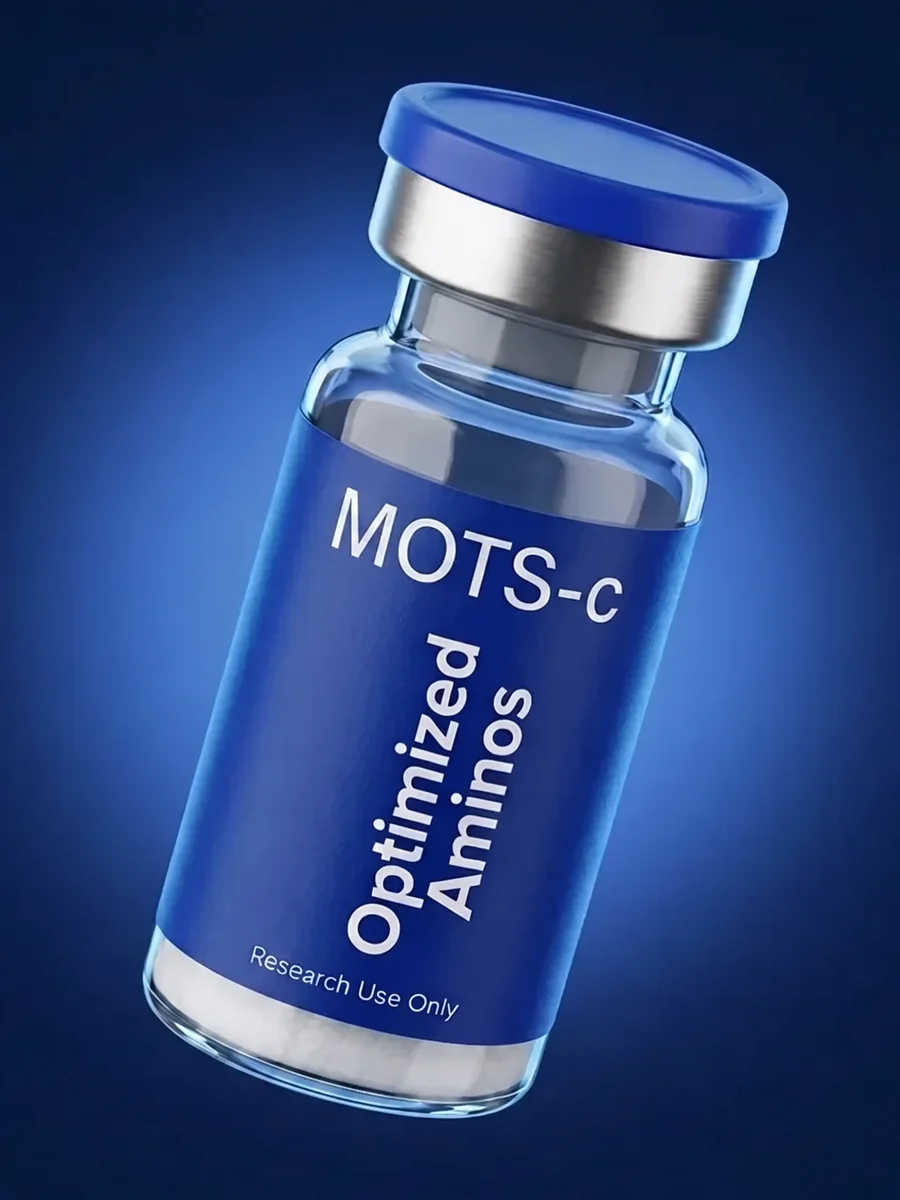
For laboratory research use only. This article compares the preclinical research literature on two mitochondrial-research molecules. It describes laboratory and animal-model findings only and contains no dosing, human-use, veterinary, or clinical guidance, and makes no health or benefit claims.
Two molecules, one organelle
Mitochondrial research draws on a wide toolkit, and two of its most-discussed molecules could hardly be more different in origin. MOTS-c is a short peptide encoded inside the mitochondrial genome itself. NAD+ (nicotinamide adenine dinucleotide) is a small coenzyme present in every living cell. Researchers reach for them to study overlapping questions about cellular energy, yet they sit at opposite ends of the biochemical spectrum — one a signaling peptide, the other a redox cofactor. Comparing how each is studied clarifies what a mitochondrial-research workflow is actually probing.
What each molecule is
MOTS-c: a mitochondrial-derived peptide
MOTS-c stands for "mitochondrial open reading frame of the 12S rRNA type-c." It is a short peptide whose coding sequence sits within the mitochondrial 12S ribosomal RNA region — one of a small class of mitochondrial-derived peptides that upended the older assumption that the mitochondrial genome encodes only a handful of respiratory-chain proteins. In the laboratory, MOTS-c is studied as a signaling molecule: something that carries information between the mitochondrion and the rest of the cell. Our overview of what metabolic research on MOTS-c has actually measured goes deeper into the specific assays.
NAD+: a redox coenzyme
NAD+ is not a peptide at all. It is a dinucleotide coenzyme that shuttles electrons in central metabolism, cycling between its oxidized form (NAD+) and reduced form (NADH). Beyond that redox role, NAD+ is consumed as a substrate by enzymes such as the sirtuins and PARPs, which links its cellular availability to a broad web of signaling and repair processes. Where MOTS-c is a discrete gene product, NAD+ is a ubiquitous currency of metabolism.
Pathways researchers actually study
MOTS-c and the AMPK axis
The most-reported thread in MOTS-c research is its relationship to AMP-activated protein kinase (AMPK), the cell's central energy sensor. In cell-culture and animal-model studies, researchers have measured MOTS-c's association with AMPK signaling and with downstream regulators of mitochondrial biogenesis such as PGC-1α. Because these are the same pathways that respond to energetic stress, much of the preclinical literature frames MOTS-c as a molecule for interrogating how cells sense and adapt to their metabolic state. All of this work is preclinical — conducted in cultured cells and laboratory animals, not in humans.
NAD+ and mitochondrial metabolism
NAD+ research centers on its dual identity as a redox carrier and an enzyme substrate. Laboratory studies examine how NAD+ availability tracks with mitochondrial function, how sirtuin activity depends on NAD+ as a co-substrate, and how the cellular NAD+/NADH ratio reflects metabolic status. A recurring theme in the published literature is that measured NAD+ levels tend to decline in aged tissues in animal models, which has made NAD+ metabolism a heavily studied axis in cellular-aging and bioenergetics research.
How they differ as research tools
The practical distinction for a researcher is what kind of question each molecule is suited to. MOTS-c is a tool for studying signaling — how a mitochondrially encoded peptide communicates with nuclear and cytosolic pathways. NAD+ is a tool for studying bioenergetics and enzyme activity — how the supply of a fundamental coenzyme constrains redox reactions and NAD+-consuming enzymes. They are not competitors so much as different instruments: one asks how the mitochondrion talks to the cell, the other asks how the cell's energy currency is spent.
They also differ in ubiquity. NAD+ is present in every cell and every organism; manipulating it touches an enormous number of downstream reactions at once, which is both its power and its complexity as an experimental variable. MOTS-c is a specific peptide with a more defined set of studied interactions, which can make its effects easier to attribute in a controlled assay.
Why they appear together in the literature
Despite their differences, MOTS-c and NAD+ show up in overlapping research programs because both connect to the same master theme: mitochondrial regulation of cellular energy. AMPK signaling (the MOTS-c thread) and NAD+-dependent sirtuin activity (the NAD+ thread) are themselves interlinked nodes in the cell's energy-sensing network. Researchers studying metabolic adaptation frequently find both molecules in the same conceptual map, which is why a mitochondrial-research catalog tends to stock them side by side. For readers comparing metabolic-pathway molecules more broadly, our metabolic-research comparison of retatrutide and semaglutide looks at a different corner of the same field.
What is and isn't established
It is worth stating plainly what this literature does and does not support. The measurements described above come from preclinical systems — isolated cells, tissue preparations, and laboratory animals. They characterize pathways and associations; they are not statements about outcomes in humans, and nothing here should be read as a benefit, dosing, or clinical claim. What the research establishes is mechanistic context: which pathways each molecule touches and how each is used as an experimental probe.
Sourcing for reproducible work
Because both molecules are studied for subtle effects on cellular energy, the quality of the starting material directly affects data quality. Whether a protocol calls for the peptide MOTS-c or the coenzyme NAD+, the material should be third-party tested with its analytical results documented. Our full certificate of analysis archive houses the HPLC and mass-spectrometry data for the catalog, so that identity and purity are verified before a molecule enters an experiment.
Bottom line
MOTS-c and NAD+ approach mitochondrial biology from opposite directions: MOTS-c is a mitochondrially encoded signaling peptide studied largely through the AMPK axis, while NAD+ is a universal redox coenzyme studied as an enzyme substrate and marker of metabolic state. They complement rather than replace each other in a research program, and both belong to the same broad question of how mitochondria govern cellular energy — a question best pursued with verified, third-party-tested material.
For laboratory research use only. Not for human or veterinary use. The information above summarizes preclinical research literature and is not medical, clinical, or dosing guidance.
For laboratory and research use only. Not for human consumption.
Related research compounds
Compounds referenced in this article, available as research-grade lyophilized peptides with third-party tested COA.