Research Blog
COA Verification for Peptides: A Lab Professional's Guide
Published
Master COA verification for peptides with essential checks for identity, purity, and contaminants. Ensure reliable results today!

COA Verification for Peptides: A Lab Professional’s Guide
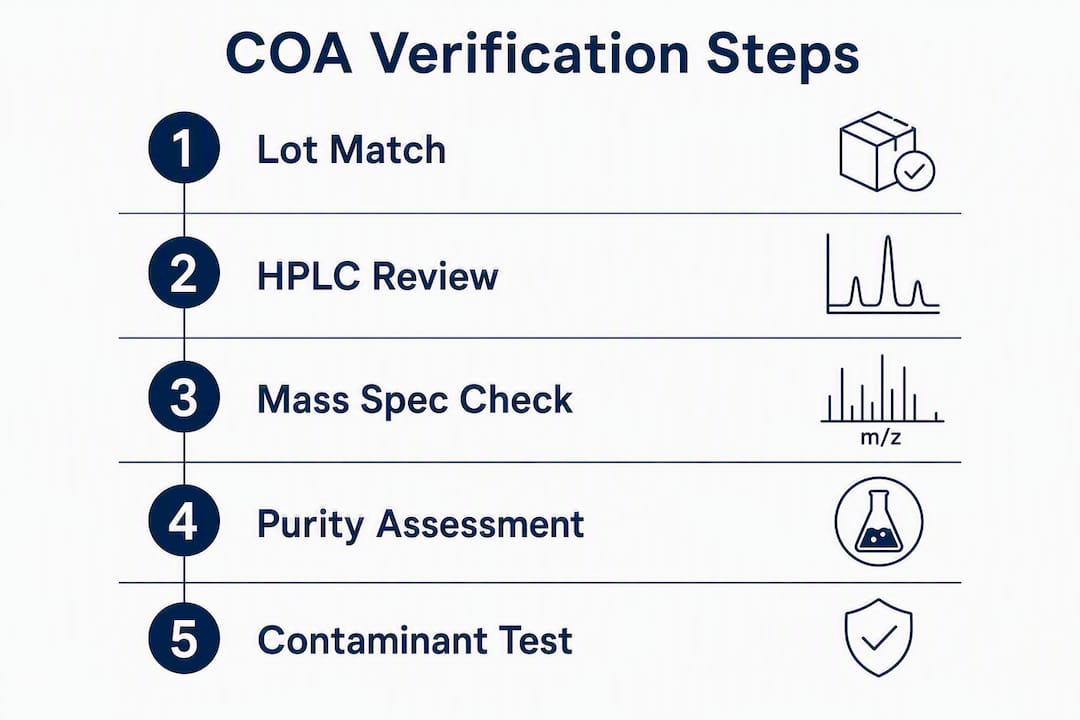
A peptide Certificate of Analysis (COA) is batch-specific test evidence of identity, purity, and selected contaminants. On any certificate you receive, run three checks immediately: match the vial’s lot number to the COA, confirm that both a mass spectrometry (MS) readout and an HPLC chromatogram are present, and verify that the issuing laboratory is independently identifiable, preferably holding ISO/IEC 17025 accreditation.
- Lot/batch match: The lot number printed on the vial label must match the lot number on the COA exactly. A mismatch means the document does not describe the material in your hands.
- MS identity confirmation: Look for observed m/z values and compare them against the expected molecular weight. No MS data means identity is unconfirmed.
- HPLC chromatogram: A purity percentage without an accompanying chromatogram image or raw data is unverifiable. The chromatogram must show a dominant peak, a clean baseline, and retention time metadata.
- Lab verification: Search the issuing laboratory by name. Confirm it exists independently of the vendor, and check for ISO/IEC 17025 accreditation where possible.
If any of these four checks fails — no lot match, no MS data, an absent or unreadable chromatogram, or an unverifiable lab — treat the COA as untrusted and hold the material until the issue is resolved. Optimized-aminos publishes a third-party-tested COA for every product, backed by independent HPLC and MS verification, which makes this first-pass check straightforward.
Pro Tip: Before opening a vial, photograph the lot number on the label and place it side by side with the COA lot field. This takes thirty seconds and creates a timestamped procurement record.
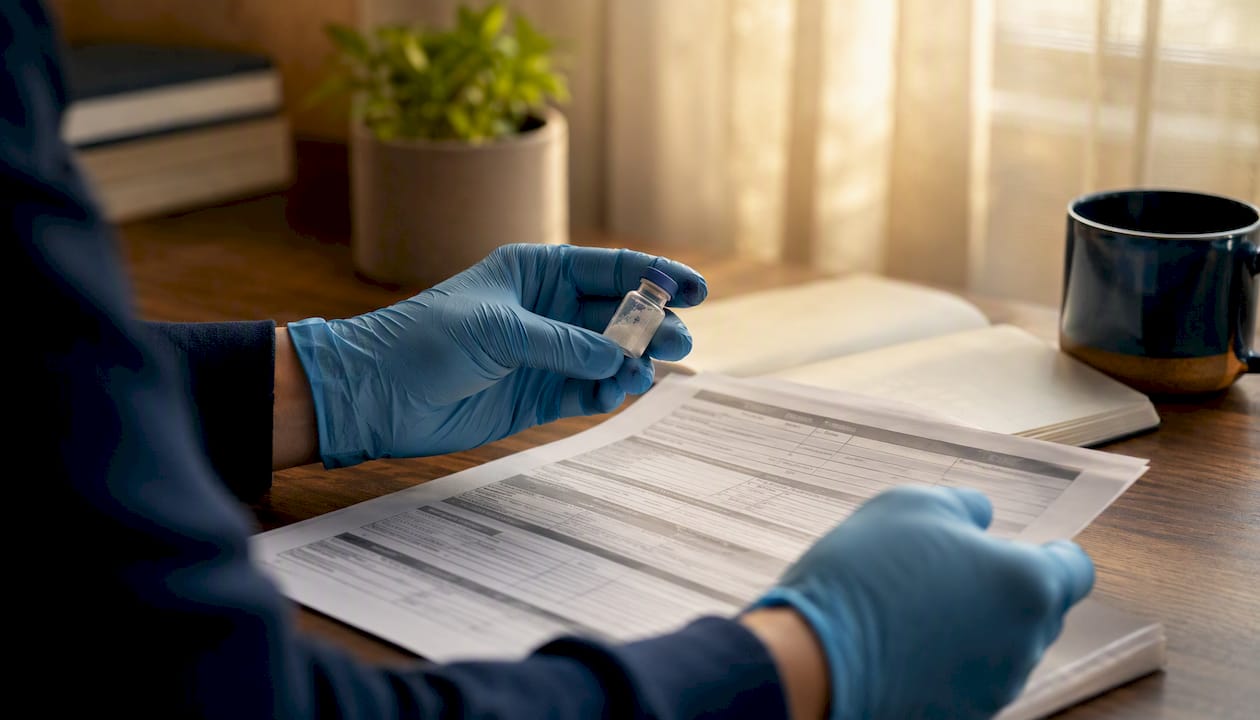
Table of Contents
- What a peptide COA contains and why each field matters
- Why COA verification matters for peptide research
- How to read and interpret HPLC, mass spectrometry, net peptide content, and contaminant panels
- Third-party COAs versus in-house supplier COAs
- Red flags and authenticity checks on peptide COAs
- COA requirements and U.S. compliance considerations for research labs
- How to request lot-specific COAs from suppliers before purchase
- A recommended multi-step COA verification workflow
- Key Takeaways
- Why strict COA standards are worth the effort
- Optimized-aminos publishes third-party-tested COAs for every research peptide
- Authoritative sources and further reading
What a peptide COA contains and why each field matters
A COA is not a product specification sheet. It is a record of analytical results performed on a specific batch, and its value depends entirely on the specificity and completeness of those results. A COA does not guarantee biological activity or sterility unless those tests are explicitly listed and passed.
Mandatory fields on a well-formed peptide COA:
- Product name and amino acid sequence: Confirms which peptide the batch represents.
- Batch/lot number: The unique identifier linking the document to a physical vial or set of vials.
- Date of analysis: When the tests were performed. A COA dated years before receipt warrants scrutiny.
- Report ID: A unique document identifier used to verify the COA on the issuing lab’s portal.
- Testing laboratory name and contact information: Must be independently searchable; vendor-only contact details are a red flag.
- Analyst signature: Confirms a named, accountable individual reviewed the results.
- Methods used: For example, RP-HPLC with a C18 column; ESI-MS or MALDI-TOF for identity.
- Result tables: Numerical outputs for each panel tested, with units and acceptance criteria stated.
Key glossary terms you will encounter:
- HPLC purity (%): The percentage of the total chromatographic peak area attributed to the target peptide.
- Net peptide content (assay): The actual mass of peptide per vial after accounting for water, salts, and counterions.
- Observed m/z: The measured mass-to-charge ratio from the mass spectrometer, compared against the theoretical value.
- Retention time: The time at which the target compound elutes from the HPLC column under defined conditions.
- LAL/endotoxin: A limulus amebocyte lysate assay result measuring bacterial endotoxin contamination.
- Limit of detection (LOD): The lowest concentration of a contaminant the method can reliably detect.
- ISO/IEC 17025 accreditation: The international standard confirming a laboratory’s technical competence for testing and calibration.
Batch specificity is what makes a COA meaningful. A generic certificate listing typical purity ranges without a lot number is not a COA in any analytically useful sense. The research peptide glossary at Optimized-aminos defines these terms in procurement-ready language for lab SOPs.
Why COA verification matters for peptide research
Traceability is the operational core of the argument. A batch-specific COA links a physical sample to its analytical results, which is required for QC records, experiment logs, and any downstream reproducibility claim. Without that link, you cannot confirm that the compound used in experiment A is the same as the compound used in experiment B, even from the same supplier.
Independent testing of research-grade peptides from unregulated vendors reveals a meaningful failure rate on purity that underlines why relying on a supplier’s word alone is insufficient. Third-party COAs reduce supplier bias because the testing laboratory has no commercial interest in the result. An in-house COA, by contrast, is produced by the same organization selling the product.
From a procurement standpoint, institutional purchasing offices and biosafety committees at universities and core facilities increasingly require batch-specific COAs and evidence of third-party testing before approving orders. This is not bureaucratic overhead; it is a practical filter against identity and purity failures that waste resources and compromise published results.
Multi-layered verification is the emerging standard: aggregating vendor-supplied COAs, community-submitted tests, and independent lab results produces a stronger vendor quality profile than any single document can provide.
How to read and interpret HPLC, mass spectrometry, net peptide content, and contaminant panels
Reading an HPLC chromatogram
HPLC purity measures the fraction of total UV-absorbance peak area attributable to the target peptide. A result of 98.5% means 98.5% of the detected signal belongs to the main compound; the remaining 1.5% represents impurities, degradation products, or synthesis byproducts.
When you read a chromatogram, look for four things:
- Dominant peak: The tallest, sharpest peak should correspond to the target peptide. Its retention time should match the method’s expected value.
- Baseline: A flat, low-noise baseline before and after the main peak indicates a clean separation. Elevated or irregular baselines suggest column contamination or method problems.
- Impurity peaks: Small peaks flanking the main peak are normal at low levels. Peaks exceeding roughly 1–2% of total area deserve attention and should be identified if possible.
- Method metadata: The column type (e.g., C18), mobile phase solvents, gradient program, and flow rate must accompany the chromatogram. Without this, the result cannot be reproduced or independently verified.
Optimized-aminos provides a step-by-step chromatogram reading guide that walks through retention time, peak identity, and baseline noise interpretation for researchers who want a hands-on reference.
Interpreting mass spectrometry data
MS confirms identity; HPLC informs purity. These two tests answer different questions and neither substitutes for the other.
On the MS readout, locate the observed m/z value and compare it to the theoretical molecular weight of the peptide. For a singly charged ion [M+H]+, the observed m/z should match the theoretical mass plus one proton (1.0073 Da). Multiply by the charge state z for multiply charged ions. A match within ±0.5 Da is generally acceptable for ESI-MS on peptides under 3,000 Da; higher-resolution instruments narrow this further.
Check for expected adducts (sodium [M+Na]+, potassium [M+K]+) and confirm that the isotope pattern is consistent with the peptide’s elemental composition. An unexpected dominant peak at a different m/z warrants investigation before use. The molecular weight explainer at Optimized-aminos covers these identity checks in detail.
Net peptide content versus declared purity
Purity (%) and net peptide content (assay, in mg) measure different things. A vial labeled “5 mg, 98% purity” does not necessarily contain 4.9 mg of active peptide. Lyophilized peptides retain water, counterions (typically trifluoroacetate or acetate from synthesis), and residual salts. Net peptide content, sometimes called the assay value, corrects for these and states the actual peptide mass per vial.
For dose-sensitive experiments, always use the net peptide content figure rather than the nominal vial weight. If the COA does not include a net peptide content or assay value, ask the supplier for it before calculating working concentrations.
Contaminant panels: when each matters
| Panel | Method | Typical acceptance threshold | When it matters most |
|---|---|---|---|
| Endotoxin (LAL) | Limulus amebocyte lysate | <1 EU/mg for research use | Cell-based assays, primary cell culture, any in vivo work |
| Heavy metals | ICP-MS | Per USP limits | Long-term or high-dose exposure studies |
| Residual solvents | GC-headspace | ICH Q3C Class 2/3 limits | Sensitive biochemical assays, toxicology studies |
| Sterility | Culture-based | No growth | In vivo or sterile-technique protocols |
Endotoxin contamination is the most commonly overlooked panel in research-grade peptide procurement. Even sub-visible endotoxin levels can activate NF-κB pathways and confound cytokine assays. For cell-based work, endotoxin and sterility testing should be a non-negotiable COA requirement.
Pro Tip: When ordering peptides for cell-based assays or primary cell culture, request the raw LAL assay data, not just a pass/fail notation. The actual EU/mg value tells you how much margin you have relative to your assay’s sensitivity threshold.
Third-party COAs versus in-house supplier COAs
Definitions
An in-house COA is produced by the supplier’s own analytical team using their own instruments. An independent (third-party) COA is issued by a laboratory that has no commercial relationship with the supplier and is accountable to its own accreditation body.
Comparative strengths
In-house testing is faster and gives suppliers direct access to raw data. For routine batch release, it is operationally practical. The limitation is conflict of interest: the same organization that profits from the sale also controls the test result.
Third-party testing under ISO/IEC 17025 accreditation removes that conflict. The laboratory’s accreditation depends on the accuracy of its results, not on the supplier’s sales volume. The tradeoff is turnaround time and cost, which are typically higher than in-house testing.
Verification steps for third-party COAs
- Locate the report ID on the COA.
- Visit the issuing laboratory’s website and search for a verification portal or certificate lookup tool.
- Enter the report ID and confirm the result matches the COA you received.
- Scan any QR code on the document and confirm it resolves to the lab’s own portal, not a vendor-controlled page.
- If no portal exists, contact the laboratory directly by email or phone using contact details found independently (not from the vendor), and provide the report ID.
- Confirm the laboratory holds ISO/IEC 17025 accreditation for the relevant test methods.
Acceptance tiers for institutional procurement
- Tier 1: Third-party COA with full raw data (chromatogram files, MS spectra), ISO/IEC 17025 accreditation confirmed, report ID verified on lab portal.
- Tier 2: In-house COA with raw data, batch-specific lot match, and method metadata; supplier has a documented QC program.
- Tier 3: Generic or undated COA, no chromatogram, no MS data, or unverifiable lab. Do not accept for research use without independent confirmatory testing.
Red flags and authenticity checks on peptide COAs
Document-level problems are the most common source of COA fraud and recycling. Guides to COA verification consistently flag the same patterns.
Document red flags:
- Missing or absent batch/lot number.
- Identical COA used across multiple products or lot numbers.
- Chromatogram image is absent, blurred, or clearly a stock image.
- MS data is missing entirely or shows only a single unlabeled peak.
- Purity claimed at exactly 100.0% (analytically implausible for a real batch result).
- Report date is static across multiple orders placed months apart.
- Inconsistent fonts, copy-paste artifacts, or misaligned tables suggesting document editing.
Behavioral red flags:
- Vendor declines to provide a batch-specific COA before purchase.
- Lab listed on the COA cannot verify the report ID.
- COA is only accessible through a vendor-hosted page with no independent lab portal.
- The same COA document is provided for different lot numbers.
Verification actions when red flags appear:
- Request raw data files: CSV chromatogram exports and vendor MS spectra.
- Contact the issuing lab using independently sourced contact details and the report ID.
- Request an independent test sample before committing to a larger purchase.
- Quarantine the material in inventory and document the hold with a timestamp.
The Disclosed Labs COA Scanner applies AI-based analysis to uploaded COAs, flagging missing panels such as endotoxin testing and returning a 0–100 trust score. A score above 80 indicates high confidence in document integrity. This tool does not replace manual verification but adds a useful automated layer for high-volume procurement.
Pro Tip: Save every COA as a timestamped PDF in your lab’s document management system and log all correspondence with the supplier about that batch. If a result is later questioned, this record is your audit trail.
COA requirements and U.S. compliance considerations for research labs
Research peptides sold in the United States for laboratory use carry Research Use Only (RUO) labeling. This designation means the product is not intended for diagnostic, therapeutic, or clinical use, and it places the responsibility for appropriate use on the purchasing institution. COAs are the primary documentation supporting RUO procurement records.
Institutional requirements researchers commonly encounter:
- University purchasing offices and sponsored research offices often require a batch-specific COA and evidence of third-party testing before approving a purchase order for research compounds.
- Institutional biosafety committees (IBCs) may request COA documentation when reviewing protocols involving novel peptides, particularly for cell-based or animal studies.
- Core facilities operating under GLP or GMP-adjacent standards typically maintain COA files linked to purchase orders and sample storage records.
Recordkeeping practices for audit readiness:
- Retain COAs and associated raw data for the duration of the study plus any applicable institutional retention period (commonly five to seven years for federally funded research).
- Link each COA to its corresponding purchase order number, storage location, and experiment log entry.
- Store COA files in a format that preserves metadata (PDF/A is preferable to image-only scans).
When to involve compliance or biosafety officers:
If sterility or endotoxin data is absent from a COA for a peptide intended for use in primary cell culture, organoid systems, or any in vivo application, escalate to your institution’s compliance or biosafety office before use. A COA discrepancy that could affect reported experimental results should also be documented and reported through your institution’s standard research integrity channels.
This article provides general informational guidance. Confirm current institutional policies and regulatory requirements with your compliance office or a qualified professional.
How to request lot-specific COAs from suppliers before purchase
Requesting a COA before purchase is standard practice in institutional procurement and should be a default step in any lab’s supplier vetting process. The supplier vetting checklist at Optimized-aminos outlines the key criteria for evaluating vendors before placing an order.
What to request from any supplier:
- Lot-specific COA as a PDF, with the lot number matching the specific batch you will receive.
- Report ID or a link to the issuing lab’s verification portal.
- Raw chromatogram data (CSV or equivalent) and MS spectra files when identity and purity are critical.
- Date of analysis and analyst name.
- Laboratory contact details (independent of the vendor).
Pre-purchase verification checklist:
- Confirm the lot number on the COA matches the batch being shipped.
- Verify the issuing lab’s portal or ISO/IEC 17025 status independently.
- Confirm both HPLC and MS data are present and readable.
- Check that the date of analysis is recent enough to be relevant to the batch’s expected shelf life.
- Confirm endotoxin data is present if the peptide will be used in cell-based or in vivo work.
Sample email request elements:
When contacting a supplier, include: the product name and catalog number, the specific lot or batch number you are ordering, a request for the lot-specific COA PDF and report ID, a request for raw chromatogram and MS files if available, and the name and contact details of the issuing laboratory. Keep the request concise and professional; most reputable suppliers respond within one business day.
If a vendor refuses to provide a batch-specific COA before purchase: decline the order or require an independently tested sample before committing to a larger quantity. A vendor’s refusal to share pre-purchase documentation is itself a disqualifying signal for institutional procurement.
A recommended multi-step COA verification workflow
The following workflow moves from fast, low-cost document checks to progressively more resource-intensive verification steps. Apply the full sequence when a COA raises questions; apply at minimum steps 1 and 2 for every new supplier or batch.
- Immediate document checks (minutes): Confirm lot match, verify that both MS and HPLC data are present and readable, check the report ID format, and scan any QR code.
- Lab portal verification (hours to one business day): Enter the report ID on the issuing lab’s verification portal. Confirm the result matches the COA you received.
- Direct lab contact (1–3 business days): If no portal is available, contact the laboratory using independently sourced contact details and provide the report ID. Request written confirmation.
- Raw data request (1–3 business days): Ask the supplier or lab for CSV chromatogram files and vendor MS spectra. Review peak areas, retention times, and m/z values against the COA summary.
- Independent confirmatory testing (3–10 business days): If steps 1–4 leave unresolved questions, send a sample to an independent analytical laboratory. HPLC plus MS confirmation typically costs a few hundred USD depending on the panel and provider.
Decision points:
- Accept: Lot match confirmed, MS identity confirmed, HPLC purity meets your acceptance criteria (commonly ≥95%), lab verified, no red flags.
- Hold: One element is missing or unverified but the issue is resolvable (e.g., waiting for portal confirmation or raw data).
- Reject or escalate: Lot mismatch, MS absent or inconsistent, lab unverifiable, or vendor refuses to provide documentation. Require independent testing or decline the order.
Verification dashboards that aggregate vendor COAs alongside community-submitted and independent lab results offer a composite trust profile that is stronger than any single document. Tools like these are useful for ongoing vendor monitoring, particularly when sourcing from newer or less-established suppliers.
Pro Tip: Write your acceptance criteria into your lab’s procurement SOP before you order. Specifying “≥95% HPLC purity + MS identity confirmed + lot-specific COA + verified third-party lab” in the SOP removes ambiguity at the point of receipt and gives you a documented basis for rejecting non-conforming material.
Key Takeaways
Rigorous COA verification for peptides requires matching the lot number, confirming both HPLC and MS data, verifying the issuing lab independently, and escalating to raw data or independent testing when any element is missing or inconsistent.
| Point | Details |
|---|---|
| Lot match is non-negotiable | The vial lot number must match the COA lot number exactly before any other check proceeds. |
| MS and HPLC serve different purposes | MS confirms identity via observed m/z; HPLC measures purity by peak area. Both are required for full COA verification. |
| Third-party COAs carry higher trust | ISO/IEC 17025-accredited labs have no commercial interest in the result, reducing supplier bias. |
| Net peptide content drives dosing | Use the assay value, not the nominal vial weight, when calculating working concentrations for experiments. |
| Optimized-aminos publishes third-party-tested COAs | Every batch ships with a third-party HPLC and MS-verified COA, supporting Tier 1 procurement standards. |
Why strict COA standards are worth the effort
The conventional wisdom in research procurement is that a COA is a formality, a box to check before a purchase order goes through. That framing misses what a COA actually is: the only analytical record connecting a physical vial to a verified identity and purity result. When that connection is weak or fabricated, every experiment run on that material is built on an unverified assumption.
What researchers often underestimate is how frequently COA problems are not outright fraud but rather recycled documentation: a real COA from a real batch, reused for a different lot because the supplier did not retest. The document looks legitimate because it is legitimate, just not for the material in your hands. This is why lot-number matching and lab portal verification matter more than visual inspection of the certificate itself.
The multi-layered verification approach, combining document checks, portal confirmation, and periodic independent testing, is not excessive caution. It reflects the same principle that makes replication central to science: a single data point is not enough. Optimized-aminos’s practice of publishing third-party-verified COAs for every product is one operational model for how suppliers can make this verification workflow faster and more reliable for researchers. The verification dashboard approach that aggregates vendor and independent data takes this further, giving labs a composite quality profile rather than a single supplier-provided document.
For labs that run high-throughput procurement, building acceptance criteria directly into the purchasing SOP is the most practical step. It converts verification from a judgment call into a documented, auditable process.
Optimized-aminos publishes third-party-tested COAs for every research peptide
Every peptide in the Optimized-aminos catalog has a third-party-tested COA published, backed by HPLC and mass spectrometry verification, targeting 99%+ purity. That documentation is not a generic certificate: it is tied to the specific lot number in your vial, with chromatogram data and MS readouts you can verify against the issuing lab’s records.
For researchers who need to interpret what they receive, Optimized-aminos maintains a full research resources library including a chromatogram reading guide, a molecular weight explainer, and a technical glossary covering COA, HPLC, net peptide content, and reconstitution terms. These resources are designed to support your lab’s procurement SOPs, not replace them.
Browse the Optimized-aminos peptide catalog to view available compounds with linked COA documentation, or contact the technical support team to request a batch-specific COA before placing your order.
Authoritative sources and further reading
- SubQ Protocol: How to Read a Peptide COA — A practical verification guide covering purity testing failure rates in the unregulated research peptide market and step-by-step COA reading instructions.
- PepPal: Peptide COA Verification Checklist — A structured checklist recommending minimum panels (HPLC, MS) and optional panels (endotoxin, heavy metals, residual solvents) for research-grade acceptance.
- PeptideClear: How to Verify a Peptide COA Step by Step — Covers the recommended verification sequence: lot match, lab existence check, portal verification, and QR code confirmation.
- Disclosed Labs COA Scanner — An AI-based tool that assigns a 0–100 trust score to uploaded COAs and flags missing panels such as endotoxin testing.
- PeptiDex Verification Dashboard — Aggregates vendor COAs, community-submitted tests, and independent lab data into a composite vendor quality profile.
- Optimized-aminos: How to Read an HPLC Chromatogram — A stepwise guide to interpreting retention time, peak identity, and baseline noise on peptide COAs.
- Optimized-aminos: Molecular Weight on a Peptide COA — Explains how to use molecular weight and MS data for identity confirmation.
- Optimized-aminos: Choosing a Research Peptide Supplier — Practical checklist for vendor vetting, integrating COA requirements into supplier selection.
Recommended
- How to Read an HPLC Chromatogram on a Peptide COA | Optimize
- Molecular Weight on a Peptide COA: What It Confirms and Why
- How to Choose a Research Peptide Supplier in 2026: A Vetting
- Endotoxin and Sterility Testing of Research Peptides, Explai
For laboratory and research use only. Not for human consumption.