Research Blog
KLOW 80mg Price Comparison: What Ten Suppliers Charge, and What the Certificate Shows
Published
List prices from ten US suppliers for an 80 mg KLOW vial, each with its source and the date it was read, plus the measured composition from our own batch certificate and an honest account of where our documentation falls short.
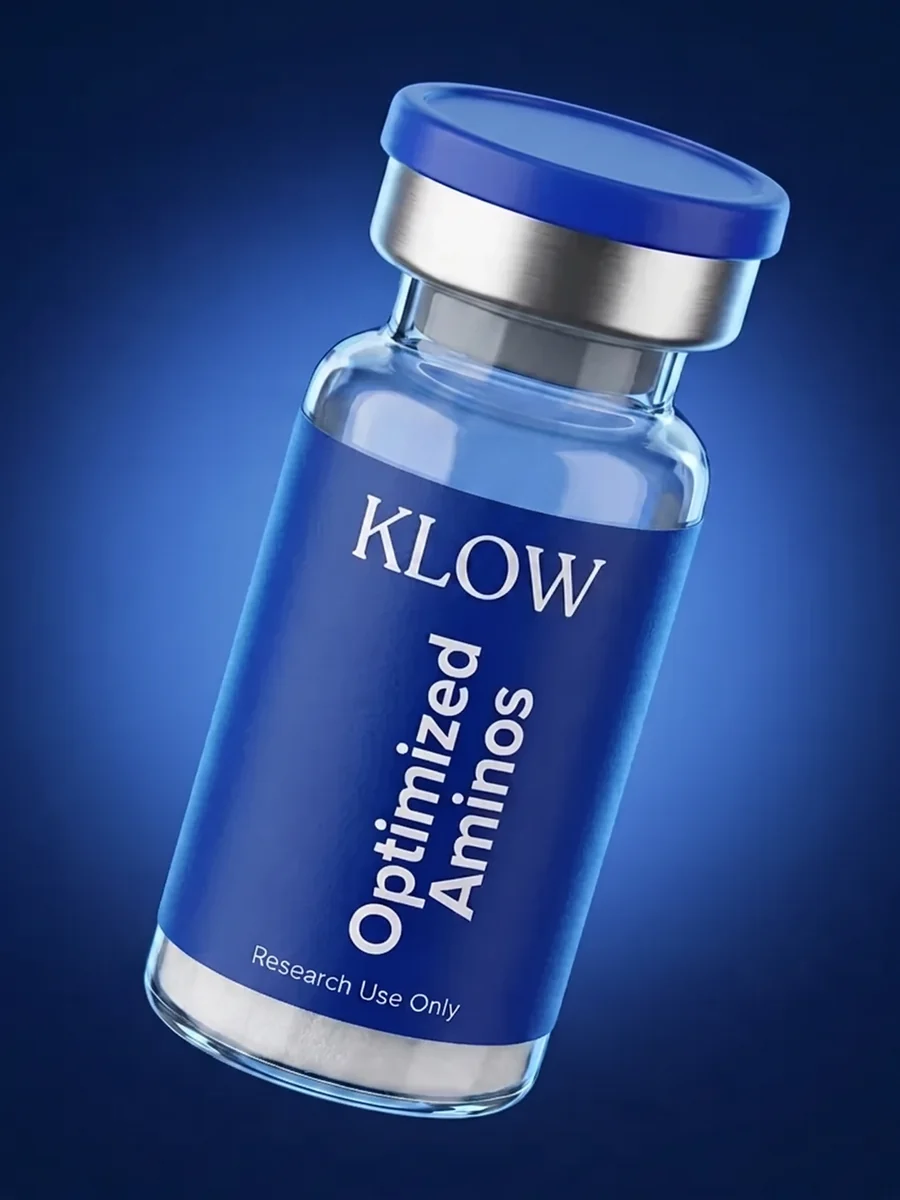
For laboratory research use only. This article compares published list prices and testing documentation for a research-use-only peptide blend. It contains no dosing, human-use, veterinary, or clinical guidance, and makes no health or benefit claims.
A KLOW vial is not a standardised product. Different suppliers use the name for blends of different composition and different total mass, so a price only means something once you know what the vial contains and what testing is published for it. Below are the list prices ten US suppliers advertised for an 80 mg KLOW vial, each with the source it came from and the date that source was read, followed by what a certificate can and cannot tell you about any of them.
What ten suppliers listed for an 80 mg vial
List prices as advertised, with any standing discount code noted in the row rather than folded into the number. Eight were read from the supplier's own storefront on 19 September 2026; two we could not confirm on the vendor's own site and are marked as third-party figures with the date that third party published them. Prices change often — check the source before relying on any row.
| Supplier | List price | Free shipping over | Source and date read |
|---|---|---|---|
| Ascend Science | $115.00 — a printed 30% code brings it to $80.50 | $200 | Vendor site, 19 Sep 2026 |
| Refined Biolabs | $85.00 | $200 | Third party, peptideprices.net, 30 Jul 2026 — not confirmed on the vendor's own site |
| Optimized Aminos | $90.00 | $100 standard, $175 express | Our own product page, 19 Sep 2026 |
| Ameano Peptides | $98.00 | $200 | Vendor site, 19 Sep 2026 |
| Amino Club | $129.99 | Not verified | Third party, brainflow.co, 19 Jul 2026 — not confirmed on the vendor's own site |
| Evo Labs Research | $129.99 | $250 | Vendor site, 19 Sep 2026 |
| Olympex Solutions | $129.99 | $150 | Vendor store data, 19 Sep 2026 |
| Peptira | $149.00 | $250 | Vendor product page, 19 Sep 2026 |
| Core Peptides | $160.00 | $200 | Vendor site, 19 Sep 2026 |
| Protide Health | $175.00 | $199 | Vendor site, 19 Sep 2026 |
Three things worth saying plainly about our own row. On list price we are second of ten, not first — Refined Biolabs lists lower — and if you use Ascend Science's printed code, their $80.50 beats us too, so two of these ten can cost less than we do. Our $100 standard free-shipping threshold is the lowest of these ten, but not the lowest in the category: some suppliers who do not sell KLOW, such as PS Peptides, ship free with no minimum at all. And the two rows we could not verify on the vendor's own site are marked as such rather than quietly presented as current.
The same name does not mean the same vial
"KLOW" is a naming convention, not a formula anyone controls. Refined Biolabs lists a "GLOW 70mg" at $75 alongside it, and Evo Labs Research lists a GLOW at $109.99 — different names, different total masses, different prices. Comparing an 80 mg price against a 70 mg price compares two different products.
The component amounts are what make a comparison real, and they are only knowable from a certificate. The vial we sell is labelled 80 mg total. The report we publish for batch LKB-2026, tested 14 April 2026, gives the measured contents as:
- GHK-Cu (GHK content): 50.65 mg
- BPC-157: 12.61 mg
- TB-500: 11.90 mg
- KPV: 11.21 mg
That report is in our COA archive, open to read without an account. If you are comparing suppliers, ask each one for the same four numbers for the vial you would actually receive. A price per milligram means little without a measured composition behind it.
Testing documentation, including where we come up short
Price is the easy axis. Documentation decides whether a price means anything, and on that axis we do not lead.
- Amino Club is the most documented supplier in this group. The vendor directory at peptideprices.net reported on 7 August 2026 that 102 of its 103 public certificates were verified against the issuing laboratories, and named ILS Laboratories and Freedom Diagnostics as those labs. That is a third-party directory's count, not a figure from Amino Club's own site, and another directory names different labs.
- Optimized Aminos publishes third-party certificates from Janoshik Analytical for 14 of the 19 products we list. The KLOW report above carries a unique key that verifies it on the laboratory's own site. Three gaps you should weigh against that. The certificates we publish were commissioned by someone else, not by us: the client field on the KLOW report names a third party, and the manufacturer is listed separately from it. Five listed products have no certificate: IGF-1 LR3 and GLP2-TR, plus bacteriostatic water, saline and acetic acid solution. And we have no third-party review profile.
We would rather state those three things than have a reader find them. Our guide to reading a peptide COA and spotting a fake one explains why the client field matters and how to verify a report with the issuing lab, whoever you buy from.
How to compare a blend properly
- Confirm the total mass and the component split from a certificate, not from a product description.
- Divide price by the measured milligrams of the component you care about, not by the headline total.
- Check who commissioned the certificate. The client field names whoever sent the sample to the lab.
- Add shipping. A $10 price gap disappears against a $200 free-shipping threshold.
- Check the batch identifier on the report, and ask whether it is the batch currently shipping.
Our guide to peptide blends covers how a blend's concentration maths differs from a single-compound vial, and the testing-transparency framework places this store on the same scale it applies to everyone else.
Frequently Asked Questions
Why do KLOW prices range from $85 to $175?
Because the vials are not the same product. Total mass, the split between components, and what testing is published all differ between suppliers, and the name itself is not standardised. Free-shipping thresholds in this group range from $150 to $250, which moves the real cost again.
Is the cheapest KLOW the best value?
Not necessarily, and we are not the cheapest in the table above. Value depends on the measured composition and on whether a certificate exists that the issuing laboratory will confirm. A low price on an unverifiable vial is not a saving for a research budget.
What should a KLOW certificate show?
Every component named, with the amount measured in the tested vial, plus the laboratory, a batch identifier and a way to verify the report. The certificates published here report the measured amount of each component. Read the report itself rather than a summary of it — a blend certificate that names the blend but not its parts has not told you what is in the vial.
Further reading
- What is a peptide blend? — composition, concentration and how to read a blend certificate.
- How to read a peptide COA and spot a fake one — the ten-point checklist.
- What does 99% purity mean? — reading the chromatogram behind the number.
- How testing works at Optimized Aminos — the purity table built from the published certificates.
For laboratory and research use only. Not for human or animal consumption. Prices and third-party information were read on the dates shown above and will change; verify at the source before relying on them. We have no affiliation with any other supplier named here.
Related research compounds
Compounds referenced in this article, available as research-grade lyophilized peptides with third-party tested COA.