Research Blog
PACAP-38: Biochemistry, Receptors, and Research Applications
Published
Discover pacap 38, a versatile neuropeptide with vital roles in neuroprotection, vasodilation, and neurological development. Learn more!

PACAP-38: Biochemistry, Receptors, and Research Applications
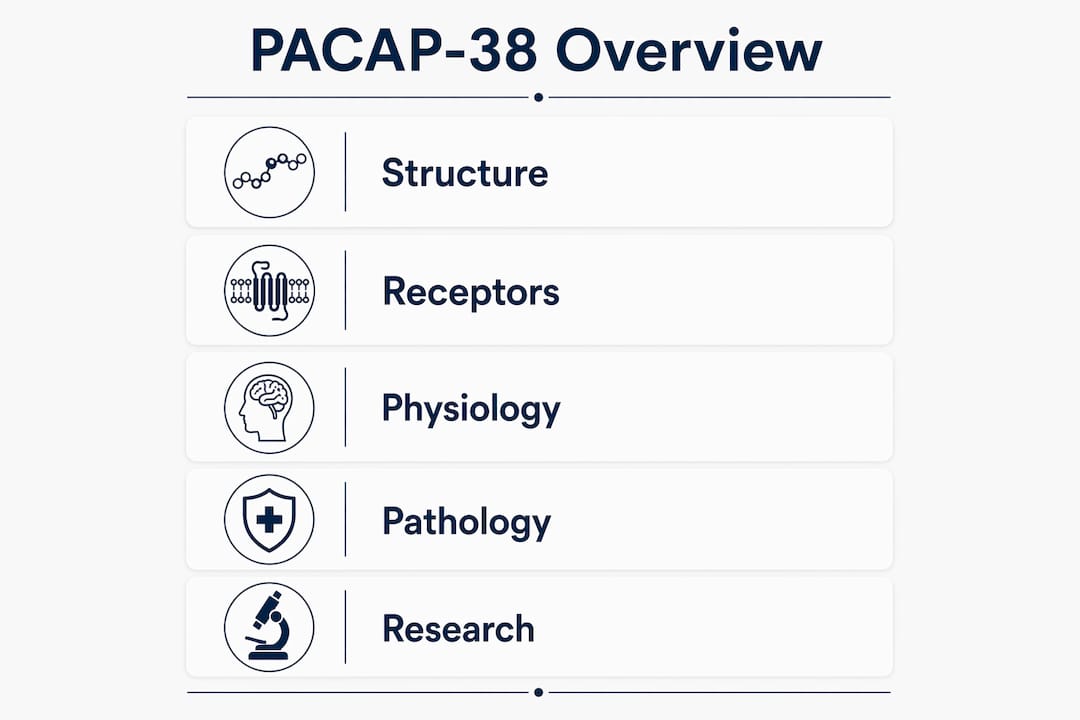
PACAP-38 is a 38-amino acid neuropeptide belonging to the secretin/glucagon/vasoactive intestinal peptide (VIP) superfamily, originally isolated from ovine hypothalamus based on its ability to stimulate cAMP production in anterior pituitary cultures. Its pleiotropic biological roles span neurotransmission, neuromodulation, neurotrophic support, and immunomodulation, making it one of the most functionally diverse neuropeptides characterized to date. Three G-protein-coupled receptors mediate its effects: PAC1, VPAC1, and VPAC2. High evolutionary conservation of the PACAP sequence across mammals signals that these functions are not peripheral adaptations but core physiological requirements.
Key biological roles include:
- Vasodilation in the trigeminovascular system, directly linked to migraine pathogenesis
- Neuroprotection and anti-apoptotic signaling following neural injury or ischemia
- Neurodevelopmental regulation, including neuronal growth and differentiation
- Circadian rhythm entrainment via the retinohypothalamic tract
- Immune modulation, acting on mast cells, microglia, and astrocytes
- Reproductive endocrinology, with transient ovarian expression during the periovulatory period
Molecular structure, isoforms, and biochemical properties of PACAP-38
PACAP-38 and its shorter isoform, PACAP-27, both derive from the same precursor protein. The prepro-PACAP precursor is 176 amino acids long; post-translational processing yields both isoforms with amidated C-terminals, a modification required for full biological activity. PACAP-38 accounts for the predominant proportion of total PACAP in mammals, making it the dominant circulating form.
Key structural and biochemical characteristics:
- Sequence homology: PACAP-38 shares approximately 68% sequence identity with VIP, placing both firmly within the secretin/glucagon superfamily
- Conservation: The sequence is highly conserved across mammalian species, consistent with essential physiological functions
- Physicochemical properties: The peptide is hygroscopic and highly soluble in aqueous buffers; lyophilized powder form is standard for storage
- Stability: Sensitivity to enzymatic degradation, particularly by neutral endopeptidase (NEP), limits in vivo half-life and complicates dosing in pharmacokinetic studies
- Storage requirements: Maintaining activity requires storage at -20°C or colder, protection from light, and avoidance of repeated freeze-thaw cycles
PACAP-27 retains the N-terminal 27 residues of PACAP-38 and shares receptor binding capacity, though PACAP-38 generally exhibits higher potency at PAC1 receptors due to its extended C-terminal region.
How does PACAP-38 bind its receptors and activate intracellular signaling?
PACAP-38 signals through three GPCRs: the PACAP-specific PAC1 receptor, and the shared VPAC1 and VPAC2 receptors, which also bind VIP with comparable affinity. Each receptor subtype carries distinct tissue distributions and downstream signaling profiles, which has direct implications for experimental design.
- PAC1 receptor: PACAP-selective; exists in multiple splice variants (e.g., PAC1-null, PAC1-hop1, PAC1-hip) that alter G-protein coupling preferences. Primarily activates adenylate cyclase (AC) and cAMP/PKA, but also engages phospholipase C (PLC), DAG/IP3/PKC, and endosomal MEK/ERK pathways
- VPAC1 and VPAC2 receptors: Bind both PACAP-38 and VIP with similar affinity; predominantly couple to Gαs and AC/cAMP signaling; expressed broadly in the CNS, lung, liver, and immune tissues
- Ion channel modulation: PACAP-38 modulates BK potassium channels via cAMP/Epac/p38 MAPK, influencing membrane excitability and cerebral artery tone; it also regulates voltage-gated sodium, calcium, and hyperpolarization-activated cation currents
- p38 MAPK pathway: Activated downstream of both PAC1 and VPAC1 receptors, contributing to inflammatory gene regulation and cellular stress responses
Receptor selectivity is a persistent experimental challenge. Because PACAP-38 activates all three receptor subtypes non-selectively, isolating PAC1-specific effects requires the use of selective agonists such as maxadilan or receptor-subtype-selective antagonists. Failing to account for concurrent VPAC1 and VPAC2 activation can confound interpretation of signaling data.
Pro Tip: When designing receptor pharmacology experiments, include VPAC1/VPAC2-selective controls alongside PAC1-targeted conditions. Splice variant expression profiling of PAC1 in your cell model will clarify which downstream pathways are most likely to dominate.

Physiological and pathological roles of PACAP-38 in humans
PACAP-38 functions simultaneously as a hormone, neurotransmitter, and immunomodulator, a combination that makes it unusually difficult to study in isolation. Its expression spans nervous, endocrine, immune, and vascular tissues, and its effects are highly context-dependent.
Physiological roles include:
- CNS neuromodulation: Regulates neuronal excitability, synaptic plasticity, and neuroprotective responses in the hippocampus, cortex, and cerebellum
- Circadian regulation: Acts as a neurotransmitter in the retinohypothalamic tract, mediating photic input to the suprachiasmatic nucleus
- Reproductive function: Transiently expressed in ovarian cells during the periovulatory period, where it acts as an autocrine/paracrine inducer of progesterone secretion and luteinization
- Immune modulation: Modulates mast cell degranulation, microglial activation, and astrocyte function, positioning it at the intersection of neural and immune signaling
- Vascular tone: Expressed in trigeminal ganglion neurons and cranial arteries, where its vasodilatory activity is central to migraine pathogenesis
The pathological relevance of PACAP-38 is most clearly established in migraine. Intravenous infusion induces migraine-like attacks in 58% of migraine patients, a rate that directly implicates the trigeminovascular system. Dysregulation of PACAP-38 signaling also appears in neuroinflammatory and neurodegenerative contexts, where its normally protective anti-apoptotic effects may become maladaptive under chronic activation.

Clinical and experimental research applications of PACAP-38
The most clinically advanced application of PACAP-38 research is migraine prevention. Lu AG09222, a monoclonal antibody that neutralizes PACAP-38 directly, demonstrated promising efficacy in reducing monthly migraine days in treatment-resistant populations. By contrast, AMG-301, which targeted the PAC1 receptor selectively, failed in proof-of-concept trials. That divergence reinforces a key principle: given PAC1 splice variant complexity and concurrent VPAC receptor activity, targeting the peptide itself is a more tractable therapeutic strategy than blocking a single receptor subtype.
For laboratory use, several practical considerations govern experimental reproducibility:
- Storage: Lyophilized PACAP-38 should be kept at -20°C; reconstituted solutions are best used promptly and not subjected to repeated freeze-thaw cycles
- Adsorption losses: The peptide adsorbs readily to standard polypropylene and glass surfaces; pre-conditioning tubes with carrier protein solutions or using low-binding labware reduces this loss
- Degradation: NEP-mediated cleavage limits in vivo half-life; researchers working in whole-animal models often use NEP inhibitors or stable analogs to maintain effective concentrations
- Purity documentation: For receptor pharmacology and signaling studies, peptide purity of 99%+ verified by HPLC and mass spectrometry, accompanied by a third-party Certificate of Analysis, is the minimum standard for reproducible data
Pro Tip: Pre-condition all tubes, pipette tips, and microplates with a 1% BSA solution before introducing PACAP-38. This simple step substantially reduces adsorption-related concentration losses, particularly at low nanomolar working concentrations.
Researchers investigating current peptide research trends will find PACAP-38 increasingly prominent in neurovascular and neuroinflammatory study designs. Gaps remain in understanding receptor subtype-specific contributions to neuroprotection and in developing CNS-penetrant PACAP-38 analogs with improved pharmacokinetic profiles.
Optimized-aminos supplies PACAP-38 as a lyophilized research peptide with 99%+ purity confirmed by HPLC and mass spectrometry. Every batch ships with a third-party tested Certificate of Analysis and is available through the research peptide shop for qualified laboratory buyers. All products are for in vitro research use only and are not intended for human or veterinary administration.
Key Takeaways
PACAP-38 acts through three GPCRs (PAC1, VPAC1, VPAC2) with pleiotropic effects spanning neurovascular regulation, circadian biology, and immune modulation, and its direct neutralization outperforms single-receptor blockade in migraine research.
| Point | Details |
|---|---|
| Dominant isoform | PACAP-38 constitutes the predominant form of total PACAP in mammals and requires C-terminal amidation for full activity. |
| Receptor non-selectivity | PACAP-38 activates PAC1, VPAC1, and VPAC2; selective agonists or antagonists are required to isolate subtype-specific signaling. |
| Migraine induction rate | Intravenous infusion induces migraine-like attacks in 58% of migraine patients, confirming trigeminovascular involvement. |
| Peptide targeting advantage | Lu AG09222 (anti-PACAP-38 antibody) showed efficacy where AMG-301 (anti-PAC1 antibody) failed, supporting direct peptide neutralization. |
| Handling requirements | Storage at -20°C and low-binding labware are necessary to prevent degradation and adsorption losses in experimental settings. |
Recommended
- PT-141 and Melanotan II: What Receptor-Pathway Research Has
- Research Blog | Optimized Aminos
- Research Peptide Directory | A–Z Index of Compounds
- Research Peptide Bundles | Save with Pre-Built Stacks | Optimized Amin
For laboratory and research use only. Not for human consumption.