Research Blog
HGH 191aa Research Overview: Full-Length Somatropin vs the 176-191 Fragment
Published
Full-length recombinant HGH (191aa somatropin) is routinely confused with the 176-191 fragment. This overview covers the 191aa sequence, how it differs from the 192aa variant and the C-terminal fragment, GH-receptor biology in model systems, and IU-versus-mg labeling.
For laboratory and research use only. Not for human consumption.
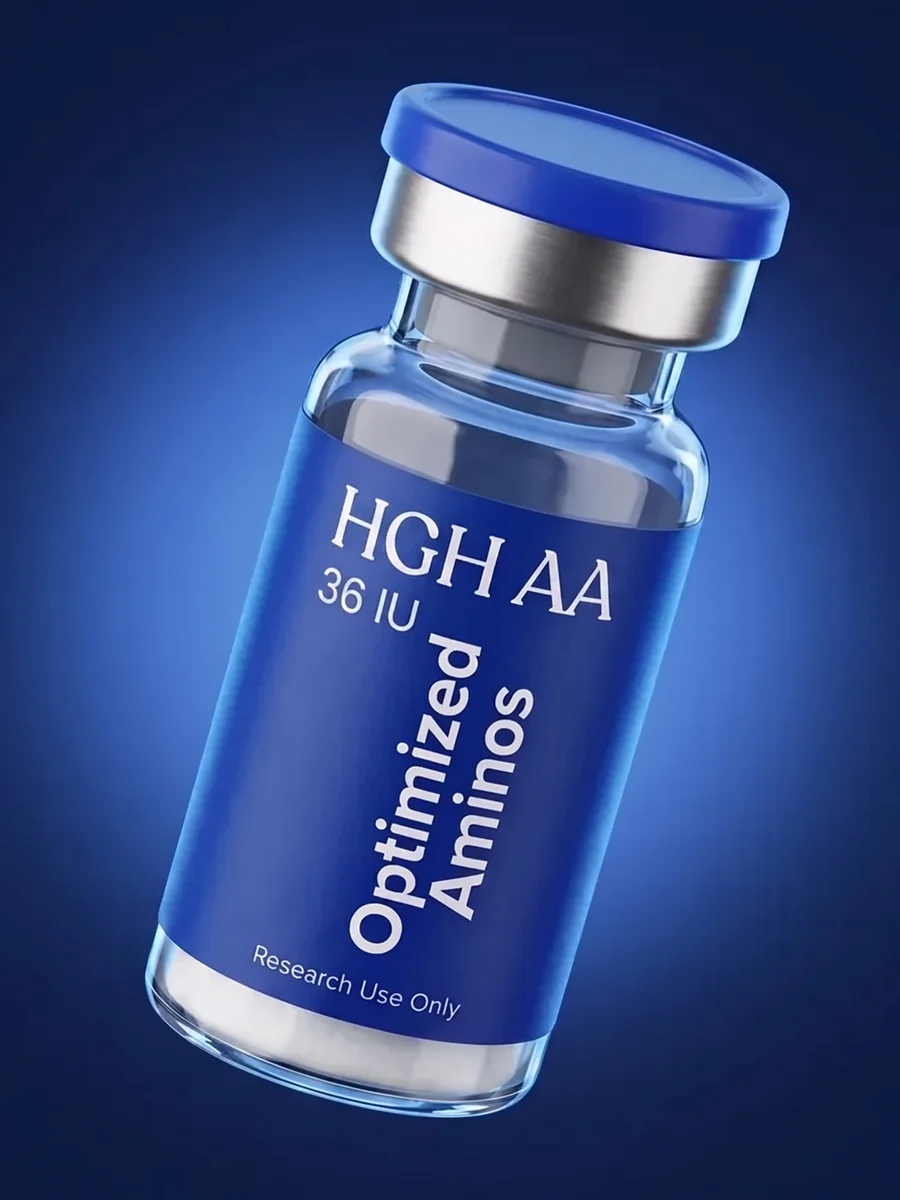
Full-length recombinant human growth hormone — the 191-amino-acid sequence sold in research catalogs as "HGH 191aa" — is one of the most-referenced protein reagents in growth-axis literature, yet it is routinely confused with the short lipolytic fragment 176-191. They are not the same molecule, and the distinction matters the moment a HGH 191aa research vial enters a protocol. This overview describes what the 191aa sequence is, how it differs from the 192aa variant and from the C-terminal fragment, and what published model-system studies actually measure.
What "191aa" Actually Refers To
Human growth hormone (hGH, somatropin) is a single-chain protein of 191 amino acid residues with a molecular weight of roughly 22,124 Da and two intramolecular disulfide bonds. The "191aa" label signals that a preparation carries the complete native pituitary sequence rather than a truncated or modified analog. Because it is a full-length protein rather than a short chain, hGH sits on the protein side of the peptide-versus-protein boundary — a distinction that shapes how it is synthesized, folded, and characterized.
Full-length hGH is produced recombinantly. A DNA template encoding the 191-residue sequence is expressed in a host organism — historically E. coli — and the resulting protein is folded and purified to yield the mature chain. This is a fundamentally different manufacturing route from the solid-phase chemical synthesis used for short research peptides, and it is why hGH reference material is characterized by techniques suited to larger proteins alongside the usual HPLC and mass-spectrometry purity checks.
191aa vs 192aa vs the 176-191 Fragment
Three names circulate in growth-hormone research listings, and conflating them produces real errors in a lab notebook. The table below summarizes the structural differences.
| Designation | Sequence | Approx. MW | What It Is |
|---|---|---|---|
| 191aa (somatropin) | Full native 191-residue chain | ~22,124 Da | Recombinant full-length hGH, identical residue sequence to pituitary hGH |
| 192aa (somatrem) | 191 residues + extra N-terminal methionine | ~22,255 Da | An older methionyl variant; the leading Met is a recombinant-expression artifact |
| Fragment 176-191 | 16-residue C-terminal fragment | ~1,817 Da | A short lipolytic-region fragment — a different reagent entirely |
The 192aa form carries one additional residue: a methionine at the N-terminus left over from bacterial translation initiation. The 191aa form corresponds to the mature, processed sequence without that leading residue. The HGH Fragment 176-191 is not a growth hormone at all in the functional sense — it is a short segment corresponding to the C-terminal region, studied in a narrow lipolytic-model context. A researcher ordering "HGH" who receives a fragment, or vice versa, is working with a molecule that behaves nothing like the one their protocol assumed.
Receptor Biology in Model Systems
Published literature describes full-length hGH acting through the growth hormone receptor (GHR), a member of the class I cytokine receptor family. In model systems, a single hGH molecule engages two receptor subunits, and the resulting receptor dimerization is associated with activation of the JAK2 kinase and downstream STAT5 signaling. A well-documented feature of this axis in cell and animal models is the induction of insulin-like growth factor 1 (IGF-1), largely from hepatic tissue — the basis of the classic "GH/IGF-1 axis" described throughout endocrine research.
These are mechanistic observations reported in named experimental systems, not outcomes in humans. Nothing here describes an effect a preparation would have on a person; the value of a 191aa reference protein in a research setting is as a characterized standard for studying receptor binding, signaling assays, and axis biology in vitro or in defined animal models.
Why hGH Is Measured in IU, Not Just mg
Growth-hormone reference material is often labeled in international units (IU) as well as mass. This is a historical convention: hGH was quantified by bioassay long before precise mass measurement was routine, and the IU is a bioassay-anchored unit rather than a direct measure of weight. A research vial listed at a given IU value also has a corresponding mass in milligrams, and converting between the two is a frequent source of confusion — the same issue covered in depth in the guide to why GH-axis reagents are measured in mg versus IU. Getting the conversion right is a prerequisite for any concentration calculation.
Where Full-Length hGH Sits in the GH-Axis Landscape
Full-length hGH is the terminal effector of a signaling cascade that many other research reagents target upstream. Growth-hormone secretagogues and releasing-hormone analogs — the subject of the GH secretagogues research hub — act on the pituitary to modulate endogenous GH release rather than supplying the hormone directly. Full-length 191aa hGH, by contrast, is the hormone itself. For researchers mapping the axis, the two categories occupy opposite ends: one studies the release machinery, the other studies the released molecule and its receptor.
Handling and Characterization Notes
As a folded protein, full-length hGH is sensitive to conditions that would leave a short peptide unaffected — aggregation, oxidation, and loss of tertiary structure are all documented failure modes for hGH preparations. Reference material is supplied lyophilized and is typically stored cold. A certificate of analysis for a 191aa reagent should report purity by HPLC and identity by mass spectrometry; the measured mass is what confirms the full-length chain is present rather than a truncation or the 192aa variant.
Frequently Asked Questions
Is HGH 191aa the same as HGH Fragment 176-191?
No. The 191aa designation refers to the complete 191-residue growth-hormone protein (~22 kDa). The 176-191 fragment is a 16-residue C-terminal segment (~1.8 kDa) studied in a narrow lipolytic-model context. They are distinct reagents with different molecular weights, structures, and research uses.
What is the difference between 191aa and 192aa growth hormone?
The 192aa form (somatrem) carries an extra N-terminal methionine left over from bacterial expression. The 191aa form corresponds to the mature native sequence without that leading residue. Mass spectrometry on a certificate of analysis distinguishes the two.
Why is HGH measured in international units?
hGH was historically quantified by bioassay, which produced a unit (IU) anchored to biological activity rather than mass. Modern reference vials list both IU and milligram values; converting between them accurately is required before any concentration math.
How is full-length hGH manufactured for research?
It is produced recombinantly — a DNA template encoding the 191-residue sequence is expressed in a host organism, then the protein is folded and purified. This differs from the solid-phase chemical synthesis used for short research peptides.
What signaling pathway does hGH act through in model systems?
Published literature describes hGH binding the growth hormone receptor and driving receptor dimerization, JAK2 activation, and STAT5 signaling, with induction of IGF-1 as a well-documented downstream readout in cell and animal models.
What should a 191aa certificate of analysis confirm?
Purity by HPLC and identity by mass spectrometry. The measured molecular mass (~22,124 Da) is what confirms the full-length chain is present rather than a truncated form or the 192aa variant.
Reviewed by the Optimized Aminos research team — last updated 2026-08-20
For laboratory and research use only. Not for human consumption.
Related research compounds
Compounds referenced in this article, available as research-grade lyophilized peptides with third-party tested COA.