Research Blog
How Research Peptides Are Made: Solid-Phase Peptide Synthesis, Explained Simply
Published
Solid-phase peptide synthesis builds research peptides one amino acid at a time. A plain-language look at how they are made, purified, and verified.
For laboratory research use only. This article explains how research peptides are manufactured. It describes chemistry and analytical methods only and contains no dosing, human-use, veterinary, or clinical guidance, and makes no health or benefit claims.
Where a research peptide actually comes from
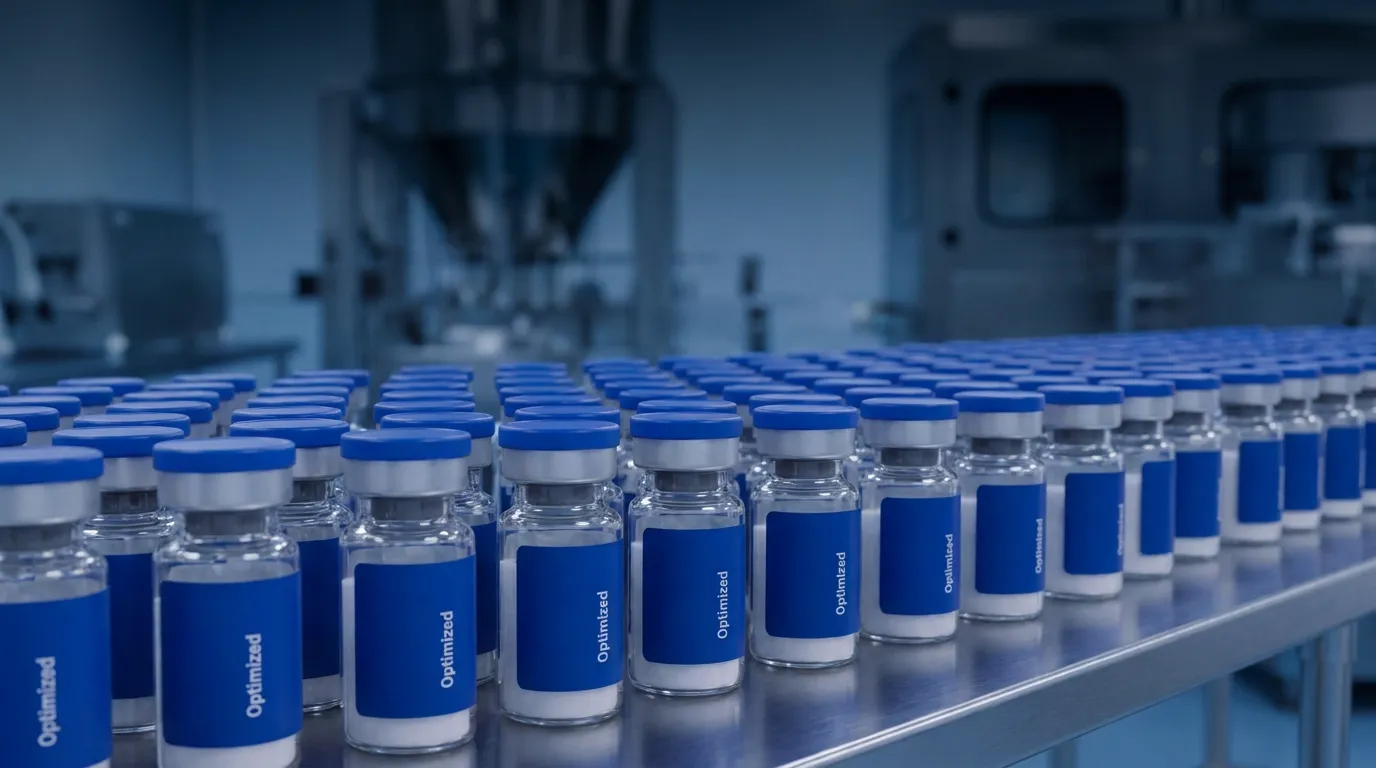
A vial of lyophilized peptide is the end of a long chemical assembly line. Before it becomes a powder in a research fridge, the peptide has to be built one amino acid at a time, cleaved from its scaffold, purified, and verified. The dominant method for making the short-to-medium synthetic peptides used in laboratory research is solid-phase peptide synthesis, or SPPS — a technique that earned Bruce Merrifield the 1984 Nobel Prize in Chemistry and still underpins most of the catalog researchers work with today. Understanding it in outline makes the numbers on a certificate of analysis far easier to interpret.
The core idea: build the chain on a bead
Before SPPS, peptides were assembled in solution, which meant isolating and purifying the growing chain after every single amino acid was added — slow, lossy work. Merrifield's insight was to anchor the first amino acid to an insoluble solid support, typically a small polymer resin bead. With the chain tethered to the bead, everything that is not the peptide — excess reagents, byproducts, solvents — can simply be washed away by filtration between steps. The peptide stays put; the mess leaves.
That single change turned peptide synthesis into a repetitive, automatable cycle. It is the reason the short synthetic peptides common in research libraries, from Semax to Selank, can be produced with consistent sequence fidelity.
The synthesis cycle, step by step
SPPS builds a peptide from the C-terminus toward the N-terminus, repeating the same four operations for every residue in the sequence.
1. Deprotection
Each incoming amino acid arrives with its reactive N-terminal group capped by a temporary protecting group so it cannot react prematurely. To add the next residue, that cap is removed — deprotected — exposing the amine that will form the next bond. In the widely used Fmoc strategy, this is a mild base step.
2. Coupling
The next protected amino acid is activated and introduced. Its carboxyl group forms a new amide (peptide) bond with the freshly exposed amine on the bead-bound chain. Coupling reagents drive this reaction toward completion so that as many chains as possible extend by exactly one residue.
3. Washing
Solvent flushes away unreacted reagents and byproducts. This is the step SPPS exists for — because the chain is anchored, purification between residues is just a rinse.
4. Repeat, then cleave
Deprotect, couple, wash — the cycle runs once per amino acid until the full sequence is assembled. Finally the completed peptide is cleaved from the resin and its side-chain protecting groups are removed, releasing the free peptide into solution.
Why purification is a separate battle
No coupling step is perfectly 100% efficient. Across a sequence of many residues, tiny per-step shortfalls accumulate into a population of closely related impurities: chains missing a residue (deletion sequences), chains that stopped early (truncations), and other byproducts. Crude SPPS product is therefore a mixture, not a pure compound.
This is why manufacturers follow synthesis with preparative high-performance liquid chromatography (HPLC), which separates the target peptide from its near-neighbors so the final material can reach high purity. When a product page cites a purity figure, that number is the output of this purification-and-analysis stage — a concept we unpack further in the peptide chemistry glossary.
How the finished peptide is verified
Purity and identity are two different questions, and a trustworthy peptide is checked for both. HPLC answers "how pure" by resolving the sample into peaks and reporting the target as a percentage of the total. Mass spectrometry answers "is this the right molecule" by measuring the peptide's molecular weight and confirming it matches the intended sequence. The two techniques are complementary — one can pass while the other fails — which is why reputable analytical packages include both, as we explain in our piece on what mass spectrometry confirms that HPLC can't.
For research use, that verification is not optional. Every compound in our catalog is third-party tested, and the analytical results — HPLC chromatograms and mass-spec data — are available in the certificate of analysis archive. A COA is, in effect, the receipt for the entire process described above: proof that the synthesis produced the intended sequence and that purification brought it to the stated purity.
Why this matters at the bench
Knowing how a peptide is made changes how a researcher reads its documentation. A high HPLC purity figure is meaningful precisely because SPPS inherently generates related impurities that have to be removed. A matching mass-spec result is meaningful because a correct molecular weight rules out the deletion and truncation products that accumulate during synthesis. And the lyophilized powder in the vial is dry because the peptide came out of a solution-phase purification and was freeze-dried for stability. Each of these details traces directly back to the manufacturing route.
Widely studied peptides such as BPC-157 are produced this way, and the same interpretive framework applies across the catalog: build the chain on a bead, purify off the byproducts, confirm identity and purity, then verify with third-party testing before anything reaches an experiment.
Bottom line
Solid-phase peptide synthesis assembles a peptide one amino acid at a time on an anchored resin bead, repeating a deprotect–couple–wash cycle before cleaving the finished chain. Because the process inevitably produces related impurities, purification by HPLC and verification by HPLC plus mass spectrometry are what turn crude product into a research-grade, third-party-tested compound. The COA is the paper trail proving it happened.
For laboratory research use only. Not for human or veterinary use. The information above describes peptide chemistry and analytical methods and is not medical, clinical, or dosing guidance.
For laboratory and research use only. Not for human consumption.
Related research compounds
Compounds referenced in this article, available as research-grade lyophilized peptides with third-party tested COA.