Research Blog
BPC-157 vs TB-500: A Research Comparison of Two Tissue-Repair Peptides
Published
How BPC-157 and TB-500 differ in structure, mechanism, and the preclinical research literature — plus why researchers study them together. Research use only.
For laboratory research use only. This article compares two research peptides as they appear in the published preclinical literature. It describes laboratory and animal-model research only, and contains no dosing, human-use, veterinary, or clinical guidance.
Two of the most-studied "repair" peptides
BPC-157 and TB-500 are two of the most frequently studied peptides in the tissue-repair research literature, and researchers new to the area often ask how they differ. They're sometimes grouped together because both appear in preclinical studies of connective-tissue and cellular-repair models — but structurally and mechanistically they are quite distinct molecules. This article lays out those differences and explains why the two are often researched side by side.
At a glance
- BPC-157 — a synthetic 15-amino-acid peptide (a partial sequence derived from a protein found in gastric juice). Molecular weight ≈ 1419 Da. Studied largely in models of localized tissue and gastrointestinal repair.
- TB-500 — a synthetic peptide fragment corresponding to the active region of Thymosin Beta-4, a naturally occurring protein involved in actin regulation. Studied largely in models of cell migration and systemic tissue response.
Structural difference: partial sequence vs. protein fragment
BPC-157 is a stable pentadecapeptide — fifteen amino acids in a specific sequence. It doesn't occur in nature exactly as sold; it's a synthesized partial sequence associated with a body-protection compound isolated from gastric juice, engineered for stability.
TB-500 is the synthetic counterpart of the biologically active fragment of Thymosin Beta-4 (often abbreviated TB-4), a 43-amino-acid protein present in most cell types. Where BPC-157 is its own defined sequence, TB-500 is best understood as a research-grade stand-in for the functional core of a larger, naturally occurring protein.
Mechanistic focus in the literature
The two peptides are studied for different — though occasionally overlapping — pathways:
- BPC-157 appears in preclinical research examining angiogenesis (new blood-vessel formation), growth-factor signalling, and the integrity of the gastrointestinal lining. A recurring theme in the literature is localized tissue response in injury models.
- TB-500 is studied mainly for its relationship to actin — the cytoskeletal protein that gives cells their structure and enables movement. Because TB-4 binds actin and is implicated in cell migration, TB-500 research often centres on the movement of repair-associated cells within tissue models, a more systemic mechanism.
In short, the published work frames BPC-157 around vascular and gut-lining models and TB-500 around cell-migration and cytoskeletal models. They are not two names for the same thing.
Why researchers study them together
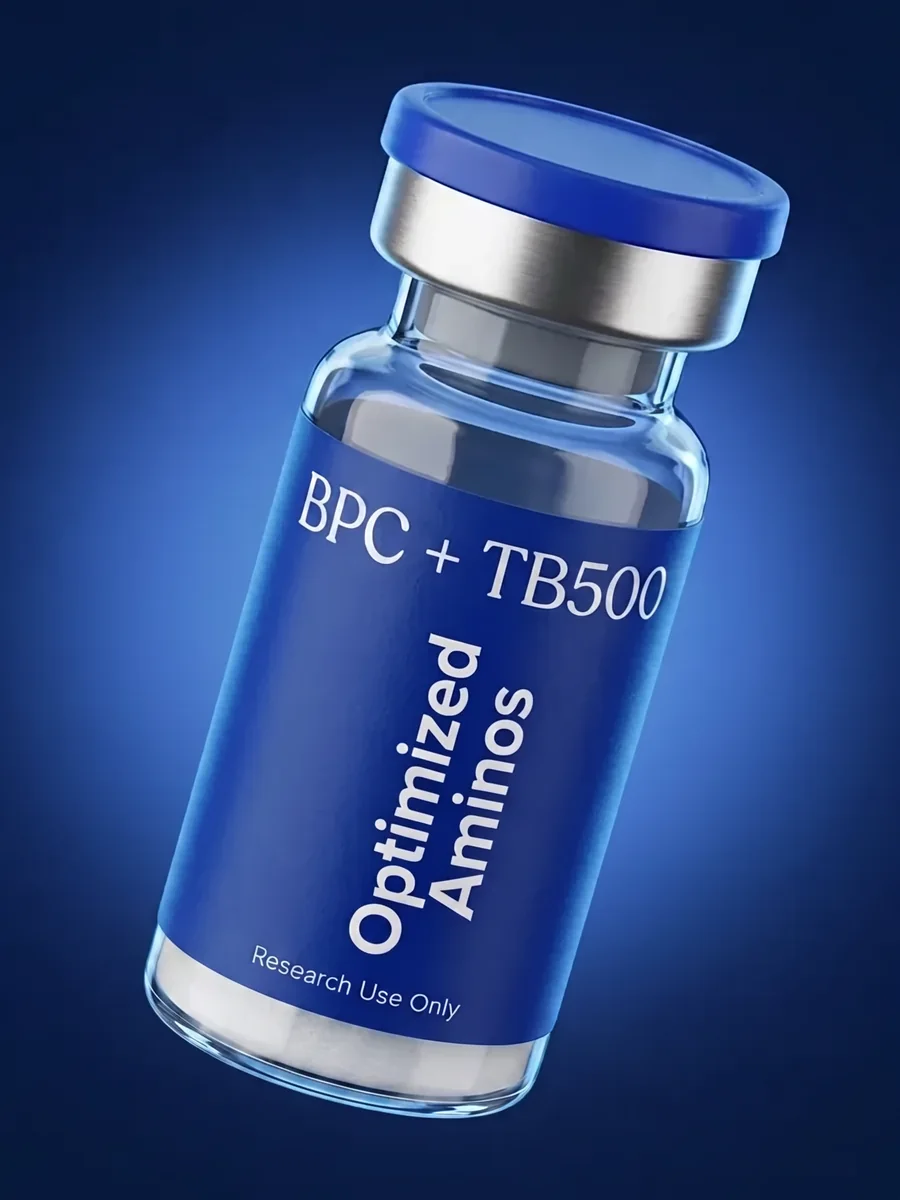
Because their mechanisms are complementary rather than redundant, the two frequently appear together in the same research context — one associated with vascular and growth-factor pathways, the other with cell-migration pathways. That pairing is exactly why blended research materials exist: our BPC + TB500 blend supplies both in a single vial for researchers whose protocol calls for studying the two in parallel, and combination-focused kits such as KLOW place them alongside other connective-tissue-research compounds.
Studying a combination doesn't imply any additive effect in a living organism — that would be a claim outside the scope of research-use material. It simply reflects that the two peptides are commonly investigated in the same experimental space.
Handling and storage: largely the same
From a bench perspective, BPC-157 and TB-500 are handled almost identically. Both arrive lyophilized, both are reconstituted with bacteriostatic water, and both follow the same gentle-swirl, no-shaking rule and the same refrigerated storage for the reconstituted solution. If you're setting up a protocol that uses both, our peptide reconstitution guide covers the concentration math and sterile technique that apply to each.
How to compare the two in your own sourcing
Whichever peptide a project calls for, the evaluation criteria are the same, and they come down to documentation:
- Purity by HPLC — reported to decimals from an integration table, with a legible chromatogram, not a round ">99%" claim.
- Identity by mass spectrometry — confirming the material is the peptide it claims to be, at the right molecular weight (≈1419 Da for BPC-157).
- Independent third-party testing — HPLC purity and mass-spec identity confirmed by an outside lab, not the seller.
The certificates published for both peptides sold here are in the COA archive. For a deeper walk-through of what separates a real report from a fabricated one, see how to spot a fake peptide COA.
The bottom line
BPC-157 and TB-500 are distinct molecules with distinct mechanistic profiles — one a defined 15-amino-acid sequence studied around vascular and gut-lining models, the other a Thymosin Beta-4 fragment studied around actin and cell migration. They're grouped together not because they're interchangeable, but because their research pathways are complementary, which is why they so often show up in the same protocol and in blended research materials. Choose based on the model you're studying, and verify either one the same way: with a real, independent third-party COA.
Further reading
- BPC-157 10mg and the BPC + TB500 blend — third-party tested research material with published COAs.
- How to reconstitute research peptides — the handling steps that apply to both compounds.
- How to spot a fake peptide COA — the verification framework for sourcing either peptide.
All information on this page is provided for laboratory research and educational use only. Optimized Aminos products are not intended for human or veterinary use, and nothing here should be read as describing effects in humans or animals or as dosing or administration guidance.
For laboratory and research use only. Not for human consumption.