Research Blog
Melanotan 2 Reconstitution: mg-to-mL Concentration Math for Research
Published
A worked walkthrough of Melanotan 2 (MT-2) reconstitution math — the mg-to-mL formula for a 10 mg vial, a dilution-ratio reference table with insulin-syringe units, the molarity conversion, diluent selection, and the photosensitivity handling factor.
For laboratory and research use only. Not for human consumption.
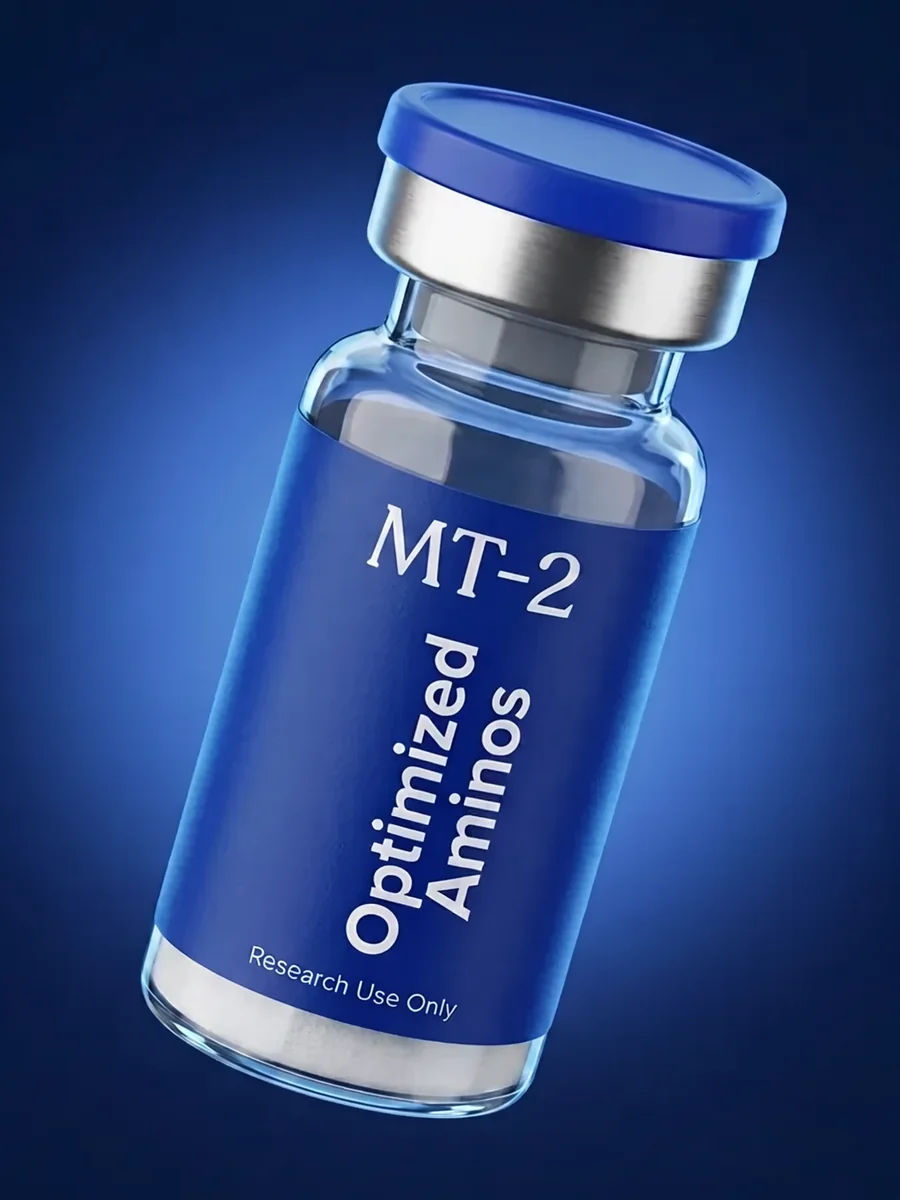
Reconstitution math is the first calculation a researcher runs before a Melanotan 2 (MT-2) 10mg vial enters a protocol, and it is where small arithmetic slips turn into large concentration errors that follow the vial for the rest of its working life. This guide walks through the mg-to-mL formula for a 10 mg MT-2 vial, a reference table of common dilution ratios, the molarity conversion its low molecular weight makes easy, and the handling factors — photosensitivity in particular — that make MT-2 slightly different to reconstitute than a larger peptide.
Why Reconstitution Math Matters for Melanotan 2 Research
Melanotan 2 ships as a lyophilized (freeze-dried) powder. In that state it has no concentration — concentration only exists once a known volume of diluent has been added to a known mass of peptide. Every downstream measurement in a protocol, from micro-liter draws to log entries, depends on that single calculation being correct. A vial reconstituted incorrectly is not off by a small margin; the error propagates through every draw taken from it.
MT-2 is a synthetic cyclic heptapeptide analog of α-MSH with a molecular weight of 1024.18 Da. That low, well-defined mass is what makes the molarity conversion later in this guide straightforward — unlike a large protein, a heptapeptide converts cleanly between mass concentration and molar concentration.
The Core Formula
The formula is the same one used across peptide research generally:
Concentration (mg/mL) = Peptide mass in the vial (mg) ÷ Diluent volume added (mL)
For a Melanotan 2 10mg vial, the peptide mass is fixed at 10 mg. The only variable a researcher controls is how much diluent — typically bacteriostatic water — is added. More diluent produces a lower concentration and a larger working volume; less diluent produces a higher concentration in a smaller volume. Neither is "correct" in the abstract — the right ratio depends on what the protocol's aliquot volumes need to look like.
Reconstitution Table for a Melanotan 2 10mg Vial
| Bacteriostatic Water Added | Resulting Concentration | Volume for a 1 mg Aliquot | Aliquot Volume (µL) |
|---|---|---|---|
| 1 mL | 10 mg/mL | 0.10 mL | 100 µL |
| 2 mL | 5 mg/mL | 0.20 mL | 200 µL |
| 2.5 mL | 4 mg/mL | 0.25 mL | 250 µL |
| 5 mL | 2 mg/mL | 0.50 mL | 500 µL |
Measured with a calibrated micropipette, the 2 mL and 2.5 mL rows are the easiest to work with because their aliquot volumes land on round hundreds of microlitres. A vial reconstituted at 1 mL gives a higher concentration in a smaller total volume, which leaves less margin for measurement error on very small aliquots. The peptide concentration mg/mL quick-reference chart extends this same logic to other vial sizes.
Converting to Molarity
Because MT-2 has a known molecular weight of 1024.18 Da (g/mol), a mass concentration converts directly to a molar concentration:
Molarity (mol/L) = Concentration (g/L) ÷ Molecular weight (g/mol)
A 5 mg/mL solution is 5 g/L. Dividing by 1024.18 g/mol gives roughly 4.88 × 10⁻³ mol/L, or about 4.88 mM. Any receptor-binding or dose-response work described in molar terms needs this step, and the general method — including the unit bookkeeping that trips people up — is covered in the guide to converting mass concentration to molarity.
Diluent Selection
Bacteriostatic water — sterile water containing 0.9% benzyl alcohol — is the common diluent for a multi-draw research vial because the preservative limits microbial growth across repeated entries. Plain sterile water lacks that preservative and is generally reserved for single-use preparations. The trade-offs between the two are laid out in the comparison of bacteriostatic versus sterile water for research use. Whichever diluent a protocol specifies, it should be added slowly down the vial wall rather than injected directly onto the powder cake, to reduce mechanical stress on the peptide.
The Photosensitivity Factor
Melanotan 2 is supplied in an amber-tinted vial specifically because several of its residues are light-sensitive. Reconstitution does not change that — a solution is, if anything, more exposed than a dry cake. Reconstituted MT-2 should be handled away from direct light and stored cold and dark, and prolonged bench exposure under lab lighting is a documented degradation pathway for photosensitive peptides. The mechanism and the case for amber glass are detailed in the discussion of peptide photodegradation and light-sensitive vials. This is one handling factor where MT-2 genuinely differs from a non-photosensitive peptide of similar size.
Common Reconstitution Mistakes
The recurring errors are arithmetic and procedural rather than exotic: adding diluent by guess instead of measuring it, forgetting that the concentration depends entirely on the volume added, reading an insulin syringe in the wrong unit scale, and leaving a reconstituted photosensitive peptide on a lit bench. Each one is avoidable by writing the target concentration and diluent volume into the notebook before the diluent goes in, then confirming the draw volume against the table above.
Frequently Asked Questions
How much bacteriostatic water should I add to a Melanotan 2 10mg vial?
There is no single correct volume — it depends on the concentration a protocol needs. Adding 2 mL yields 5 mg/mL; 2.5 mL yields 4 mg/mL. The reconstitution table above lists common ratios and the corresponding draw volumes.
What is the mg-to-mL formula for reconstitution?
Concentration (mg/mL) equals peptide mass in the vial (mg) divided by diluent volume added (mL). For a 10 mg MT-2 vial the mass is fixed at 10 mg, so only the diluent volume varies.
How do I convert a Melanotan 2 concentration to molarity?
Divide the concentration in g/L by the molecular weight, 1024.18 g/mol. A 5 mg/mL (5 g/L) solution works out to roughly 4.88 mM.
Why is Melanotan 2 supplied in an amber vial?
Several of its residues are light-sensitive. The amber tint reduces light exposure to the lyophilized powder; a reconstituted solution should likewise be kept cold and away from direct light.
Can I use plain sterile water instead of bacteriostatic water?
Sterile water lacks the benzyl alcohol preservative that limits microbial growth across repeated vial entries, so it is generally reserved for single-use preparations rather than a multi-draw research vial.
Does the peptide mass change if I add more diluent?
No. The mass in the vial is fixed at 10 mg. Adding more diluent lowers the concentration and increases the working volume, but the total peptide mass is unchanged.
Reviewed by the Optimized Aminos research team — last updated 2026-08-20
For laboratory and research use only. Not for human consumption.
Run the numbers for your own vial
The reconstitution calculator takes a labeled vial mass and a solvent volume and returns the resulting concentration in mg/mL, along with the aliquot volume in microlitres for any target mass — the same arithmetic worked through above, without the decimal-place risk of doing it from memory. Bacteriostatic water (10 mL) is the diluent used in these worked examples, and every compound referenced here is third-party tested with a published COA.
Related research compounds
Compounds referenced in this article, available as research-grade lyophilized peptides with third-party tested COA.