Research Blog
NAD+ in Cellular Research: What the Literature Describes
Published
A laboratory reference on NAD+: its redox role in energy metabolism, its newer role as a consumed signaling substrate, biosynthesis pathways, and handling.
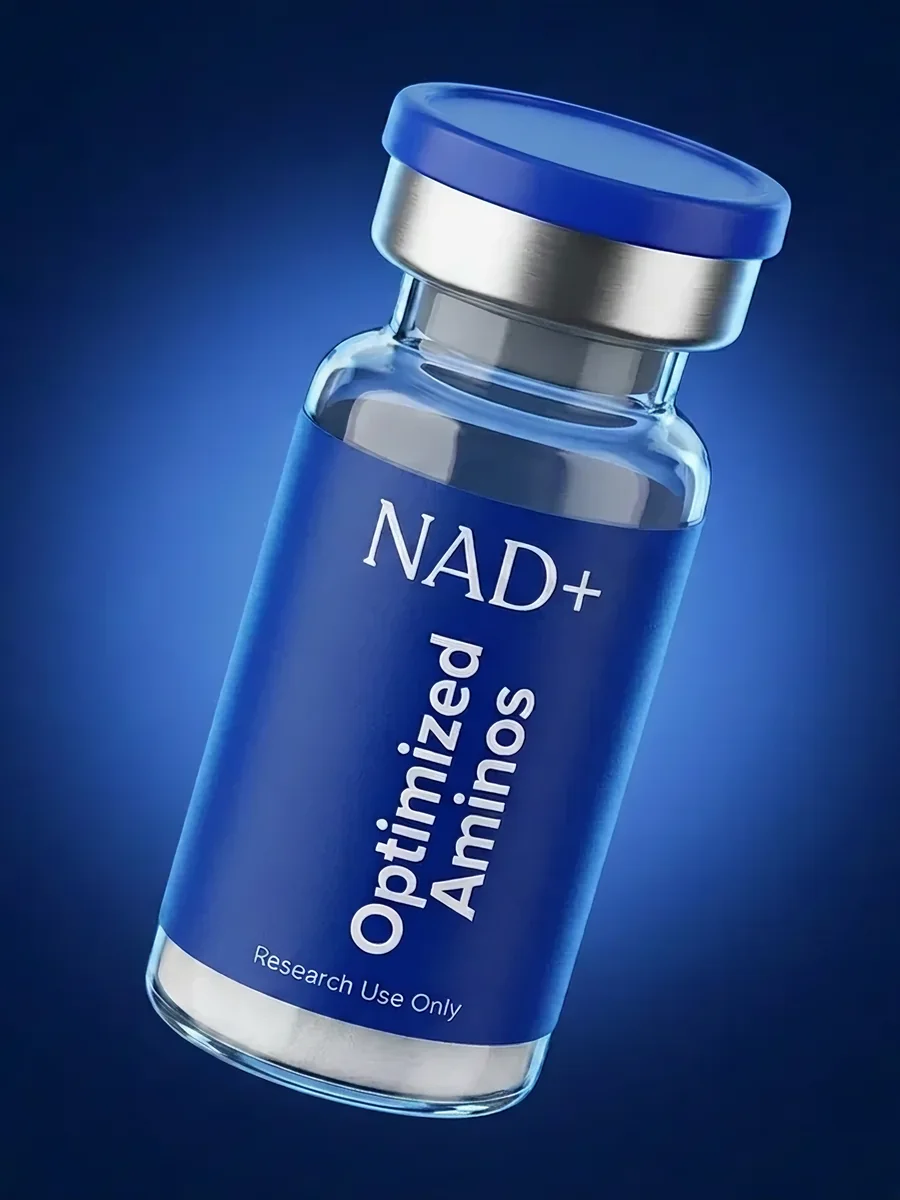
For laboratory research use only. The following summarizes publicly available biochemical and preclinical literature for reference. It is not medical, veterinary, or dosing guidance and makes no health or therapeutic claims. These materials are intended for qualified researchers working in controlled laboratory settings.
Few molecules appear in cellular-research literature as often as NAD+ — nicotinamide adenine dinucleotide. It is one of the most fundamental coenzymes in biology, and interest in it as a research subject has grown sharply as its roles in metabolism and cellular signaling have been mapped in more detail. This article describes what the research literature actually covers about NAD+, framed for laboratory reference rather than any applied use.
What NAD+ is, chemically
NAD+ is a dinucleotide: two nucleotides joined through their phosphate groups, one carrying an adenine base and the other a nicotinamide base. It exists in a redox pair — the oxidized form, NAD+, and the reduced form, NADH. This interconversion is the heart of its most-studied function: NAD+ accepts electrons in catabolic reactions to become NADH, and NADH donates them elsewhere. That electron-shuttling cycle is why NAD+ is described as a coenzyme in hundreds of enzymatic reactions.
Because it is a small, water-soluble molecule rather than a peptide, NAD+ handles somewhat differently at the bench than the peptides in our catalog — but the same principles of careful reconstitution and cold storage apply, as covered in our guide on how to store research compounds by refrigeration and freezing.
The two research themes the literature keeps returning to
1. Energy metabolism and the redox balance
The oldest and best-established body of NAD+ research concerns its role in central metabolism — glycolysis, the citric-acid cycle, and oxidative phosphorylation all depend on the NAD+/NADH ratio. Research models frequently use that ratio as a readout of a cell''s metabolic state. This is the domain where NAD+ overlaps conceptually with mitochondrial-signaling research, a theme we explore in our MOTS-c vs NAD+ mitochondrial research comparison.
2. NAD+ as a substrate, not just a cofactor
A more recent and rapidly expanding theme is NAD+''s role as a consumed substrate for a family of enzymes — sirtuins, PARPs, and CD38 among them. Unlike its redox role, where NAD+ is recycled, these enzymes cleave the molecule, meaning cellular NAD+ pools are actively depleted and must be resynthesized. This "NAD+ consumption" biology is what drives much of the current interest in the coenzyme as a research target, because it links NAD+ availability to signaling processes studied in models of cellular stress and aging.
Biosynthesis and precursor pathways
Cells maintain NAD+ through several biosynthetic routes: the de novo pathway from tryptophan, the Preiss-Handler pathway from nicotinic acid, and the salvage pathway that recycles nicotinamide. Precursor molecules such as NMN and NR feed these pathways and are themselves frequent subjects of comparative research. The salvage pathway, which regenerates NAD+ from the nicotinamide released by consuming enzymes, is the route most often examined in models of NAD+ turnover.
Why NAD+ is a demanding research compound
NAD+ is sensitive. It is subject to hydrolysis, its redox state can shift with handling, and measured NAD+/NADH ratios are notoriously dependent on how quickly and cleanly samples are processed. Researchers characterizing NAD+ typically pay close attention to freeze-thaw cycles, extraction speed, and analytical method — small procedural differences can produce large apparent differences in results. For any NAD+ research material, confirming identity and purity against a certificate of analysis is a baseline step; our COA archive shows the kind of third-party testing documentation researchers should expect.
Measuring NAD+ in the lab
Because NAD+ and NADH interconvert so readily, measuring them accurately is its own research challenge. Common approaches include enzymatic cycling assays, which amplify a signal proportional to the coenzyme present, and analytical separations such as HPLC or LC-MS that can quantify NAD+ and its metabolites directly. A recurring methodological point in the literature is that the NAD+/NADH ratio is highly sensitive to how the sample is quenched: because the two forms convert during extraction, results depend on stopping enzymatic activity quickly and consistently. Studies that report NAD+ measurements therefore tend to describe their extraction and quenching protocol in detail, and comparisons across studies have to account for methodological differences. For any lab characterizing NAD+ as a research material, controlling these analytical variables is as important as the source purity itself.
Where NAD+ sits among research peptides and cofactors
NAD+ is not a peptide, but it is frequently studied alongside peptides that touch the same metabolic and mitochondrial pathways. Labs assembling a metabolic- or mitochondrial-research bench often keep NAD+ next to compounds like those in our mitochondrial-research reading, including the overview of what MOTS-c metabolic research has measured. You can review our NAD+ research material and our MOTS-c research material for the documentation and formats we supply, and pair either with bacteriostatic water for reconstitution where appropriate.
Summary
NAD+ research divides cleanly into two currents: its classical role as a redox coenzyme in energy metabolism, and its newer characterization as a consumed substrate for signaling enzymes that deplete cellular pools. Both are active areas, and both make NAD+ one of the more procedurally demanding compounds to characterize because of its sensitivity to handling. For researchers, the practical takeaways are to control sample processing tightly and to verify every batch against proper third-party testing before beginning work.
For laboratory research use only. Nothing here is intended for human or animal use. All materials referenced are supplied for in-vitro and other controlled preclinical research by qualified professionals and are third-party tested for identity and purity. This article describes published research and asserts no health, therapeutic, or performance outcome.
For laboratory and research use only. Not for human consumption.