Research Blog
Where to Buy Selank for Research in 2026: Sourcing & COA Checklist
Published
A 2026 sourcing guide for laboratory researchers evaluating Selank suppliers, COA verification, and third-party purity testing standards.
For laboratory and research use only. Not for human consumption.
Selank is a synthetic heptapeptide that has drawn sustained interest in behavioral and neuropharmacology research circles. As demand for research-grade Selank has grown heading into 2026, so has the range of supplier quality — from laboratories that publish rigorous third-party testing to sellers who provide little more than a product photo. This guide walks through what a serious research buyer should evaluate before selecting a Selank source, with a focus on certificate of analysis (COA) literacy and verification steps.
Key Facts
- Selank is a synthetic analog of the endogenous immunomodulatory peptide tuftsin, studied primarily in rodent behavioral models.
- Published research on Selank has largely used in vivo rodent models and in vitro assays to characterize its interaction with central nervous system pathways.
- A trustworthy Selank COA should report both HPLC purity and mass spectrometry identity confirmation, tied to a specific production lot.
- Selank is classified as a research chemical for laboratory use and is not approved by any regulatory agency for human administration.
- Reconstitution of lyophilized Selank into a working stock solution is a concentration calculation, not a human dosing instruction.
What Selank Represents in Peptide Research
Selank belongs to a family of tuftsin-derived peptide fragments that researchers have studied for their interactions with neuropeptide signaling pathways. Preclinical literature has examined Selank in rodent behavioral assays, including elevated plus maze and other standardized stress-response paradigms, as well as in vitro work characterizing enzymatic stability and receptor-adjacent activity. Because the compound is short-lived once in aqueous solution, researchers typically work from lyophilized (freeze-dried) powder that is reconstituted immediately before an experiment.
Why Sourcing Quality Is the First Variable to Control
In any peptide research protocol, the compound itself is a variable that needs to be controlled before an experiment can be considered valid. A vial that is mislabeled, degraded, underfilled, or cut with filler material introduces uncontrolled variability into downstream results. This is why sourcing — not just price — should be the first checkpoint in a research buyer's workflow.
Third-Party HPLC and Mass Spectrometry Testing
High-performance liquid chromatography (HPLC) is the standard method for estimating peptide purity by resolving a sample into its component peaks and calculating the percentage of total peak area attributable to the target compound. However, HPLC purity alone does not confirm that the resolved peak is actually Selank rather than a similarly sized contaminant. Mass spectrometry (MS) is the complementary method that confirms molecular identity by matching observed mass to the expected molecular weight. A rigorous supplier will provide both, generated by an independent, third-party laboratory rather than in-house equipment alone. Our own approach to this is detailed on our third-party testing page, which outlines how lot-specific verification should be documented and disclosed.
Common COA Red Flags
Several patterns should raise questions for a research buyer reviewing a COA:
- A COA with no lot number, making it impossible to match the document to the specific vial received.
- Purity data with no accompanying chromatogram image, only a stated percentage.
- HPLC data but no mass spectrometry confirmation of identity.
- A testing date that is more than a year old relative to the current production run.
- A laboratory name that cannot be independently verified as an operating, accredited facility.
A Practical COA Checklist for Research Buyers
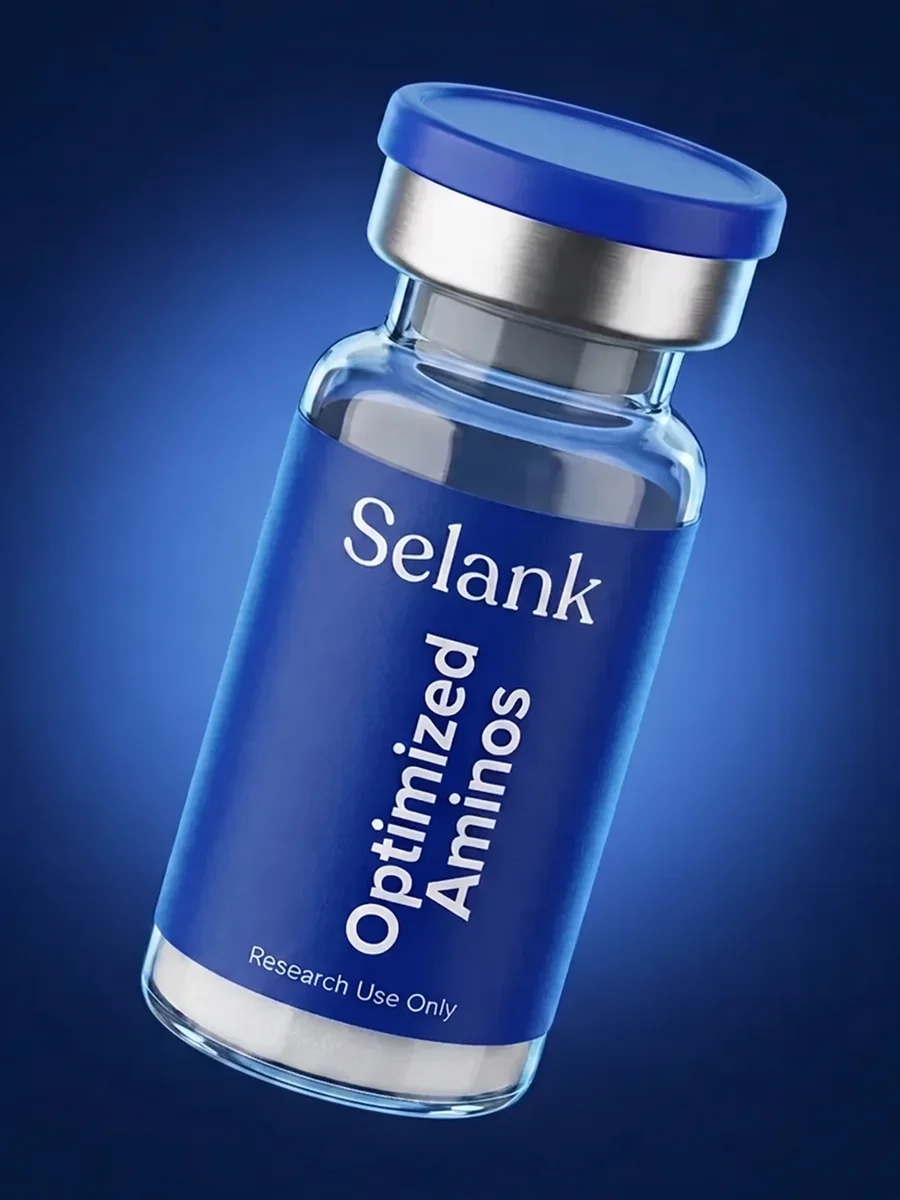
Before finalizing a Selank source, researchers can work through a short checklist: confirm the COA is a current, third-party tested document rather than a recycled generic; confirm both HPLC and MS data are present; confirm the testing laboratory is named and, ideally, independently searchable; confirm the reported purity threshold is stated numerically rather than described qualitatively (e.g., "high purity" without a percentage); and confirm the supplier is willing to provide the raw chromatogram, not just a summary line. Selank listed for research use is available on our Selank 10mg research product page, where lot documentation is provided for exactly this kind of review.
Reconstitution and Concentration Math for the Lab Bench
Once a research-grade vial has been sourced and verified, the next step in most protocols is reconstitution — dissolving the lyophilized peptide in an appropriate solvent to create a working stock solution at a known concentration. This is purely arithmetic: total peptide mass divided by solvent volume yields a concentration expressed in milligrams per milliliter, which downstream in vitro or in vivo protocols then reference for pipetting volumes. Rather than doing this math by hand, researchers can use our reconstitution calculator to model different solvent volumes and see the resulting stock concentration instantly. This calculator is a lab-bench tool for concentration planning, not a source of human dosing guidance.
Selank in Context: Related Comparison Research
Selank is frequently discussed alongside Semax, a structurally distinct but functionally related peptide also studied in neurobehavioral rodent research. Researchers comparing the two compounds' reported study designs, stability profiles, and structural differences may find our two comparison articles useful: Semax vs. Selank: Cognitive Research Comparison and Selank vs. Semax: Nootropic Research Comparison, both of which summarize how published preclinical literature has characterized each peptide's studied mechanisms.
Frequently Asked Questions
What should a Selank certificate of analysis (COA) include?
A complete Selank COA should include the lot number, HPLC purity percentage, mass spectrometry confirmation of molecular identity, testing date, and the name of the third-party laboratory that performed the analysis, not just the internal supplier's own numbers.
Is Selank approved for human use?
No. Selank is sold and studied strictly as a research chemical for laboratory and in vitro or animal-model research. It is not an approved drug and is not intended for human consumption.
How can researchers verify a supplier's purity claims?
Researchers can request a lot-specific COA, cross-check it against independent third-party testing when available, and confirm that both HPLC and mass spectrometry data are reported, since HPLC alone confirms purity but not molecular identity.
How is a Selank stock solution concentration calculated?
Stock solution concentration is calculated by dividing the total peptide mass in a vial by the volume of solvent added, a standard concentration calculation that laboratories can perform manually or with a reconstitution calculator tool.
For laboratory and research use only. Not for human consumption.
Related research compounds
Compounds referenced in this article, available as research-grade lyophilized peptides with third-party tested COA.