Research Blog
Where to Buy the GH Stack for Research in 2026: Sourcing & COA Checklist
Published
A supplier vetting framework for the GH Stack (CJC-1295 no DAC + Ipamorelin + Tesamorelin): per-vial COAs, GHRH/GHS-R1a identity confirmation, and multi-vial reconstitution planning. Research use only.
For laboratory and research use only. Not for human consumption.
The GH Stack has a composition explainer and a reconstitution walkthrough, but unlike single-compound bestsellers such as BPC-157 or GHK-Cu, it has never had a dedicated sourcing guide of its own. Because the stack combines two separately reconstituted vials targeting two different receptor systems, evaluating a supplier means checking documentation for each vial independently, not treating "the stack has a COA" as one pass/fail condition. This guide covers what to verify before ordering.
What the GH Stack Actually Contains
The GH Stack ships as two vials: a co-lyophilized CJC-1295 (no DAC) + Ipamorelin vial, and a separate Tesamorelin vial. CJC-1295 (no DAC) and Tesamorelin are both GHRH-receptor agonists, while Ipamorelin acts on the separate GHS-R1a receptor. Because the three peptides are studied through two distinct receptor mechanisms, a researcher combining them is typically probing both arms of growth-hormone-axis signaling, not a single pathway.
Why Sourcing a Two-Receptor-System Stack Needs Extra Diligence
A stack is only as well-documented as its least-documented vial. A supplier can publish a clean Certificate of Analysis for the Tesamorelin vial while shipping an undocumented CJC-1295/Ipamorelin co-lyophilized preparation, or the reverse. Evaluating the GH Stack means requesting COAs for both vials separately and confirming each is batch-specific, since a single generic certificate covering "the stack" as a whole does not confirm the identity of either component vial.
The Supplier Vetting Checklist
1. A Separate, Batch-Specific COA for Each Vial
Request documentation for the CJC-1295/Ipamorelin vial and for the Tesamorelin vial independently. Each should carry its own lot number and its own third-party lab report — a single certificate covering the kit as a whole is not equivalent to two vial-specific ones.
2. LC-MS Identity Confirmation for Both Receptor-Class Peptides
HPLC purity shows how clean a sample is relative to itself; it does not confirm which molecule is in the vial. Mass spectrometry confirms identity by matching observed mass to the expected mass of each sequence. This matters especially in the co-lyophilized vial, where CJC-1295 and Ipamorelin each need independent identity confirmation despite sharing a container.
3. A Named, Accredited Third-Party Lab
Look for a testing partner named on the certificate, ideally operating to ISO/IEC 17025 or an equivalent standard, for both vials. An anonymous "independent lab" credit on a COA is not verifiable.
4. Consistent RUO Labeling Across the Whole Kit Listing
A stack listing that frames any one vial around personal outcomes, rather than what receptor-binding or pharmacokinetic research has measured, is a compliance signal worth weighing regardless of how clean the purity numbers look. Check the listing copy for both vials, not just the headline product name.
5. Published Reconstitution Guidance for Both Vials
Because the kit involves two vials reconstituted to independent concentrations, concentration math has to be worked out per vial. Our GH Stack reconstitution guide walks through the mg-to-mL math for each vial in the kit.
Understanding the Stack Before You Evaluate a Listing
Knowing what published pharmacology actually describes for each receptor system makes it easier to spot a listing that overstates its own subject matter. Our explanation of the GH Stack combination covers why a GHRH-receptor agonist and a GHS-R1a agonist are paired together, and our comparison of Tesamorelin and CJC-1295 lays out how the two GHRH-receptor analogs differ structurally, which is useful context for understanding why both appear in GH-axis research literature rather than one substituting for the other. A broader survey of this receptor landscape is available in the GH secretagogues hub.
Red Flags Worth Treating as Disqualifying
Rule a kit listing out if either vial ships without its own COA, if a certificate cannot be matched to a lot number, if the kit's price is far below what documented individual vials would cost separately with no testing to explain the gap, or if the listing describes personal outcomes for either vial rather than research findings in receptor-binding or pharmacokinetic model systems. A stack is not a shortcut around per-vial diligence — it is two sourcing decisions bundled into one purchase.
Storage Considerations for a Two-Vial Kit
A stack adds a logistical wrinkle a single-compound order doesn't have: two lyophilized vials, potentially with different stability profiles, arriving and needing storage at the same time. Both vials should stay refrigerated or frozen and protected from light until reconstitution, and each should be labeled clearly enough that a lab notebook entry can trace a given aliquot back to its specific lot number months later. Treating the kit as a single undifferentiated "stack" in storage records, rather than two individually tracked materials, makes it harder to isolate which vial was involved if a result doesn't reproduce.
Frequently Asked Questions
What peptides are in the GH Stack?
The GH Stack ships as two vials: a co-lyophilized CJC-1295 (no DAC) + Ipamorelin vial, and a separate Tesamorelin vial. All three peptides are studied in growth-hormone-axis research, across two distinct receptor mechanisms.
Is the GH Stack legal to purchase for laboratory research?
Research-use-only compounds like these are generally available for purchase by qualified laboratories and researchers in many jurisdictions, but rules vary by location and can change. The stack is sold strictly for laboratory research and is not approved or labeled for human consumption.
Do I need a separate COA for each vial, or is one certificate enough?
Each vial should have its own batch-specific Certificate of Analysis. A single certificate covering the kit as a whole, without lot-specific data for both the CJC-1295/Ipamorelin vial and the Tesamorelin vial, does not confirm the identity or purity of either.
Why does the GH Stack combine a GHRH-receptor agonist with a GHS-R1a agonist instead of using one receptor pathway?
CJC-1295 and Tesamorelin act on the GHRH receptor, while Ipamorelin acts on the separate GHS-R1a receptor. Combining a GHRH-receptor agonist with a GHS-R1a agonist is a documented pairing in GH-axis pharmacology because the two receptor pathways act on complementary steps of growth-hormone pulse generation.
How should the two GH Stack vials be stored between reconstitution sessions?
Refrigerate both reconstituted vials at 2-8°C, protect from light, and label each with the reconstitution date and concentration used, since the two vials in this kit are not reconstituted to matching concentrations.
Reviewed by the Optimized Aminos research team — last updated August 24, 2026.
For laboratory and research use only. Not for human consumption.
Related research compounds
Compounds referenced in this article, available as research-grade lyophilized peptides with third-party tested COA.
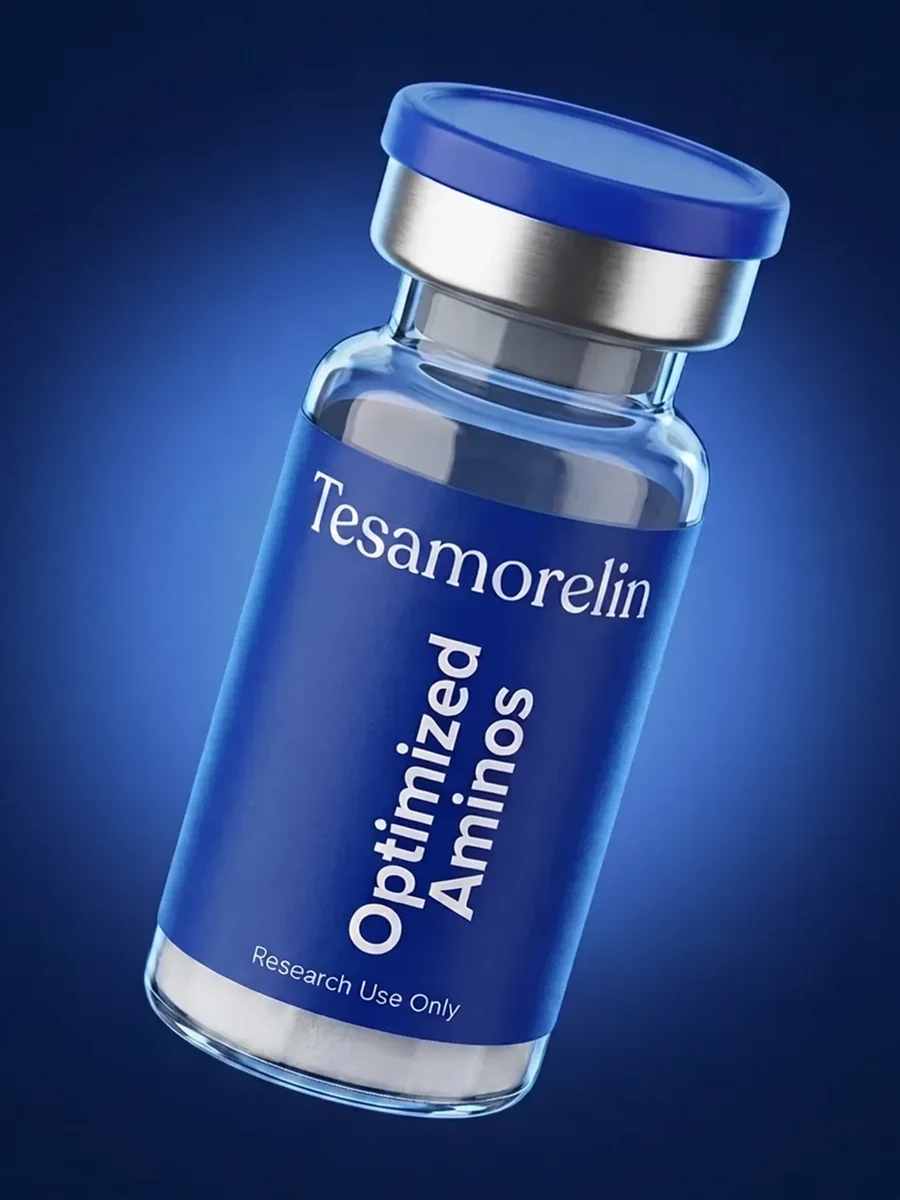
Tesamorelin reference peptide — synthetic GRF analog of 44 amino acids with a trans-3-hexenoic acid modification (MW ~5135.8 Da). Produced at >98% purity with structural confirmation via peptide mapping and MALDI-TOF. Referenced in published preclinical endocrinology literature. Temperature-sensitive — requires cold-chain storage at -20°C; cold-pack shipping recommended. Reconstitute with bacteriostatic water. For in-vitro laboratory and analytical research use only. Not a drug, supplement, or therapeutic product. Not for human or animal consumption, ingestion, injection, or any clinical use. Not FDA-approved.
View product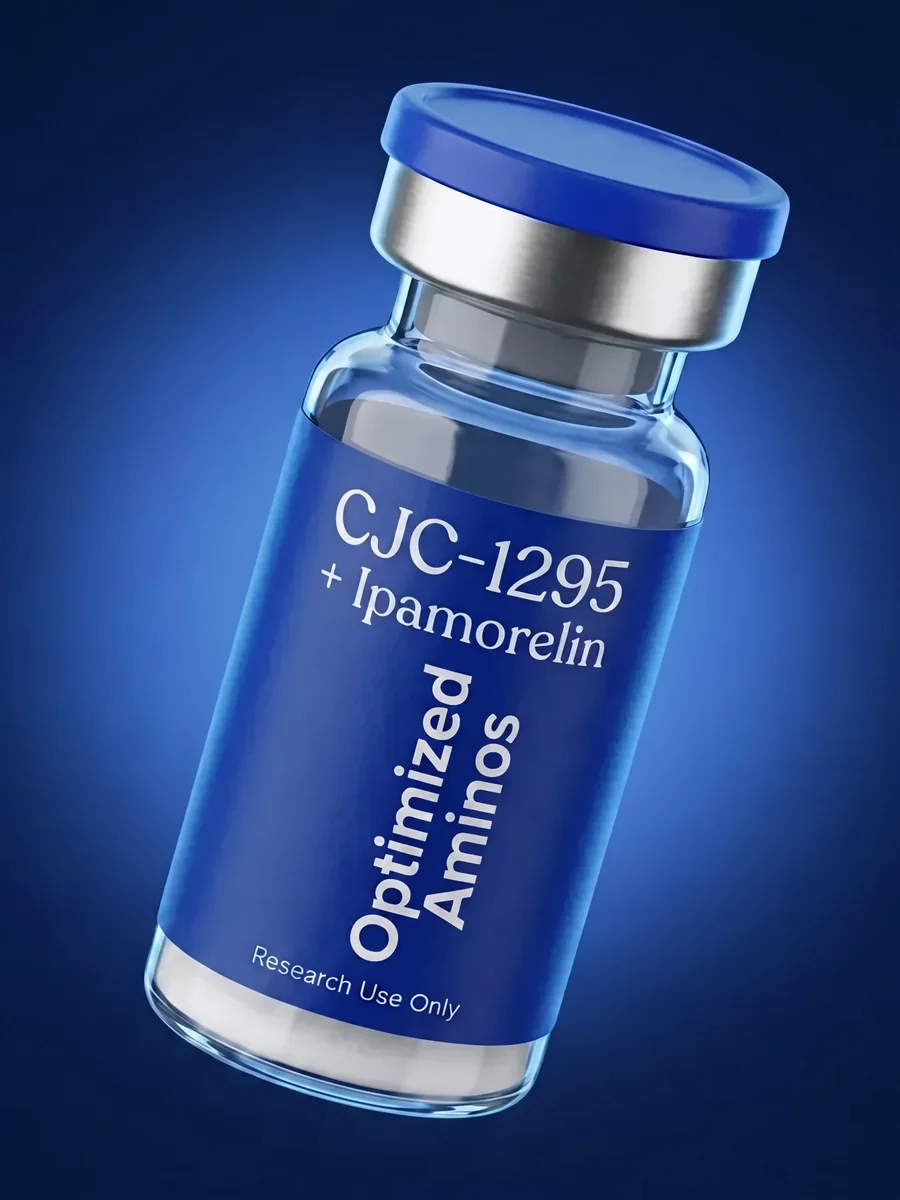
Research-grade lyophilized blend of CJC-1295 without DAC (mod GRF 1-29, MW 3367.97 Da) and Ipamorelin (MW 711.85 Da). Both peptides are synthesized at >98% purity and verified by third-party HPLC analysis. Studied in published in-vitro and preclinical literature on growth hormone secretagogue signaling. Supplied as lyophilized powder in a sealed sterile vial; store frozen at -20°C. Reconstitute with bacteriostatic water for laboratory use. For laboratory and analytical research use only. Not for human or animal consumption, ingestion, injection, therapeutic, cosmetic, or diagnostic use. Not an FDA-approved product.
View product