Research Blog
HGH 191aa Reconstitution: mg-to-mL Concentration Math for Research
Published
HGH 191aa reconstitution math for researchers: converting the 36 IU vial label to an estimated mg mass, mg-to-mL concentration formulas, and a bacteriostatic water dilution chart.
For laboratory and research use only. Not for human consumption.
Reviewed by the Optimized Aminos research team — last updated August 23, 2026
HGH 191aa — full-length recombinant human growth hormone, also called somatropin — is supplied as a lyophilized (freeze-dried) powder that must be reconstituted into solution before use in solution-based laboratory work. Unlike most of the shorter synthetic peptides in this catalog, which are labeled directly in milligrams, HGH 191aa is labeled in International Units (IU) on the vial. That single difference is where most reconstitution-math confusion starts. This article walks through what IU labeling means, how to convert it to an estimated milligram mass for concentration calculations, and the resulting mg-to-mL dilution math — strictly as a laboratory reference, not as guidance for human use or dosing.
Key Facts
- The HGH 191aa research vial is labeled 36 IU per vial at 97.6% purity.
- IU is a potency-based unit, not a direct mass unit — converting to mg requires a reference conversion factor.
- Using the commonly cited ~3 IU per mg reference for recombinant somatropin, 36 IU is an estimated 12 mg of peptide mass.
- Concentration (mg/mL) = estimated peptide mass (mg) ÷ volume of diluent added (mL).
- Bacteriostatic water is the standard multi-draw diluent; plain sterile water is generally treated as single-use once opened.
- A reconstitution calculator can automate this math once a target concentration is chosen.
Why HGH 191aa Is Labeled in IU, Not mg
Most peptides in this catalog — BPC-157, Selank, DSIP, and similar — are produced by solid-phase peptide synthesis, which yields a discrete synthetic mass that can be weighed directly on an analytical balance and printed on the label in mg. Recombinant human growth hormone has a different history: growth hormone potency was historically measured by biological (bioassay) response rather than mass alone, and that IU convention persisted even after recombinant production made precise mass measurement straightforward. Our companion HGH 191aa research overview covers this IU-versus-mg distinction in more depth, including how the 191aa full-length sequence differs from the shorter 176-191 fragment sold separately.
Converting IU to an Estimated mg Mass
To run the standard concentration formula, a milligram figure is needed. The reference conversion widely cited for recombinant somatropin, based on the WHO International Standard for growth hormone potency, is approximately 3 IU per 1 mg. Applying that reference to a 36 IU vial:
36 IU ÷ 3 IU/mg ≈ 12 mg estimated peptide mass
This is presented as an estimate derived from a standard reference conversion, not a milligram figure printed on the vial. Labs that need a documented mass figure for record-keeping should note the conversion factor used alongside the calculation, since potency-to-mass conversions are a reference approximation rather than a direct balance reading.
The Core Concentration Formula
Once an estimated mg mass is established, reconstitution math for HGH 191aa follows the same formula used across every lyophilized peptide in this catalog:
Concentration (mg/mL) = Peptide mass (mg) ÷ Volume of diluent added (mL)
mg-to-mL Concentration Chart: ~12 mg Estimated Vial Mass
The table below applies the formula above to the ~12 mg estimated mass across a range of common bacteriostatic water volumes.
| Diluent Added (mL) | Resulting Concentration (mg/mL, estimated) | Resulting Concentration (mcg/mL, estimated) |
|---|---|---|
| 1 mL | ~12 mg/mL | ~12,000 mcg/mL |
| 2 mL | ~6 mg/mL | ~6,000 mcg/mL |
| 3 mL | ~4 mg/mL | ~4,000 mcg/mL |
| 4 mL | ~3 mg/mL | ~3,000 mcg/mL |
| 6 mL | ~2 mg/mL | ~2,000 mcg/mL |
| 12 mL | ~1 mg/mL | ~1,000 mcg/mL |
As with any reconstitution chart, doubling the diluent volume halves the resulting concentration. See the HGH 191aa product listing for the current labeled IU count and purity data used as the basis for these estimates.
Working Backward: Solving for a Target Concentration
When a protocol specifies a target concentration rather than a diluent volume, rearrange the formula:
Volume of diluent (mL) = Estimated peptide mass (mg) ÷ Target concentration (mg/mL)
Example: to prepare an estimated 1 mg/mL stock from the ~12 mg vial, divide 12 by 1, which gives 12 mL of diluent. Our reconstitution calculator can run this calculation directly if a target concentration is entered.
Diluent Choice and Handling
Bacteriostatic water — water for injection preserved with 0.9% benzyl alcohol — is the standard diluent for a vial that will be drawn from more than once, since the preservative inhibits bacterial growth across repeated withdrawals. Plain sterile water carries no such preservative and is generally treated as single-draw only once opened. Our guide on how much bacteriostatic water to add across different vial sizes covers this in more detail, and the same bacteriostatic water 10 mL listing used elsewhere in this catalog applies here.
Documentation and Common Mistakes
Because HGH 191aa's label uses IU rather than mg, it's the single most common source of reconstitution-math errors for this product specifically: applying a straight mg-based formula to the IU figure without converting first produces a concentration that is off by roughly a factor of three. Labs should record which conversion factor was used, the resulting estimated mass, and the diluent volume added, alongside the standard preparation date and storage log. Our broader peptide reconstitution mistakes checklist covers this and other common lab errors across the full catalog.
Solution Stability
Once reconstituted, HGH 191aa exists in aqueous solution, where protein structure is generally more susceptible to degradation over time than in lyophilized form. General lab practice is to store reconstituted vials refrigerated and to log preparation dates so a solution is not used indefinitely past a defined stability window, consistent with handling practices for other growth-hormone-axis research peptides in this catalog.
Frequently Asked Questions
What's the formula for calculating peptide concentration after reconstitution?
Concentration (mg/mL) equals the total peptide mass in the vial (mg) divided by the volume of diluent added (mL). The same formula applies to every lyophilized research peptide regardless of vial size or diluent volume.
How many mg is 36 IU of HGH 191aa?
The vial label states 36 IU rather than a milligram figure, and IU is a potency-based unit rather than a direct mass unit. Using the widely cited WHO International Standard reference of approximately 3 IU per mg for recombinant somatropin, 36 IU corresponds to an estimated 12 mg of peptide mass. This is a commonly used conversion reference, not a value printed on the vial itself, so researchers documenting protocols should note it as an estimate.
How much bacteriostatic water should be added to an HGH 191aa vial?
There is no single fixed volume — it depends on the target concentration a given protocol requires. Using the ~12 mg estimated mass, adding 1 mL yields roughly 12 mg/mL, 2 mL yields roughly 6 mg/mL, and 4 mL yields roughly 3 mg/mL. A reconstitution calculator can automate this once a target concentration is chosen.
Why is HGH 191aa labeled in IU while other research peptides are labeled in mg?
IU labeling for growth hormone is a legacy convention from early bioassay-based potency testing, when growth hormone activity was measured by biological response rather than mass alone. Most shorter research peptides synthesized today are labeled directly in mg because solid-phase synthesis yields a precisely weighable mass, while recombinant growth hormone products often retain IU labeling for historical and regulatory-reference reasons.
How long is a reconstituted HGH 191aa solution considered stable?
Stability is time- and temperature-dependent. General lab practice is to store reconstituted vials refrigerated and use them within a defined, limited window, logging the reconstitution date, since peptide structure can degrade in aqueous solution over time.
For laboratory and research use only. Not for human consumption.
Related research compounds
Compounds referenced in this article, available as research-grade lyophilized peptides with third-party tested COA.
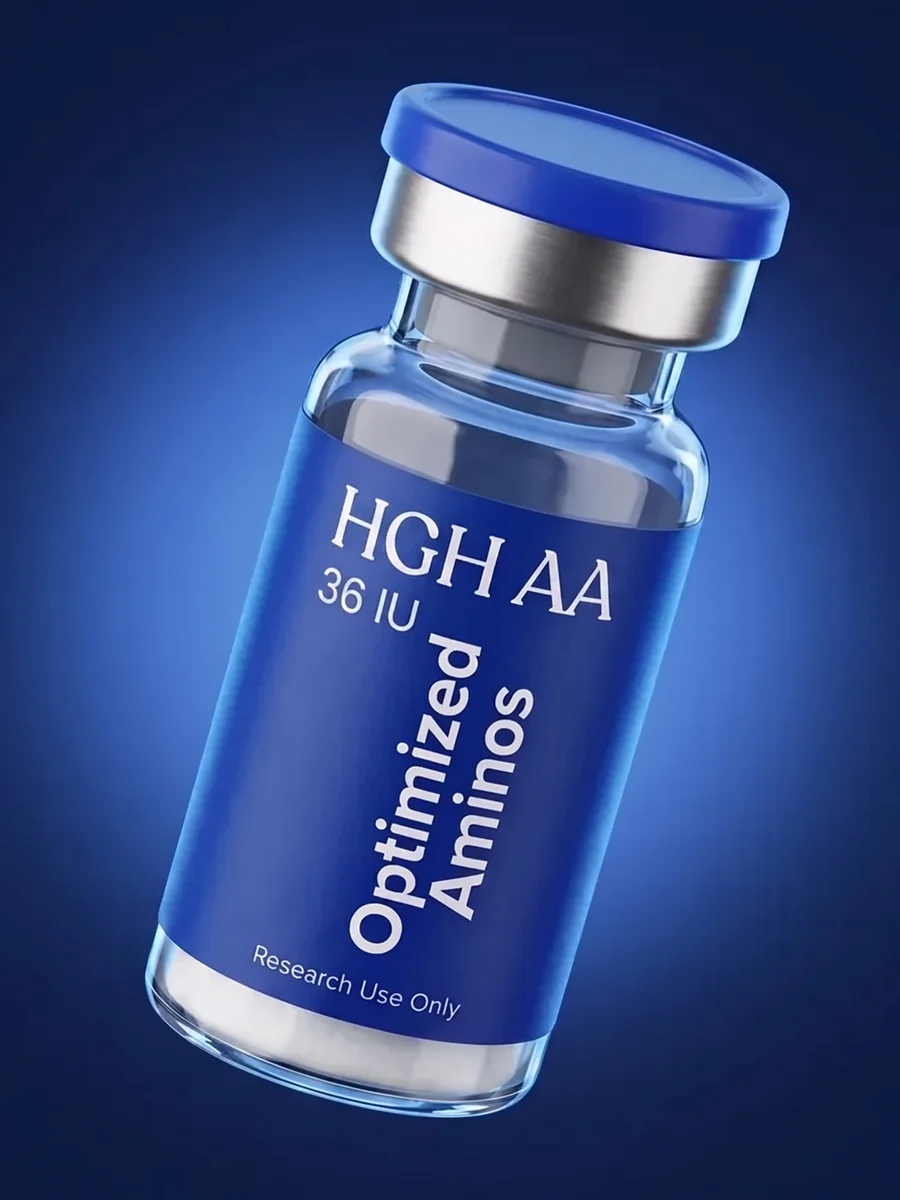
Research-grade human growth hormone, 36 IU per vial. Lyophilized powder for laboratory reconstitution. For research use only — not for human consumption.
View product
USP-grade bacteriostatic water (0.9% benzyl alcohol) in a sterile 10 mL multi-use vial. Manufactured under cGMP conditions and tested for endotoxins, sterility, and particulate matter. Commonly used in research laboratories as a reconstitution solvent for lyophilized reference peptides. Compatible with standard luer-lock syringes for precise dispensing. Store at controlled room temperature away from direct light. Sold as a laboratory reagent for research use only. Not for human or animal injection or any clinical use.
View product
USP-grade bacteriostatic water (0.9% benzyl alcohol) in a sterile 10 mL multi-use vial. Manufactured under cGMP conditions and tested for endotoxins, sterility, and particulate matter. Commonly used in research laboratories as a reconstitution solvent for lyophilized reference peptides. Compatible with standard luer-lock syringes for precise dispensing. Store at controlled room temperature away from direct light. Sold as a laboratory reagent for research use only. Not for human or animal injection or any clinical use.
View product