Research Blog
Where to Buy KLOW Blend for Research in 2026: Sourcing & COA Checklist
Published
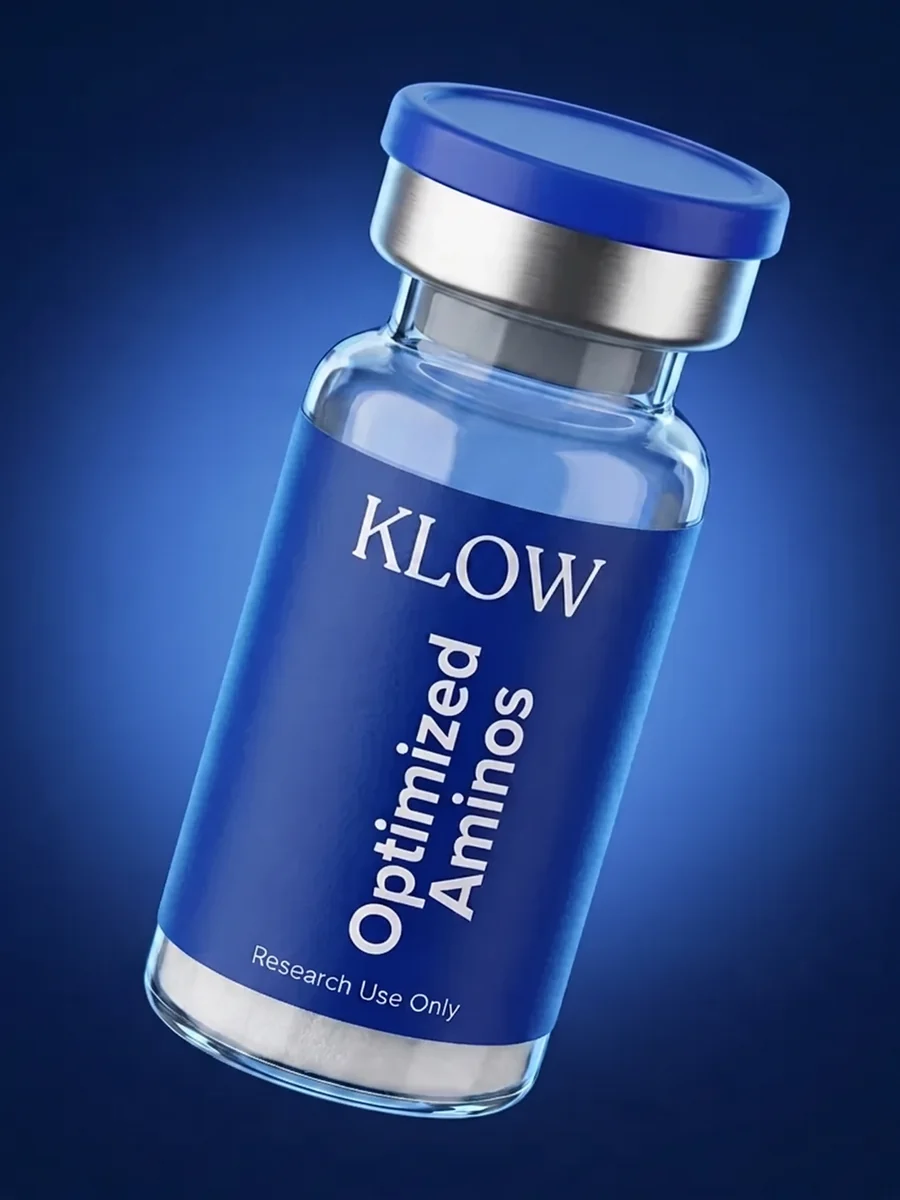
A supplier vetting framework for the KLOW blend (GHK-Cu + BPC-157 + TB-500 co-lyophilized): per-component mass breakdown, LC-MS identity confirmation, and salt-form/endotoxin disclosure. Research use only.
For laboratory and research use only. Not for human consumption.
KLOW has a components breakdown and a reconstitution walkthrough on this site, but unlike single-compound bestsellers such as BPC-157 or GHK-Cu, it has never had a dedicated sourcing guide of its own. Because a blend combines multiple peptides in a single co-lyophilized vial, evaluating a supplier requires checking documentation for each component individually, not just for the vial as a whole. This guide covers what to verify before ordering.
What the KLOW Blend Actually Contains
The KLOW 80mg vial combines a core trio of synthetic peptides studied for distinct, non-overlapping research pathways: GHK-Cu, studied for copper-chelation-related signaling in dermal and connective-tissue models; BPC-157, studied for angiogenesis and tissue-repair-pathway signaling; and TB-500, studied for actin-binding and cell-migration processes. Because the three are studied through different proposed mechanisms, researchers working with KLOW are typically probing for combined structural, repair, and migration-pathway effects in a single preparation rather than a single unified mechanism.
Why Sourcing a Multi-Peptide Co-Lyophilized Vial Needs Extra Diligence
A blend is only as well-documented as its least-documented component. A supplier can publish a clean HPLC trace for the vial as a whole while never confirming that all three peptides are present at their labeled ratio — co-lyophilization makes it easy to disclose one dominant peak and omit the others. Evaluating a KLOW listing means requesting per-component mass and identity data, not treating a single aggregate purity number as sufficient.
The Supplier Vetting Checklist
1. A Per-Component Mass Breakdown on the COA
Request a Certificate of Analysis that lists GHK-Cu, BPC-157, and TB-500 individually, with the per-vial mass of each. A certificate that reports only a single blended-purity percentage without breaking out each peptide's contribution does not confirm the labeled ratio is what's actually in the vial.
2. LC-MS Identity Confirmation for All Three Peptides
HPLC purity shows how clean a sample is relative to itself; it does not confirm which molecules are present. Mass spectrometry confirms identity by matching observed mass to the expected mass of each sequence — essential in a co-lyophilized vial, where three peptides sharing one preparation each need independent identity confirmation.
3. A Named, Accredited Third-Party Lab
Look for a testing partner named on the certificate, ideally operating to ISO/IEC 17025 or an equivalent standard. An anonymous "independent lab" credit on a COA is not verifiable.
4. Disclosed Salt Form and Endotoxin Data
A complete KLOW COA discloses the salt form used (acetate is generally preferred over TFA salts in peptide research) and reports endotoxin levels, typically below 1.0 EU/mg. Listings that omit both should be treated as incomplete documentation, not a minor gap.
5. Published Reconstitution Guidance for the Vial
Because KLOW ships as a single co-lyophilized vial containing three peptides, concentration math has to account for all three simultaneously rather than treating the vial as a single dose unit. Our KLOW reconstitution guide walks through the mg-to-mL math for the vial.
Understanding the Blend Before You Evaluate a Listing
Knowing what published research has actually examined for each component makes it easier to spot a listing that overstates its own subject matter. Our component-by-component breakdown of the KLOW blend covers each peptide's structure and studied mechanism in more depth, and our overview of peptide blends generally explains why the fixed-ratio blend format trades individual-component titration for single-vial convenience.
Red Flags Worth Treating as Disqualifying
Rule a KLOW listing out if the COA reports only an aggregate purity figure with no per-component mass or identity data, if a certificate cannot be matched to a lot number, if the vial's price is far below what documented individual components would cost separately with no testing to explain the gap, or if the listing describes personal outcomes rather than research findings in model systems. A blend is not a shortcut around per-component diligence — it is three sourcing decisions co-lyophilized into one vial.
Storage Considerations for a Multi-Peptide Vial
KLOW should be stored exactly as any other lyophilized peptide preparation: refrigerated or frozen and protected from light until reconstitution. Because it is a single vial rather than a multi-vial kit, storage logistics are simpler than for a stack — but the lab notebook entry should still record the lot number and reconstitution date clearly, so that if a result doesn't reproduce, the specific batch used can be traced back to its COA.
Frequently Asked Questions
What peptides are in the KLOW blend?
KLOW's core trio is GHK-Cu, BPC-157, and TB-500, co-lyophilized in a single vial. Some supplier formulations add further peptides such as CJC-1295/Ipamorelin, Selank, Epitalon, or PEG-MGF — always match the label to the batch-specific COA rather than assuming a fixed formula.
Is KLOW legal to purchase for laboratory research?
Research-use-only compounds like these are generally available for purchase by qualified laboratories and researchers in many jurisdictions, but rules vary by location and can change. KLOW is sold strictly for laboratory research and is not approved or labeled for human consumption.
Do I need separate identity confirmation for each peptide, or is one purity number enough?
Each component should have its own mass-spectrometry identity confirmation and contribute to a disclosed per-component mass breakdown. A single blended purity percentage, without data for each peptide, does not confirm that all three components are present at their labeled ratio.
How is a co-lyophilized blend like KLOW typically reconstituted?
The vial is reconstituted as a single unit with a chosen diluent volume, but because it contains three peptides at fixed ratios, the resulting concentration of each individual component needs to be calculated separately rather than treating the vial as one dose figure.
Is KLOW approved for human use?
No. None of its components are FDA-approved drugs, and none are evaluated or labeled for human or veterinary use. KLOW is intended exclusively for laboratory research by qualified personnel.
Reviewed by the Optimized Aminos research team — last updated August 24, 2026.
For laboratory and research use only. Not for human consumption.
Related research compounds
Compounds referenced in this article, available as research-grade lyophilized peptides with third-party tested COA.